10-K: Annual report [Section 13 and 15(d), not S-K Item 405]
Published on February 26, 2026
United States
SECURITIES AND EXCHANGE COMMISSION
Washington, D.C. 20549
FORM 10-K
| ANNUAL REPORT PURSUANT TO SECTION 13 OR 15(d) OF THE SECURITIES EXCHANGE ACT OF 1934 | |||||||||||
For the fiscal year ended December 31 , 2025
OR
| TRANSITION REPORT PURSUANT TO SECTION 13 OR 15(d) OF THE SECURITIES EXCHANGE ACT OF 1934 | |||||||||||
For the transition period from _________ to _________
Commission file number 1-11986 (Tanger Inc.)
Commission file number 333-3526-01 (Tanger Properties Limited Partnership)
(Exact name of registrant as specified in its charter)
| (Tanger Inc.) | ||||||||
| (Tanger Properties Limited Partnership) | ||||||||
| (State or other jurisdiction of incorporation or organization) | (I.R.S. Employer Identification No.) | |||||||
(Address of principal executive offices)
(336 ) 292-3010
(Registrant’s telephone number, including area code)
| Securities registered pursuant to Section 12(b) of the Act: | ||||||||
| Tanger Inc.: | ||||||||
| Title of each class | Trading Symbol (s) | Name of exchange on which registered | ||||||
| Tanger Properties Limited Partnership: | ||||||||
| None | ||||||||
| Securities registered pursuant to Section 12(g) of the Act: | ||||||||
| Tanger Inc.: None | ||||||||
| Tanger Properties Limited Partnership: None | ||||||||
Indicate by check mark if the registrant is a well-known seasoned issuer, as defined in Rule 405 of the Securities Act.
| Tanger Inc. | ☒ | No | ☐ | |||||||||||
| Tanger Properties Limited Partnership | ☒ | No | ☐ | |||||||||||
Indicate by check mark if the registrant is not required to file reports pursuant to Section 13 or Section 15(d) of the Act.
| Tanger Inc. | Yes | ☐ | ☒ | |||||||||||
| Tanger Properties Limited Partnership | Yes | ☐ | ☒ | |||||||||||
Indicate by check mark whether the registrant (1) has filed all reports required to be filed by Section 13 or 15(d) of the Securities Exchange Act of 1934 during the preceding 12 months (or for such shorter period that the registrant was required to file such reports), and (2) has been subject to such filing requirements for the past 90 days.
1
| Tanger Inc. | ☒ | No | ☐ | |||||||||||
| Tanger Properties Limited Partnership | ☒ | No | ☐ | |||||||||||
Indicate by check mark whether the registrant has submitted electronically every Interactive Data File required to be submitted pursuant to Rule 405 of Regulation S-T (§232.405 of this chapter) during the preceding 12 months (or for such shorter period that the registrant was required to submit such files).
| Tanger Inc. | ☒ | No | ☐ | |||||||||||
| Tanger Properties Limited Partnership | ☒ | No | ☐ | |||||||||||
Indicate by check mark whether the registrant is a large accelerated filer, an accelerated filer, a non-accelerated filer, a smaller reporting company, or an emerging growth company. See the definitions of “large accelerated filer,” “accelerated filer," “smaller reporting company,” and "emerging growth company" in Rule 12b-2 of the Exchange Act.
| Tanger Inc. | ||||||||||||||
| ☒ | Accelerated Filer | ☐ | ||||||||||||
| Non-accelerated Filer | ☐ | Smaller Reporting Company | ||||||||||||
| Emerging Growth Company | ||||||||||||||
| Tanger Properties Limited Partnership | ||||||||||||||
| Large Accelerated Filer | ☐ | Accelerated Filer | ☐ | |||||||||||
| ☒ | Smaller Reporting Company | |||||||||||||
| Emerging Growth Company | ||||||||||||||
If an emerging growth company, indicate by check mark if the registrant has elected not to use the extended transition period for complying with any new or revised financial accounting standards provided pursuant to Section 13(a) of the Exchange Act.
| Tanger Inc. | ☐ | ||||
| Tanger Properties Limited Partnership | ☐ | ||||
Indicate by check mark whether the registrant has filed a report on and attestation to its management’s assessment of
the effectiveness of its internal control over financial reporting under Section 404(b) of the Sarbanes-Oxley Act (15 U.S.C.
7262(b)) by the registered public accounting firm that prepared or issued its audit report.
| Tanger Inc. | |||||
| Tanger Properties Limited Partnership | |||||
If securities are registered pursuant to Section 12(b) of the Act, indicate by check mark whether the financial statements
of the registrant included in the filing reflect the correction of an error to previously issued financial statements. ☐
Indicate by check mark whether any of those error corrections are restatements that required a recovery analysis of incentive-based compensation received by any of the registrant’s executive officers during the relevant recovery period pursuant to §240.10D-1(b). ☐
Indicate by check mark whether the registrant is a shell company (as defined in Rule 12b-2 of the Act).
| Tanger Inc. | Yes | No | ||||||||||||
| Tanger Properties Limited Partnership | Yes | ☐ | No | |||||||||||
The aggregate market value of voting shares held by non-affiliates of Tanger Inc. was approximately $3,378,785,572 based on the closing price on the New York Stock Exchange for such shares on June 30, 2025.
The number of Common Shares of Tanger Inc. outstanding as of February 2, 2026 was 114,507,737 .
Documents Incorporated By Reference
Portions of Tanger Inc.'s definitive proxy statement to be filed no later than 120 days after the end of the registrant’s fiscal year with respect to the 2026 Annual Meeting of Shareholders are incorporated by reference into Items 10 through 14 of this Annual Report on Form 10-K.
2
PART I
EXPLANATORY NOTE
This report combines the Annual Reports on Form 10-K for the year ended December 31, 2025 of Tanger Inc., a North Carolina corporation, and Tanger Properties Limited Partnership, a North Carolina limited partnership. Unless the context indicates otherwise, the term "Company", refers to Tanger Inc. and its subsidiaries and the term "Operating Partnership" refers to Tanger Properties Limited Partnership and its subsidiaries. The terms “we”, “our” and “us” refer to the Company or the Company and the Operating Partnership together, as the context requires. On November 16, 2023, the Company changed its legal name from Tanger Factory Outlet Centers, Inc. to Tanger Inc. We refer to Tanger Inc.’s current legal name throughout this Annual Report on Form 10-K (the "Annual Report").
The Company is one of the leading owners and operators of outlet and other open-air retail destinations in the United States and Canada. The Company is a fully integrated, self-administered and self-managed real estate investment trust ("REIT"), which, through its controlling interest in the Operating Partnership, focuses on developing, acquiring, owning, operating and managing outlet and other open-air retail centers. The retail centers and other assets are held by, and all of the operations are conducted by, the Operating Partnership. Accordingly, the descriptions of the business, employees and assets of the Company are also descriptions of the business, employees and assets of the Operating Partnership. As the Operating Partnership is the issuer of our registered debt securities, we present a separate set of financial statements for this entity.
The Company, including Tanger LP Trust, owns the majority of the units of partnership interests issued by the Operating Partnership. As of December 31, 2025, the Company and its wholly owned subsidiaries owned 115,097,359 units of the Operating Partnership and other limited partners (the "Non-Company LPs") collectively owned 4,662,904 Class A common limited partnership units. Each Class A common limited partnership unit held by the Non-Company LPs is exchangeable for one of the Company's common shares, subject to certain limitations to preserve the Company's status as a REIT for U.S. federal income tax purposes. Class B common limited partnership units, which are held by Tanger LP Trust, are not exchangeable for common shares of the Company.
In addition, as of December 31, 2025, 248,948 of long-term incentive plan units (“LTIP units”) were outstanding. LTIP Units are intended to qualify as “profits interests” for U.S. federal income tax purposes and are compensatory awards granted to service providers of the Company and the Operating Partnership. Each LTIP unit, if and upon vesting, is convertible, upon the satisfaction of minimum allocations to the capital account of the LTIP unit for federal income tax purposes, into a non-voting Class C common unit of the Operating Partnership. Each such Class C common unit may be exchanged by the holder for one common share of the Company.
Management operates the Company and the Operating Partnership as one enterprise. The management of the Company consists of the same members as the management of the Operating Partnership. These individuals are officers and employees of the Company.
We believe combining the Annual Reports on Form 10-K of the Company and the Operating Partnership into this single Annual Report provides the following benefits:
•enhancing investors' understanding of the Company and the Operating Partnership by enabling investors to view the business as a whole in the same manner as management views and operates the business;
•eliminating duplicative disclosure and providing a more streamlined and readable presentation since a substantial portion of the disclosure applies to both the Company and the Operating Partnership; and
•creating time and cost efficiencies through the preparation of one combined Annual Report instead of two separate Annual Reports.
There are only a few differences between the Company and the Operating Partnership, which are reflected in the disclosure in this Annual Report. We believe it is important, however, to understand these differences between the Company and the Operating Partnership in the context of how the Company and the Operating Partnership operate as an interrelated consolidated company.
3
As stated above, the Company is a REIT, whose only material asset is its ownership of partnership interests of the Operating Partnership, including through its wholly-owned subsidiary, Tanger LP Trust. As a result, the Company does not conduct business itself, other than issuing public equity from time to time and incurring expenses required to operate as a public company. However, all operating expenses incurred by the Company are reimbursed by the Operating Partnership, thus the only material item on the Company's income statement is its equity in the earnings of the Operating Partnership. Therefore, the assets and liabilities and the revenues and expenses of the Company and the Operating Partnership are the same on their respective financial statements, except for immaterial differences related to cash, other assets and accrued liabilities that arise from public company expenses paid by the Company. The Company itself does not hold any indebtedness but does guarantee certain debt of the Operating Partnership, as disclosed in this Annual Report.
The Operating Partnership holds all of the shopping centers and other assets, including the ownership interests in consolidated and unconsolidated joint ventures. The Operating Partnership conducts the operations of the business and is structured as a partnership with no publicly traded equity. Except for net proceeds from public equity issuances by the Company, which are contributed to the Operating Partnership in exchange for partnership units, the Operating Partnership generates the capital required through its operations, its incurrence of indebtedness or through the issuance of partnership units.
Noncontrolling interests, shareholder's equity and partners' capital are the main areas of difference between the consolidated financial statements of the Company and those of the Operating Partnership. The limited partnership interests in the Operating Partnership held by the Non-Company LPs are accounted for as partners' capital in the Operating Partnership's financial statements and as noncontrolling interests in the Company's financial statements.
To help investors understand the significant differences between the Company and the Operating Partnership, this Annual Report presents the following separate sections for each of the Company and the Operating Partnership:
•Consolidated financial statements;
•The following notes to the consolidated financial statements:
•Debt of the Company and the Operating Partnership;
•Shareholders' Equity and Partners' Equity;
•Earnings Per Share and Earnings Per Unit;
•Accumulated Other Comprehensive Income of the Company and the Operating Partnership; and
•Liquidity and Capital Resources in the Management's Discussion and Analysis of Financial Condition and Results of Operations.
4
This Annual Report also includes separate Item 9A. Controls and Procedures sections and separate Exhibit 31 and Exhibit 32 certifications for each of the Company and the Operating Partnership in order to establish that the Principal Executive Officer and Principal Financial Officer of each entity have made the requisite certifications and that the Company and Operating Partnership are compliant with Rule 13a-15 or Rule 15d-15 of the Securities Exchange Act of 1934, as amended (the "Exchange Act") and 18 U.S.C. §1350.
The separate sections in this Annual Report for the Company and the Operating Partnership specifically refer to the Company and the Operating Partnership. In the sections that combine disclosure of the Company and the Operating Partnership, this Annual Report refers to actions or holdings as being actions or holdings of the Company. Although the Operating Partnership is generally the entity that enters into contracts and joint ventures and holds assets and debt, reference to the Company is appropriate because the business is one enterprise and the Company operates the business through the Operating Partnership.
The Company currently consolidates the Operating Partnership because it has (1) the power to direct the activities of the Operating Partnership that most significantly impact the Operating Partnership’s economic performance and (2) the obligation to absorb losses and the right to receive the residual returns of the Operating Partnership that could be potentially significant. The separate discussions of the Company and the Operating Partnership in this Annual Report should be read in conjunction with each other to understand the results of the Company on a consolidated basis and how management operates the Company.
5
PART I
CAUTIONARY NOTE REGARDING FORWARD-LOOKING STATEMENTS
Certain statements made in this Annual Report contain forward-looking statements within the meaning of Section 27A of the Securities Act of 1933, as amended, or the Securities Act and Section 21E of the Securities Exchange Act of 1934, as amended, or the Exchange Act. We intend such forward-looking statements to be covered by the safe harbor provisions for forward-looking statements contained in the Private Securities Litigation Reform Act of 1995 and include this statement for purposes of complying with these safe harbor provisions. Forward-looking statements are generally identifiable by use of the words “anticipate,” “believe,” “can,” “continue,” “could,” “designed,” “estimate,” “expect,” “forecast,” “goal,” “intend,” “may,” “might,” “plan,” “possible,” “potential,” “predict,” “project,” “should,” “target,” “will,” “would,” and similar expressions that do not report historical matters, and describe or reflect our plans, strategies, beliefs and expectations, including as to future financial results, access to, and costs of, capital, liquidity, cash flows, dividend payments and long-term growth. There are a number of risks, uncertainties and other factors that could cause our actual results to differ materially from the forward-looking statements contained in or contemplated by this Annual Report. Any forward-looking statements should be considered in light of the risks, uncertainties and other factors referred to in Item 1A. “Risk Factors” in this Annual Report on Form 10-K. Such risks and uncertainties include, but are not limited to: risks associated with general economic and financial conditions, including inflationary pressures and recessionary fears, newly-imposed and potentially additional U.S. tariffs and responsive non-U.S. tariffs, increased capital costs and capital markets volatility, increases in unemployment and reduced consumer confidence and spending; risks related to our ability to acquire or develop new retail centers or expand existing retail centers successfully; risks related to the financial performance and market value of our retail centers and the potential for reductions in asset valuations and related impairment charges; our dependence on rental income from real property; the relative illiquidity of real property investments; failure of our acquisitions or dispositions of retail centers to achieve anticipated results; competition for the acquisition and development of retail centers, and our inability to complete the acquisitions of retail centers we may identify; competition for tenants with competing retail centers and our inability to execute leases with tenants on terms consistent with our expectations; the diversification of our tenant mix may not achieve our expected results; risks associated with environmental regulations; risks associated with possible terrorist activity or other acts or threats of violence and threats to public safety; risks related to international military conflicts, international trade disputes and foreign currency volatility; the fact that certain of our leases include co-tenancy and/or sales-based provisions that may allow a tenant to pay reduced rent and/or terminate a lease prior to its natural expiration; our dependence on the results of operations of our retailers and their bankruptcy, early termination or closing could adversely affect us; the impact of geopolitical conflicts; the immediate and long-term impact of the outbreak of a highly infectious or contagious disease on our tenants and on our business (including the impact of actions taken to contain the outbreak or mitigate its impact); the fact that certain of our properties are subject to ownership interests held by third parties, whose interests may conflict with ours; risks related to climate change; risks related to uninsured losses; the risk that consumer, travel, shopping and spending habits may change; risks associated with our Canadian investments; risks associated with attracting and retaining key personnel; risks associated with debt financing; risks associated with our guarantees of debt for, or other support we may provide to, joint venture properties; the effectiveness of our interest rate hedging arrangements; our potential failure to qualify as a REIT; our legal obligation to pay dividends to our shareholders; legislative or regulatory actions that could adversely affect our shareholders, our dependence on distributions from the Operating Partnership to meet our financial obligations, including dividends; risks of costs and disruptions from cyber-attacks or acts of cyber-terrorism on our information systems or on third party systems that we use; unanticipated threats to our business from changes in information and other technologies, including artificial intelligence; and the uncertainties of costs to comply with regulatory changes and other important factors that may cause actual results to differ materially from current expectations. We qualify all of our forward-looking statements by these cautionary statements. The forward-looking statements in this Annual Report are only predictions. We have based these forward-looking statements largely on our current expectations and projections about future events and financial trends that we believe may affect our business, financial condition and results of operations. Because forward-looking statements are inherently subject to risks and uncertainties, some of which cannot be predicted or quantified, you should not rely on these forward-looking statements as predictions of future events. The events and circumstances reflected in these forward-looking statements may not be achieved or occur and actual results could differ materially from those projected in the forward-looking statements. Except as required by applicable law, we do not plan to publicly update or revise any forward-looking statements contained herein, whether as a result of any new information, future events, changed circumstances or otherwise.
6
RISK FACTOR SUMMARY
We are subject to a variety of risks that are inherent to our business, including risks that may prevent us from achieving our business objectives or may adversely affect our financial condition, results of operations and liquidity. The following list of risks and uncertainties is only a summary of some of the most important factors and is not intended to be exhaustive. The risk factor summary should be read together with the more detailed discussion of risks and uncertainties set forth in Item 1A. “Risk Factors” of this Form 10-K.
Risks Related to Real Estate Investments:
•The economic performance and the market value of our centers are dependent on risks associated with real property investments.
•We may be unable to develop new centers or expand existing centers successfully.
•Real property investments are relatively illiquid.
•Properties have been in the past and may be in the future subject to impairment charges, which can adversely affect our financial results.
•Dispositions may not achieve anticipated results.
•We face competition for the acquisition and development of centers, and we may not be able to complete acquisitions or developments that we have identified.
•We may be subject to environmental regulation.
•We may incur significant costs to comply with the Americans with Disabilities Act and fire, safety and other regulations.
Risks Related to Our Business:
•Conditions that adversely affect the general retail environment could materially and adversely affect us.
•Our earnings and therefore our profitability are dependent on rental income from real property.
•We are substantially dependent on the results of operations of our retail tenants and their bankruptcy, early termination or closing could adversely affect us.
•Significant inflation could negatively impact our business.
•Certain of our properties are subject to ownership interests held by third parties, whose interests may conflict with ours and thereby constrain us from taking actions concerning these properties which otherwise would be in our best interests and our shareholders' interests.
•We face risks associated with climate change and severe weather.
•An uninsured loss or a loss that exceeds our insurance policies on our centers or the insurance policies of our tenants could subject us to lost capital and revenue on those centers.
•Our Canadian investments may subject us to different or greater risk from those associated with our domestic operations.
Risks Related to our Indebtedness and Financial Markets:
•We are subject to the risks associated with debt financing.
•The Company depends on distributions from the Operating Partnership to meet its financial obligations, including its obligation to pay dividends.
•We may not be able to obtain additional capital to further our business objectives.
•The Operating Partnership has, and may in the future, guarantee debt for joint venture properties.
•Adverse changes in our credit ratings could negatively affect our financing ability and borrowing terms.
•Hedging activity may expose us to risks, including the risk that a counterparty will not perform and that the hedge will not yield the economic benefits we anticipate, which may adversely affect us.
•The price per share of our common shares may fluctuate significantly.
•The exchange of the Exchangeable Notes (as defined herein) may dilute the ownership interest of our shareholders or may otherwise depress the price of the common shares.
7
•The Operating Partnership may not have the ability to raise the funds necessary to settle exchanges of the Exchangeable Notes or to repurchase the Exchangeable Notes upon a fundamental change, and its future debt may contain limitations on its ability to pay cash upon exchange or repurchase of the Exchangeable Notes.
•The conditional exchange feature of the Exchangeable Notes, if triggered, may adversely affect our liquidity and financial condition.
•The Capped Call Transactions (as defined herein) entered into in connection with the issuance of the Exchangeable Notes may affect the market price of our common shares.
•Certain provisions in the indenture governing the Exchangeable Notes may delay or prevent an attempted takeover of us that might be financially advantageous to shareholders.
•Changes in the accounting treatment for exchangeable debt securities that may be settled in cash, such as the Exchangeable Notes, could have a material effect on our reported financial results.
Risks Related to Federal Income Tax Laws:
•If we fail to qualify as a REIT, our operations and distributions to shareholders would be adversely affected.
•We may need to incur additional borrowings to meet the REIT minimum distribution requirement and to avoid excise tax.
•Complying with REIT requirements may cause us to forego otherwise attractive opportunities or liquidate otherwise attractive investments.
•The tax imposed on REITs engaging in “prohibited transactions” may limit our ability to engage in transactions which would be treated as sales for U.S. federal income tax purposes.
•Complying with REIT requirements may limit our ability to hedge effectively and may cause us to incur tax liabilities.
•Dividends payable by REITs do not qualify for the reduced tax rates available for some dividends.
•The U.S. federal income tax treatment of the cash that we might receive from cash settlement of the forward sale agreement is unclear and could jeopardize our ability to meet the REIT qualification requirements.
•Changes to the U.S. federal income tax laws, including the enactment of certain tax reform measures, could have an adverse impact on our business and financial results.
General Risks:
•Cyber-attacks or acts of cyber-terrorism could disrupt our or our third-party providers' business operations and information technology systems or result in the loss or exposure of confidential or sensitive customer, employee or Company information.
•Our success depends, in part, on our ability to attract, retain and develop talented employees, and our failure to do so, including the loss of any one of our key personnel, could adversely impact our business.
•Use of artificial intelligence presents risks and challenges that could impact our business.
•Trade negotiations and related government actions may create regulatory uncertainty for us and our tenants and adversely affect our performance.
•Meeting constantly evolving federal, state, and local laws and regulations may impose additional costs and expose us to new risks.
8
| Tanger, Inc. | |||||
| Tanger Properties Limited Partnership | |||||
| Annual Report on Form 10-K | |||||
| December 31, 2025 | |||||
| Page | |||||
Information about the Executive Officers of Tanger Inc. | |||||
9
ITEM 1.BUSINESS
The Company and the Operating Partnership
Tanger Inc. and its subsidiaries, which we refer to as the Company, is one of the leading owners and operators of outlet and other open-air retail destinations in the United States and Canada. We are a fully-integrated, self-administered and self-managed REIT, which focuses on developing, acquiring, owning, operating and managing outlet and other open-air retail centers. As of December 31, 2025, our consolidated portfolio consisted of 31 outlet centers and three open-air lifestyle centers, with a total gross leasable area of approximately 14.0 million square feet, which were 98% occupied and contained over 2,600 stores representing over 700 store brands. We also had partial ownership interests in six unconsolidated centers totaling approximately 2.1 million square feet, including two centers in Canada. Our portfolio also includes one managed center, totaling approximately 457,000 square feet. Each of our centers, except one joint venture center, features the Tanger brand name.
Our shopping centers and other assets are held by, and all of our operations are conducted by, Tanger Properties Limited Partnership and its subsidiaries, which we refer to collectively as the Operating Partnership. The Company, including its wholly-owned subsidiary, Tanger LP Trust, owns the majority of the units of partnership interest issued by the Operating Partnership. The Company controls the Operating Partnership as its sole general partner. Tanger LP Trust holds a limited partnership interest in the Operating Partnership.
As of December 31, 2025, the Company and its wholly-owned subsidiaries owned 115,097,359 units of the Operating Partnership and the Non-Company LPs collectively owned 4,662,904 Class A common limited partnership units. Each Class A common limited partnership unit held by the Non-Company LPs is exchangeable for one of the Company's common shares, subject to certain limitations to preserve the Company's status as a REIT for U.S. federal income tax purposes. Class B common limited partnership units, which are held by Tanger LP Trust, are not exchangeable for common shares of the Company.
In addition, as of December 31, 2025, 248,948 of LTIP units were outstanding. LTIP units are intended to qualify as “profits interests” for U.S. federal income tax purposes and are compensatory awards granted to service providers of the Company and the Operating Partnership. Each LTIP unit, if and upon vesting, is convertible, upon the satisfaction of minimum allocations to the capital account of the LTIP unit for federal income tax purposes, into a non-voting Class C common unit of the Operating Partnership. Each such Class C common unit may be exchanged by the holder for one common share of the Company.
Ownership of the Company's common shares is restricted to preserve the Company's status as a REIT for U.S. federal income tax purposes. Subject to certain exceptions, a person may not actually or constructively own more than 9.8% of our common shares. We also operate in a manner intended to enable us to preserve our status as a REIT, including, among other things, making distributions with respect to our then outstanding common shares and preferred shares, if applicable, equal to at least 90% of our taxable income each year, excluding net capital gains.
The Company is a North Carolina corporation that was incorporated in March 1993 and the Operating Partnership is a North Carolina limited partnership that was formed in May 1993. Our executive offices are currently located at 3200 Northline Avenue, Suite 360, Greensboro, North Carolina, 27408 and our telephone number is (336) 292-3010. Our website can be accessed at www.tanger.inc. Copies of our Annual Reports on Form 10-K, Quarterly Reports on Form 10-Q, Current Reports on Form 8-K and any amendments thereto can be obtained, free of charge, on our website as soon as reasonably practicable after we file such material with, or furnish it to, the SEC. The information found on, or otherwise accessible through, our website is not incorporated into, and does not form a part of, this Annual Report or any other report or document we file with or furnish to the Securities and Exchange Commission (the "SEC").
10
Business Strategy
Our Company was built on a firm foundation of strong and enduring business relationships coupled with disciplined business practices. We partner with many of the world's best known and most respected brands and retailers. By fostering and maintaining strong relationships with these successful, high-volume companies, we believe we have been able to solidify our position as a leader in the outlet retail industry for over thirty years. The confidence and trust that we have developed with our retail partners from the very beginning has allowed us to forge the impressive retail alliances that we enjoy today with our brands and retailers. Our seasoned team of professionals with diverse sets of expertise utilize the knowledge and experience that we have gained to give us a competitive advantage in the outlet and other open-air retail formats.
The Outlet Concept
Outlet centers generally consist of stores operated by brands and retailers that sell primarily branded products, some of which are made specifically for the outlet distribution channel, to consumers at significant discounts from regular retail prices charged by department stores, specialty stores and their own full price channels. Outlet centers offer advantages to brands and retailers as they are often able to charge customers lower prices for branded and designer products by eliminating the third-party retailer or through operating efficiencies. Stores and outlet centers also typically have lower operating costs than other retailing formats, enhancing their profit potential. Outlet centers enable retailers to optimize the size of production runs and their inventory positions while continuing to maintain control of their distribution channels. Outlet centers also enable brands and retailers to establish a direct relationship with their customers and maintain brand integrity through control of product placement and pricing.
Our Centers
Each of our outlet centers, except one joint venture center, features the Tanger brand name. Additionally, we leverage the Tanger brand and platform to manage an outlet center in Palm Beach, Florida. We believe that our tenants and consumers recognize the Tanger brand as one that provides retail centers where consumers can trust the brand, value and experience.
In addition to our Tanger branded outlet portfolio, since 2023, we acquired three open-air lifestyle centers in Huntsville, Alabama, Little Rock, Arkansas and Cleveland, Ohio; which were natural extensions of our capabilities and consistent with our long-term strategy of investing in dominant open-air retail centers in markets that benefit from outsized residential and economic growth drivers.
As one of the original participants in the outlet industry and through key additions to our executive, leasing, operating and center teams, we have long-standing relationships with many of our tenants that we believe are critical in operating, managing, developing, and acquiring successful retail centers.
Our consolidated centers are typically located in a variety of geographical areas, including high frequency tourist destinations and suburbs of vibrant and fast-growing markets. Additionally, our centers are often situated in close proximity to interstate highways that provide accessibility and visibility to potential customers or that serve as the dominant shopping center in a market.
We have a diverse tenant base throughout our consolidated portfolio comprising over 2,600 stores operated by more than 700 different brand name companies. Our centers offer shoppers a curated mix of retailers specializing in apparel, footwear, accessories, athletic wear, athleisure, home furnishings, health and beauty, and digitally-native brands. Additionally, we are adding food, beverage, and entertainment options, along with other services, at our centers to attract new shoppers, extend visitor dwell time and increase frequency of visits.
No single tenant, including all of its store concepts, accounted for 10% or more of our combined base and percentage rental revenues during the years ended 2025, 2024 or 2023. As of December 31, 2025, no single tenant accounted for more than 7% of our leasable square feet or 6% of our combined base and percentage rental revenues.
11
A portion of our rental revenues are dependent on variable revenue sources. For the year ended December 31, 2025, the components of rental revenues are as follows (in thousands):
| 2025 | ||||||||
| Rental revenues - fixed | $ | 437,255 | ||||||
Rental revenues - variable (1) | 113,641 | |||||||
| Rental revenues | $ | 550,896 | ||||||
(1)Primarily includes rents based on a percentage of tenant gross sales volume and reimbursable expenses such as advertising, common area expenses, utilities, insurance and real estate taxes, which are paid on a pro rata basis.
Growth Strategy
Our goal is to build shareholder value through a comprehensive, disciplined plan for sustained, long-term growth. We focus our efforts on increasing net operating income at our existing centers, renovating and optimizing selected centers and pursuing disciplined external growth in our current markets and potential new markets through selective ground-up development or the acquisition of retail real estate. Future retail real estate assets may be wholly-owned by us, owned through joint ventures or partnership arrangements, or through management agreements.
Increasing net operating income at existing centers
Our leasing team focuses on optimizing the use of our real estate to attract and engage best in class brands and retailers with a focus on maximizing consumer demand and rent. The majority of our leases are negotiated to provide for inflation-based contractual rent increases or periodic fixed contractual rent increases and percentage rents. We have historically been able to renew many leases at higher base rents per square-foot and replace underperforming tenants with new or existing brands in our portfolio. Given the current retail environment, we may choose to execute leases with new tenants or renew certain tenants to enhance our tenant mix or maintain a high portfolio occupancy rate. In addition, we are focused on generating non-store revenues (other revenues), through marketing partnerships, media and return on investment ("ROI") driven sustainability initiatives, and actively managing property operating expenses and marketing expenses as a means of growing net operating income.
Expanding and renovating existing centers
Keeping our centers vibrant and growing is a key part of our formula for success. In order to maintain our reputation as the premier shopping destination in the markets that we serve, we have an ongoing program of renovations and expansions taking place at our centers. Construction for expansion and renovation of existing properties typically takes between six to nine months depending on the scope of the project.
Acquiring retail real estate
We may selectively choose to acquire individual properties or portfolios of properties that meet our strategic investment criteria. We believe that our extensive expertise in the retail real estate business, access to capital markets, familiarity with real estate markets and our management experience will allow us to evaluate and execute our acquisition strategy successfully over time. Through our tenant relationships, our teams have the ability to implement a re-merchandising strategy when needed to increase occupancy rates, optimize rents and maximize value. We believe that our brand operating platform and operational expertise and overall retail industry experience will also allow us to add long-term value and viability to these assets.
Developing new centers
We believe that there continue to be opportunities to introduce the Tanger brand in untapped or under-served markets across the United States and Canada in the long-term. We believe our expertise in the outlet and open-air retail industry, extensive development expertise and strong retail relationships give us a distinct competitive advantage.
12
In order to help ensure the viability of proceeding with a project, we first gauge the interest of our retail partners. We typically prefer to have signed leases or leases out for negotiation with tenants for at least 60% of the space in each center prior to acquiring the site and beginning construction; however, we may choose to proceed with construction with less than 60% of the space pre-leased under certain circumstances. Construction of a new center typically takes us 12 to 18 months from groundbreaking to the grand opening of the center.
Operating Strategy
Increasing cash flow to enhance the value of our properties and operations remains a primary business objective. Through targeted marketing and operational efficiencies, we strive to improve sales and profitability of our tenants and our centers as a whole. Achieving higher base and percentage rents and generating additional income from temporary leasing, media and other non-store sources also remains an important focus and goal.
Leasing
Our long-standing retailer relationships and our focus on identifying emerging retailers allow us the ability to provide our shoppers with a collection of the world's most popular retailers. Tanger customers shop and save on their favorite branded merchandise including men's, women's and children's ready-to-wear, digitally native brands, lifestyle apparel, footwear, jewelry and accessories, beauty, tableware, housewares, luggage and home goods. In addition, we are focused on adding non-traditional uses to our tenant mix, including experiential and food and beverage tenants. In order for our centers to perform at a high level, our leasing professionals continually monitor and evaluate tenant mix, store size, store location and sales performance. They also work to assist our tenants through re-sizing and re-location of retail space within each of our centers for maximum sales of each retail unit across our portfolio.
Marketing
Our comprehensive marketing plans are designed to drive sales and traffic in partnership with our retail partners. We leverage data to enable a return on our investment-oriented performance marketing approach for efficient customer acquisition. Investments to transform our digital channels allow us to engage existing customers with timely and personalized communications. Our loyalty strategies are two pronged – earning increased wallet share with vested customers and optimizing an incremental ancillary revenue stream. Our efforts to engage broad audiences through seasonal events and our digital channels enable our ability to monetize our customer audience for media and sponsorship opportunities with retail partners and nationally trusted brands.
Capital Strategy
We believe we achieve a strong and flexible financial position by attempting to: (1) maintain a conservative leverage position relative to our portfolio when pursuing new development, expansion and acquisition opportunities, (2) extend and sequence debt maturities, (3) manage our interest rate risk through an appropriate mix of fixed and variable rate debt and interest rate hedging strategies, (4) maintain access to liquidity by using our lines of credit in a conservative manner and (5) preserve internally generated sources of capital by maintaining a conservative distribution payout ratio. We manage our capital structure to reflect a long-term investment approach and utilize multiple sources of capital to meet our requirements, including without limitation, cash on hand, retained free cash flow and debt and equity issuances.
We intend to retain the ability to raise additional capital, including public debt or equity, to pursue attractive investment opportunities that may arise and to otherwise act in a manner that we believe to be in the best interests of our shareholders and unitholders. We are a well-known seasoned issuer with a shelf registration statement on Form S-3 that allows us to register unspecified amounts of different classes of securities. To generate capital to reinvest into other attractive investment opportunities, we may also consider the use of financial, operational and developmental joint ventures, the sale or lease of outparcels on our existing properties and the sale of certain properties that do not meet our long-term investment criteria. Based on cash provided by operations, cash and cash equivalents, our short-term investments, existing lines of credit, ongoing relationships with certain financial institutions and our ability to issue debt or equity subject to market conditions, we believe that we have access to the necessary financing to fund our planned capital expenditures during 2026.
13
We anticipate that adequate cash will be available to fund our operating and administrative expenses, regular debt service obligations, and the payment of dividends in accordance with REIT requirements in both the short and long-term. Although we receive most of our rental payments on a monthly basis, distributions to shareholders and unitholders are made quarterly and interest payments on the senior, unsecured notes are made semi-annually. Amounts accumulated for such payments will be used in the interim to reduce the outstanding borrowings under our existing lines of credit or invested in short-term money market or other suitable instruments adhering to our investment policies.
We believe our current balance sheet position is financially sound, particularly given our recent expansion and extension of our term loans and issuance of our Exchangeable Notes in January 2026 along with capacity under our existing line of credit; however, due to the uncertainty and unpredictability of the capital and credit markets, we can give no assurance that affordable access to capital will exist between now and our next significant debt maturity, which is our $350.0 million unsecured senior notes due September 2026.
As a result, we will continue to focus on managing our capital and liquidity position by controlling our capital expenditure levels, generating positive cash flows from operations to cover our distributions and maintaining appropriate leverage levels.
Competition
We carefully consider the degree of existing and planned competition in a proposed area before deciding to develop, acquire or expand a new retail center. Our centers compete for customers primarily with retail centers built and operated by different developers, traditional shopping malls, full- and off-price retailers and e-commerce retailers.
Because our revenues are ultimately linked to our tenants' success, we are affected by the same competitive factors, such as consumer spending habits, as our tenants.
We compete with institutional pension funds, private equity investors, other REITs, individual owners of retail centers, specialty stores and others who are engaged in the acquisition, development or ownership of retail centers and stores. In addition, the number of entities competing to acquire or develop retail centers has increased and may continue to increase in the future, which could increase demand for these retail centers and the prices we must pay to acquire or develop them.
Financial Information
We have one reportable operating segment. For financial information regarding our segment, see our consolidated financial statements.
Corporate and Regional Headquarters
We rent space in an office building in Greensboro, North Carolina where our corporate headquarters is located, as well as a regional office in New York, New York.
As of December 31, 2025, we maintain offices and employ on-site management at 37 consolidated and unconsolidated centers and one managed center. The managers closely monitor the operation, marketing and local relationships at each of their centers.
Insurance
We believe that as a whole our properties are covered by adequate comprehensive liability, fire, flood, earthquake and extended loss insurance provided by reputable companies with commercially reasonable and customary deductibles and limits. Northline Indemnity, LLC, a wholly-owned captive insurance subsidiary of the Operating Partnership, is responsible for losses up to certain levels for property damage (including wind damage from hurricanes) prior to third-party insurance coverage. Specified types and amounts of insurance are required to be carried by each tenant under their lease. There are, however, types of losses, like those resulting from wars or nuclear radiation, which may either be uninsurable or not economically insurable in some or all of our locations.
14
An uninsured loss could result in a loss to us of both our capital investment and anticipated profits from the affected property.
Our Core Values
Our Core Values are integrity, inclusion and innovation. Integrity means always showing up with honesty and accountability, acting fairly and demonstrating care in every decision we make and action we take. Inclusion is how we build and sustain a workplace culture and community that respects the diverse perspectives, viewpoints, and identities within our organization. By embracing an inclusive mindset, we create an environment where everyone can contribute to our collective success. Innovation fuels our cutting-edge strategies and solutions and powers the best-in-class results we deliver to our customers, partners and communities.
We live our values through our actions. We build trust by fostering a culture of respect and make decisions with fairness, objectivity and accountability. We challenge the status quo by taking smart risks, finding innovative solutions and embracing change to grow stronger. We win together by putting people first, building, supporting and empowering relationships, and celebrating success together. We make it happen by taking initiative, problem-solving and delivering excellence.
Human Capital
As of December 31, 2025, we had 407 full-time employees and 70 part-time employees. Our corporate headquarters are located in North Carolina, and we maintain 37 business offices. In 2025, 43% of our full-time workforce have been employed by us for five years or longer. We believe our relations with our employees to be relatively good. None of our employees are represented by a union or parties to a collective bargaining agreement.
As of December 31, 2025, female team members made up 70% of field employees, 40% of our executive leadership team, and 69% of our total 477-person workforce. Racial minorities made up 18% of our total workforce in 2025. The Board's gender composition consisted of 33% members who are female and 22% of members with racial diversity.
We believe attracting, developing and retaining talent is critical to our long-term success. We focus on creating strategies that enhance an environment of high-performance engagement, and individual development, where employees are rewarded and recognized. We provide numerous training programs, which include topics such as operational training, leadership development, customer service and technology training. We recognize that motivation and rewards are different for individuals at various times in their careers, and a balanced blend of monetary and non-monetary rewards can generate valuable business results. We provide employee benefits on par or above industry standards. In addition, we support employees with 40 hours per year of paid volunteer time off to encourage volunteering for worthwhile activities in their local communities. Part-time employees are included in our 401(k) plans. This plan allows participants to defer a portion of their compensation and to
receive matching contributions for a portion of the deferred amounts. Part-time employees also participate in paid time off ("PTO") after five years of service and are eligible to participate in our accident and critical Illness voluntary benefits.
Corporate Responsibility
We believe that supporting strong communities and making conscious decisions about our impact on our planet align with our business strategies to create long-term value for our shareholders, retail partners and employee team members. We integrate programs into our business practices which seek to address the issues most important to our stakeholders. Our Core Values of Integrity, Inclusion and Innovation form the foundation of our approach as we set goals to create positive social and economic impact while enhancing the resilience and performance of our business.
15
Stakeholder Alignment
Stakeholder assessments and business priorities drive the strategy behind our corporate responsibility programs. We begin by identifying opportunities and risks, and leverage external frameworks and engage stakeholders, executives and our Board members to help identify key issues impacting our business. These key issues are translated into operational priorities and processes across the Company. In 2025, we partnered with a third party to refresh our materiality assessment in alignment with double materiality to evaluate the impact of environmental and social issues on our financial performance. We believe that this double materiality assessment provides us with valuable insights that we can use to ensure that our priorities are aligned with the view and opinions of our stakeholders.
Governance and Reporting
Our management team has formed an executive committee that advises on the Company’s approach to corporate responsibility and consists of executives from various functional areas of our Company, including, without limitation, Operations, Finance and People and Culture. This executive committee monitors progress toward achievement of goals and communicates priority issues to senior leadership.
Our Nominating and Corporate Governance Committee of our Board provides oversight of risks related to environmental, social and sustainability matters to ensure such risks are managed appropriately and regularly reviews our programs and practices to ensure alignment with our overall business strategy.
Our goal is to utilize best practices in every aspect of our business, including our disclosures and reporting. In 2025 we published our ninth consecutive report on corporate responsibility initiatives (the "2025 Impact Report"), enumerating our environmental, social and governance practices and programs, reinforcing our commitment to transparency and accountability. We continue to assess and refine our climate-related governance and strategy to remain apace with current regulatory landscape and framework reporting requirements.
For the avoidance of doubt, while certain matters discussed in our 2025 Impact Report may be significant, any significance should not be read as necessarily rising to the level of materiality as that concept is used for the purposes of our compliance and reporting pursuant to the U.S. federal securities laws and regulations. The concept of materiality used in our environmental, social and governance disclosures, including as it is used above, is based on other definitions of materiality, some of which may require that we use a level of estimation and assumption that may make the resulting disclosures inherently uncertain. This is the case even where we use the word “material” or “materiality” in our environmental, social and governance disclosures. Therefore, issues that we identify as “material” from an environmental, social and governance perspective are not necessarily material to the Company under the U.S. federal securities laws and regulations. The contents of our 2025 Impact Report, our corporate policies and related disclosures are not incorporated by reference into this Annual Report and do not form a part of this Annual Report.
Government Regulations
We are subject to regulation by various federal, state, provincial and local agencies. These agencies include the Environmental Protection Agency, Occupational Safety and Health Administration and Department of Labor and Equal Employment Opportunity Commission. We believe we comply, in all material respects, with existing applicable statutes and regulations affecting environmental issues and our employment, workplace health and workplace safety practices, and compliance with such statutes and regulations has no material effect on our capital expenditures, earnings or competitive position.
16
Recent Developments
Acquisitions
In February 2025, we acquired a 640,000-square-foot open-air, grocery-anchored mixed-use center in Cleveland,
Ohio for $167.0 million using cash on hand and available liquidity. The center is Northeast Ohio's premier retail and entertainment destination and has become the go-to choice for retailers seeking market entry. The stores at the center are complemented by an expansive menu of entertainment and dining options.
In September 2025, we acquired a 690,000-square-foot open-air outlet center in Kansas City, Kansas for $130.0 million, including the assumption of a $115.0 million, 7.57% interest-only mortgage, with an effective rate of 6.0% that matures in November 2027. The center is Kansas' only outlet center and serves as the retail anchor of Village West, the state's top tourist destination.
Financing Transactions
ATM Program
In September 2025, we settled all of the outstanding forward shares that were previously issued during the fourth quarter of 2024 under the ATM Program for total gross proceeds of $69.7 million. As of December 31, 2025, we have a remaining authorization of $400.0 million under the ATM Program.
Unsecured Term Loans
In January 2026, we closed on $550.0 million of unsecured term loans, comprised of (i) an amendment of our existing $325.0 million term loan increasing the capacity to $350.0 million and extending the maturity to December 2030 (the "2030 Term Loan") and (ii) a new $200.0 million term loan due January 2033 (the "2033 Term Loan"). We drew an incremental $75.0 million at closing, for a total outstanding amount of $400.0 million and has a combined $150.0 million available under a delayed draw feature, allowing us to draw the proceeds over a six to nine month period. The applicable pricing margin is SOFR plus 95 basis points for the 2030 Term Loan and SOFR plus 125 basis points for the 2033 Term Loan based on our current credit rating.
Derivatives
Throughout 2025 and in January 2026, we entered into several interest rate swap agreements on unsecured debt totaling $275.0 million with effective dates throughout 2026 and 2027 with a weighted average interest rate of 3.3%. These agreements have expiration dates ranging from October 1, 2027 to September 1, 2030.
Exchangeable Notes
In January 2026, the Operating Partnership issued $250.0 million aggregate principal amount of 2.375% Exchangeable Senior Notes due 2031 (the “Exchangeable Notes”), which are guaranteed, on a senior unsecured basis, by the Company. The Exchangeable Notes bear interest at a rate of 2.375% per year, payable semi-annually in arrears on January 15 and July 15 of each year, beginning on July 15, 2026. The Exchangeable Notes mature on January 15, 2031, unless earlier exchanged, redeemed or repurchased. The Exchangeable Notes will be exchangeable at an initial exchange rate of 24.0662 common shares per $1,000 principal amount of the Exchangeable Notes (equivalent to an exchange price of approximately $41.55 per common share). The Exchangeable Notes will be exchangeable for cash up to the aggregate principal amount of the Exchangeable Notes to be exchanged and, in respect of the remainder of the exchange obligation, if any, in excess thereof, cash, common shares or a combination thereof, at the election of the Operating Partnership. Net proceeds after the initial purchaser’s discount and estimated offering costs were approximately $243 million.
In connection with the Exchangeable Notes, we entered into privately negotiated capped call transactions with certain of the initial purchasers of the Exchangeable Notes or their affiliates or other financial institutions. The capped call transactions cover, subject to customary adjustments, the number of Company common shares that underlie the Exchangeable Notes. The cap price of the capped call transaction initially is approximately $47.49 per share, which represents a premium of approximately 40% over the last reported sale price of the Company's common shares of $33.92 per share on the New York Stock Exchange on January 7, 2026, and is subject to certain adjustments under the terms of the capped call transactions. A portion of the proceeds from the Exchangeable Notes were used to pay the capped call premium of approximately $9 million, which will be recorded in shareholders' equity for the Company and partners' equity for the Operating Partnership.
17
Finally, concurrent with the pricing of the Exchangeable Notes, we repurchased approximately 590,000 Company common shares for approximately $20 million in privately negotiated transactions effected with or through one of the initial purchasers or its affiliate, at a price per share equal to the last reported sale price of the Common Shares on the New York Stock Exchange on January 7, 2026.
Memphis Mortgage Refinancing
In April 2025, the Southaven, Mississippi consolidated joint venture amended its mortgage increasing the outstanding borrowings from $51.7 million to $61.7 million and extending the maturity date from October 2026 to April 2030 with no extension options. The stated interest rate remained unchanged at the Adjusted Secured Overnight Financing Rate (“Adjusted SOFR”) + 2.0%. In December 2025, the mortgage was amended to remove the SOFR spread, making the interest rate Daily SOFR + 2.0%. In May 2025, we entered into an interest rate swap transaction to fix the interest rate at 3.5% through April 2029.
Organizational Changes
In May 2025, Dave Henry retired from the Board of Directors at the end of his term at the Annual Meeting. Following his retirement, the size of the Board of Directors was reduced from ten to nine.
ITEM 1A RISK FACTORS
Important risk factors that could materially affect our business, financial condition or results of operations in future periods are described below. These factors are not intended to be an all-encompassing list of risks and uncertainties and are not the only risks and uncertainties we face. Additional risks not currently known to us or that we currently deem to be immaterial also may materially adversely affect our business, financial condition or results of operations in future periods. Additional information regarding forward-looking statements is included in the beginning of Part I in this Annual Report.
Risks Related to Real Estate Investments
The economic performance and the market value of our centers are dependent on risks associated with real property investments.
Real property investments are subject to varying degrees of risk. The economic performance and market values of our real property investments may be affected by many factors, including changes in the international, national, regional and local economic climate, political and legislative uncertainty, inflation, deflation, interest rates, changes in government policies and regulations, including changes in tax laws, unemployment rates, consumer confidence, consumer shopping preferences, local conditions such as an oversupply of space or a reduction in demand for real estate in the area, the attractiveness of the properties to tenants, competition from other available space, our ability to provide adequate maintenance and insurance, increased operating costs and increased costs to address environmental impacts related to climate change or natural disasters.
We may be unable to develop new centers or expand existing centers successfully.
We intend to continue to develop new centers and expand existing centers as opportunities arise. However, there are significant risks associated with our development activities in addition to those generally associated with the ownership and operation of established retail properties. While we have policies in place designed to limit the risks associated with development, these policies do not mitigate all development risks associated with a project. These risks include, but are not limited to, the following:
•significant expenditure of money and time on projects that may be delayed or never be completed;
•higher than projected construction costs;
•shortage of construction materials and supplies;
•failure to obtain zoning, occupancy or other governmental approvals or to the extent required, tenant approvals;
•late completion because of construction delays, delays in the receipt of zoning, occupancy and other approvals or other factors outside of our control; and
•development projects may have defects we do not discover through our inspection processes, including latent defects that may not reveal themselves until many years after we put a property in service.
18
The realization of any of the above risks could significantly and adversely affect our ability to meet our financial expectations, our financial condition, results of operations, and cash flows, our ability to pay dividends to our shareholders, the market price of our common shares, and our ability to satisfy our debt service obligations.
Real property investments are relatively illiquid.
Our centers represent a substantial portion of our total consolidated assets. These assets are relatively illiquid. As a result, our ability to sell one or more of our centers in response to any changes in economic or other conditions is limited. If we want to sell a center, there can be no assurance that we will be able to dispose of it in the desired time period or that the sales price will exceed the cost of our investment.
Properties have been in the past and may be in the future subject to impairment charges, which can adversely affect our financial results.
We periodically evaluate long-lived assets to determine if there has been any impairment in their carrying values or if there are other indicators of impairment and record impairment losses if the undiscounted cash flows estimated to be generated by those assets are less than their carrying amounts. If it is determined that an impairment has occurred, we would be required to record an impairment charge equal to the excess of the asset's carrying value over its estimated fair value, which could have a material adverse effect on our financial results in the accounting period in which the adjustment is made. Our estimates of undiscounted cash flows expected to be generated by each property are based on a number of assumptions that are subject to economic and market uncertainties including, but not limited to, estimated hold period, terminal capitalization rates, demand for space, competition for tenants, changes in market rental rates and costs to operate each property. As these factors are difficult to predict and are subject to future events that may alter our assumptions, the future cash flows estimated in our impairment analysis may not be achieved.
Also, we assess whether there are any indicators that the value of our investments in unconsolidated joint ventures may be impaired. An investment is impaired only if management's estimate of the value of the investment is less than the carrying value of the investments, and such decline in value is deemed to be other than temporary. To the extent impairment has occurred, the loss is measured as the excess of the carrying amount of the investment over the estimated fair value of the investment. Our estimates of value for each joint venture investment are based on a number of assumptions that are subject to economic and market uncertainties including, among others, estimated hold period, terminal capitalization rates, demand for space, competition for tenants, discount and capitalization rates, changes in market rental rates and operating costs of the property. As these factors are difficult to predict and are subject to future events that may alter our assumptions, the values estimated by us in our impairment analysis may not be realized.
In recent years, we have recorded impairment charges related to both our long-lived assets and our investments in consolidated joint ventures. In addition, based upon current market conditions, our center in Atlantic City, NJ has an estimated fair value significantly less than its recorded carrying value of approximately $102.1 million. However, based on our current plan with respect to that center, we believe that its carrying amount is recoverable and therefore no impairment charge was recorded. Accordingly, we will continue to monitor circumstances and events in future periods that could affect inputs such as the expected holding period, operating cash flow forecasts and capitalization rates, utilized to determine whether an impairment charge is necessary. As these inputs are difficult to predict and are subject to future events that may alter our assumptions, the future cash flows estimated by management in its impairment analysis may not be achieved, and actual losses or impairment may be realized in the future.
Dispositions may not achieve anticipated results.
From time to time, we have strategically disposed of assets, and may dispose of additional assets in the future, with the goal of improving the overall performance of our core portfolio. However, we may not achieve the results we originally anticipated at the time of disposition. If we are not successful at achieving the anticipated results, there is a potential for a significant adverse impact on our returns and our overall profitability.
19
We face competition for the acquisition and development of centers, and we may not be able to complete acquisitions or developments that we have identified.
We intend to grow our business in part through acquisitions and new developments. We compete with institutional pension funds, private equity investors, other REITs, small owners of outlet centers, specialty stores and others who are engaged in the acquisition, development or ownership of centers and stores. These competitors may succeed in acquiring or developing centers themselves. Also, our potential acquisition targets may find our competitors to be more attractive acquirers because they may have greater marketing and financial resources, may be willing to pay more, or may have a more compatible operating philosophy. If we pay higher prices for centers, our profitability may be reduced. We may also have to accept less favorable terms to acquire a center. For example, we may acquire assets subject to liabilities and without any recourse, or with only limited recourse, with respect to unknown liabilities, such as liabilities for the remediation of undisclosed environmental contamination; claims by tenants, vendors, or other persons dealing with the former owners of the assets; and claims for indemnification by general partners, directors, officers, and others indemnified by the former owners of the assets. Also, once we have identified potential acquisitions, such acquisitions are subject to the successful completion of due diligence, the negotiation of definitive agreements and the satisfaction of customary closing conditions. We cannot assure you that we will be able to reach acceptable terms with the sellers or that these conditions will be satisfied. The realization of any of the above risks could significantly and adversely affect our ability to meet our financial expectations, our financial condition, results of operations, and cash flows, our ability to pay dividends to our shareholders, the market price of our common shares, and our ability to satisfy our debt service obligations.
We may be subject to environmental regulation.
Under various federal, state and local laws, ordinances and regulations, we may be considered an owner or operator of real property and may be responsible for paying for the disposal or treatment of hazardous or toxic substances released on or in our property or disposed of by us, as well as certain other potential costs which could relate to hazardous or toxic substances (including governmental fines and injuries to persons and property). This liability may be imposed whether or not we knew about, or were responsible for, the presence of hazardous or toxic substances. This liability could exceed our resources and any recovery available through any applicable insurance coverage, which could adversely affect our ability to pay dividends to shareholders.
We may incur significant costs to comply with the Americans With Disabilities Act and fire, safety and other regulations.
Compliance with the Americans with Disabilities Act and fire, safety and other regulations may require us to make expenditures that could adversely affect our cash flows. Compliance with the Americans with Disabilities Act (the “ADA”) requirements could require removal of access barriers, and non-compliance could result in the imposition of fines by the United States government, awards of damages to private litigants, or both. While the tenants to whom our portfolio is leased are obligated to comply with ADA provisions, within their leased premises, we are required to comply with ADA requirements within the common areas of the properties in our portfolio and we may not be able to pass on to our tenants any costs necessary to remediate any common area ADA issues. In addition, we are required to operate the properties in compliance with fire and safety regulations and applicable building codes, as they may be adopted by governmental agencies and bodies and become applicable to our portfolio. We may be required to make substantial capital expenditures to comply with, and we may be restricted in our ability to renovate or redevelop the properties subject to, those requirements and to comply with the provisions of the ADA. The resulting expenditures and restrictions could have a material adverse effect on our financial condition and operating results.
20
Risks Related to our Business
Conditions that adversely affect the general retail environment could materially and adversely affect us
Our primary source of revenue is derived from retail tenants, which means that we could be materially and adversely affected by conditions that materially and adversely affect the retail environment generally, including, without limitation:
•domestic issues, such as government policies and regulations, tariffs, energy prices, market dynamics, rising interest rates, inflation and limited growth in consumer income as well as from actual or perceived changes in economic conditions, which can result from global events such as international trade disputes, a foreign debt crisis, foreign currency volatility, natural disasters, war, epidemics and pandemics, the fear of spread of contagious diseases, and civil unrest and terrorism;
•levels of consumer spending, changes in consumer confidence, income levels, and fluctuations in seasonal spending in the United States and internationally;
•supply chain disruptions and labor shortages;
•consumer perceptions of the safety, convenience and attractiveness of our centers, including due to a heightened level of concern in public places due to risks associated with the transmission of disease, random acts of violence or consumer perception of increased risk of criminal activity;
•the impact on our retail tenants and demand for retail space at our centers from the increasing use of the Internet by retailers and consumers, which accelerated during the COVID-19 pandemic;
•the creditworthiness of our retail tenants and the availability of new creditworthy tenants and the related impact on our occupancy levels and lease income;
•the willingness of retailers to lease space in our properties at attractive rents, or at all;
•changes in applicable laws and regulations, including tax, environmental, safety and zoning;
•changes in regional and local economies, which may be affected by increased rates of unemployment, increased foreclosures, higher taxes, decreased tourism, industry slowdowns, adverse weather conditions, and other factors;
•increased costs of maintenance, insurance and operations (including real estate taxes); and
•epidemics, pandemics or other public health crises, like the COVID-19 pandemic, and the governmental reaction thereto.
To the extent that any or a portion of these conditions occur, they are likely to impact the retail industry, our retail tenants, the emergence of new tenants, the demand for retail space, market rents and rent growth, the vacancy levels at our properties, the value of our properties, which could directly or indirectly materially and adversely affect our financial condition, operating results and overall asset value. Additionally, a portion of our lease income is derived from overage rents based on sales over a stated base amount that directly depend on the sales volume of our retail tenants. Accordingly, declines in our tenants’ sales performance could reduce the income produced by our properties. Over time, declines in our tenants’ sales performance can also negatively impact our ability to sign new and renewal leases at desired rents.
Our earnings and therefore our profitability are dependent on rental income from real property.
Substantially all of our income is derived from rental income from real property. Our income and funds for distribution would be adversely affected if rental rates at our centers decrease, if a significant number of our tenants were unable to meet their obligations to us or if we were unable to lease a significant amount of space in our centers on economically favorable lease terms. In addition, the terms of outlet store tenant leases traditionally have been significantly shorter than in other retail segments. There can be no assurance that any tenant whose lease expires in the future will renew such lease or that we will be able to re-lease space on economically favorable terms.
We are substantially dependent on the results of operations of our retail tenants and their bankruptcy, early termination or closing could adversely affect us.
Our operations are subject to the results of operations of our retail tenants. As noted above, a portion of our rental revenues are derived from percentage rents that directly depend on the sales volume of certain tenants.
21
A number of companies in the retail industry, including some of our tenants, have declared bankruptcy or have voluntarily closed all or certain of their stores in recent years. The bankruptcy of a major tenant or number of tenants may result in the closing of certain affected stores or reduction of rent for stores that remain operating. If any of our tenants becomes a debtor in a case under the U.S. Bankruptcy Code, as amended, we cannot evict that tenant solely because of its bankruptcy. The bankruptcy court may authorize the tenant to reject and terminate its lease with us. Our claim against such tenant for uncollectible future rent would be subject to a statutory limitation that might be substantially less than the remaining rent actually owed to us under the tenant’s lease.
In addition, certain of our lease agreements include co-tenancy and/or sales-based provisions that may allow a tenant to pay reduced rent and/or terminate a lease prior to its natural expiration if we fail to maintain certain occupancy levels or retain specified named tenants, or if the tenant does not achieve certain specified sales targets. Our occupancy at our consolidated centers has remained stable at 98% on each of December 31, 2025 and 2024. If our occupancy declines, certain centers may fall below the minimum co-tenancy thresholds and could trigger many tenants ability to pay reduced rents, which in turn may negatively impact our results of operations.
Re-leasing this space may take longer than our historical experience. In addition, we may be unable to replace the space at equal or greater rent, and/or we may incur significant tenant allowances to induce tenants to enter into leases. As such, the closings of a significant amount of stores could have a material adverse effect on our results of operations and could result in a lower level of funds for distribution to our shareholders.
Significant inflation could negatively impact our business.
Substantial inflationary pressures can adversely affect us by increasing the costs of materials, labor and other costs needed to operate our business. Higher construction costs could adversely impact our investments in real estate assets and our expected yields on development projects. The majority of our leases are negotiated to provide for inflation-based contractual rent increases or periodic fixed contractual rent increases and percentage rents. However, if we are unable to increase our rental prices to offset the effects of inflation, our business, results of operations, cash flows and financial condition could be adversely affected. In addition, interest rate increases enacted to combat inflation have caused market disruption and could prevent us from acquiring or disposing of assets on favorable terms.
Inflation may also cause increased volatility in financial markets, which could affect our ability to access the capital markets or impact the cost or timing at which we are able to do so. To the extent our exposure to increases in interest rates on any of our debt is not eliminated through interest rate swaps and interest rate protection agreements, such increases will result in higher debt service costs, which will adversely affect our cash flows.
There is no guarantee that we will be able to mitigate the effects of inflation and related impacts, and the duration and extent of any prolonged periods of inflation, and any related adverse effects on our results of operations and financial condition, remain unknown at this time.
Certain of our properties are subject to ownership interests held by third parties, whose interests may conflict with ours and thereby constrain us from taking actions concerning these properties which otherwise would be in our best interests and our shareholders' interests.
We own partial interests in centers with various joint venture partners. The approval or consent of the other members of these joint ventures is required before we may sell, finance, expand or make other significant changes in the operations of these properties. We also may not have control over certain major decisions, including approval of the annual operating budgets, selection or termination of the property management company, leasing and the timing and amount of distributions, which could result in decisions that do not fully reflect our interests. To the extent such approvals or consents are required, we may experience difficulty in, or may be prevented from, implementing our plans and strategies with respect to expansion, development, property management, on-going operations, financing (for example, decisions as to whether to refinance or obtain financing, when and whether to pay down principal of any loan and whether and how to cure any defaults under loan documents) or other similar transactions with respect to such properties.
22
Further, these investments, and other future similar investments, could involve risks that would not be present were a third party not involved, including the possibility that partners or other owners might become bankrupt, suffer a deterioration in their creditworthiness, or fail to fund their share of required capital contributions. If one of our partners or other owners in these investments were to become bankrupt, we may be precluded from taking certain actions regarding our investments without prior court approval, which at a minimum may delay the actions we would or might want to take.
Disputes between us and partners or other owners might result in litigation or arbitration that could increase our expenses and prevent us from focusing our time and efforts on our business. Consequently, actions by, or disputes with, partners or other owners might result in subjecting properties owned by the partnership or joint venture to additional risk. In addition, we risk the possibility of being liable for the actions of our partners or other owners.
We face risks associated with climate change and severe weather.
To the extent climate change causes changes in weather patterns, our properties in certain markets could experience, among other impacts, severe weather, rising sea levels and other natural disasters. Approximately, 37% of the square footage of our consolidated portfolio are located in coastal areas, which are at risk of being impacted by storms intensity and 13% of the square footage of our consolidated portfolio are in areas that are at risk to be impacted by rising sea levels. Over time, these conditions could result in volatile or decreased demand for retail space at certain of our properties or, in extreme cases, our inability to operate the properties at all. Climate change may also have indirect effects on our business by increasing the cost of (or making unavailable) insurance on favorable terms, or at all, increasing the cost of energy at our properties or requiring us to spend funds to repair and protect our properties against such risks. Changes in federal, state, and local legislation and regulation based on concerns about climate change, including compliance with “green” building codes, could result in increased capital expenditures on our existing properties and our new development properties (for example, to improve their energy efficiency and/or resistance to severe weather) or increased taxes and fees assessed on us or our properties, and in our and our tenants’ increased compliance and other costs, without a corresponding increase in revenue, which may result in adverse impacts to our and our tenants’ operating results. There can be no assurance that climate change and severe weather, or the potential impacts of these events on our tenants, will not have a material adverse effect on our properties, operations, or business.
An uninsured loss or a loss that exceeds our insurance policies on our centers or the insurance policies of our tenants could subject us to lost capital and revenue on those centers.
Some of the risks to which our centers are subject, including risks of terrorist attacks, war, earthquakes, wildfires, hurricanes and other natural disasters, are not insurable or may not be insurable in the future. Should a loss occur that is uninsured or in an amount exceeding the combined aggregate limits for the insurance policies noted above or in the event of a loss that is subject to a substantial deductible under an insurance policy, we could lose all or part of our capital invested in and anticipated revenue from one or more of our centers, which could adversely affect our results of operations and financial condition, as well as our ability to pay dividends to our shareholders.
Under the terms and conditions of our leases, tenants generally are required to indemnify and hold us harmless from liabilities resulting from injury to persons and contamination of air, water, land or property, on or off the premises, due to activities conducted in the leased space, except for claims arising from negligence or intentional misconduct by us or our agents. Additionally, tenants generally are required, at the tenant's expense, to obtain and keep in full force during the term of the lease, liability and property damage insurance policies issued by companies acceptable to us. These policies include liability coverage for bodily injury and property damage arising out of the ownership, use, occupancy or maintenance of the leased space. All of these policies may involve substantial deductibles and certain exclusions. Therefore, an uninsured loss or loss that exceeds the insurance policies of our tenants could also subject us to lost capital and revenue. We cannot predict the future availability of insurance coverage against any risk of loss. Insurance companies may discontinue coverage for certain risks, or, if offered, such coverage may become excessively expensive.
23
Our Canadian investments may subject us to different or greater risk from those associated with our domestic operations.
As of December 31, 2025, through a co-ownership arrangement with a Canadian REIT, we have an ownership interest in two centers located in Canada. Our operating results and the value of our Canadian operations may be impacted by any unhedged movements in the Canadian dollar. Canadian ownership activities carry risks that are different from those we face with our domestic properties. These risks include:
•adverse effects of changes in the exchange rate between the U.S. and Canadian dollar;
•changes in Canadian political and economic environments, regionally, nationally, and locally;
•challenges of complying with a wide variety of foreign laws;
•changes in applicable laws and regulations in the United States that affect foreign operations;
•property management services being provided directly by our 50/50 co-owner, not by us; and
•obstacles to the repatriation of earnings and cash.
Any or all of these factors may adversely impact our operations and financial results, as well as our overall business.
Risks Related to our Indebtedness and Financial Markets
We are subject to the risks associated with debt financing.
We are subject to risks associated with debt financing, including the risk that the cash provided by our operating activities will be insufficient to meet required payments of principal and interest. Disruptions in the capital and credit markets may adversely affect our operations, including the ability to fund planned capital expenditures and potential new developments or acquisitions. Further, there is the risk that we will not be able to repay or refinance existing indebtedness or that the terms of any refinancing will not be as favorable as the terms of existing indebtedness. If we are unable to access capital markets to refinance our indebtedness on acceptable terms, we might be forced to dispose of properties on disadvantageous terms, which might result in losses.
The Company depends on distributions from the Operating Partnership to meet its financial obligations, including dividends.
The Company's operations are conducted by the Operating Partnership, and the Company's only significant asset is its interest in the Operating Partnership. As a result, the Company depends upon distributions or other payments from the Operating Partnership in order to meet its financial obligations, including its obligations under any guarantees or to pay dividends to its common shareholders. As a result, these obligations are effectively subordinated to existing and future liabilities of the Operating Partnership. The Operating Partnership is a party to loan agreements with various bank lenders that require the Operating Partnership to comply with various financial and other covenants before it may make distributions to the Company. Although the Operating Partnership presently is in compliance with these covenants, there is no assurance that the Operating Partnership will continue to be in compliance and that it will be able to make distributions to the Company.
We may not be able to obtain additional capital to further our business objectives.
Our ability to acquire and develop properties depends upon our ability to obtain capital. The real estate industry has historically experienced periods of volatile debt and equity capital markets and/or periods of extreme illiquidity. A prolonged period in which we cannot effectively access the public debt and/or equity markets may result in heavier reliance on alternative financing sources to undertake new investments. An inability to obtain debt and/or equity capital on acceptable terms could delay or prevent us from acquiring, financing, and completing desirable investments and could otherwise adversely affect our business. If we raise additional funds through the issuance of equity or debt securities, those securities may have rights, preferences or privileges senior to the rights of our common shares and our shareholders may experience dilution. For example, if the Operating Partnership elects to deliver common shares to settle conversions of outstanding Exchangeable Notes (other than paying cash in lieu of delivering any fractional share), it may have a dilutive effect on our shareholders’ equity holdings.
24
The Operating Partnership has, and may in the future, guarantee debt or otherwise provide support for unconsolidated joint venture properties.
The Operating Partnership has, and may in the future, guarantee debt or otherwise provide support for unconsolidated joint venture properties. Joint venture debt is the liability of the joint venture and is typically secured by a mortgage on the joint venture property, which is non-recourse to us. Nevertheless, the joint venture’s failure to satisfy its debt obligations could result in the loss of our investment therein. As of December 31, 2025, the Operating Partnership did not guarantee any unconsolidated joint venture-related mortgage indebtedness. A default by a joint venture under its debt obligations would expose us to liability under a guaranty. We may elect to fund cash needs of a joint venture through equity contributions (generally on a basis proportionate to our ownership interests), advances or partner loans, although such funding is not typically required contractually or otherwise.
Adverse changes in our credit ratings could negatively affect our financing ability and borrowing terms.
Our credit ratings may affect the amount of capital we can access, as well as the terms and pricing of existing financing or future financing we may obtain. There can be no assurance that we will be able to maintain and/or improve our current credit ratings. In the event that our current credit ratings are downgraded or removed, we would most likely incur higher borrowing costs and experience greater difficulty in obtaining additional financing, which in turn would have a material adverse impact on our financial condition, results of operations, cash flows, and liquidity.
Hedging activity may expose us to risks, including the risk that a counterparty will not perform and that
the hedge will not yield the economic benefits we anticipate, which may adversely affect us.
As of December 31, 2025, we had approximately $430.7 million of outstanding consolidated indebtedness that bears interest at variable rates, and we may incur more variable rate indebtedness in the future. As of December 31, 2025, we had interest rate hedging agreements in place for $386.7 million of variable rate cash flows which expire between January 1, 2027 and April 24, 2029, including the impact of forward swap agreements. We manage our exposure to interest rate risk by periodically entering into interest rate hedging agreements to effectively fix a portion of our variable rate debt. Our use of interest rate hedging arrangements to manage risk associated with interest rate volatility may expose us to additional risks, including that a counterparty to a hedging arrangement may fail to honor its obligations. We enter into swaps that are exempt from the requirements of central clearing and/or trading on a designated contract market or swap execution facility pursuant to the applicable regulations and rules, and thus there may be more counterparty risk relative to others who do not utilize such exemption. Developing an effective interest rate risk strategy is complex and no strategy can completely insulate us from risks associated with interest rate fluctuations. There can be no assurance that our hedging activities will have the desired beneficial impact on our results of operations or financial condition. We might be subject to additional costs, such as transaction fees or breakage costs, if we terminate these arrangements.
In addition, in connection with the Exchangeable Notes Offering, we entered into certain Capped Call Transactions (as defined herein) with option counterparties, which are financial institutions or affiliates of financial institutions (as defined herein), and we are subject to the risk that one or more of such option counterparties may default under the Capped Call Transactions. Our exposure to the credit risk of the option counterparties will not be secured by any collateral. Past global economic conditions have resulted in the actual or perceived potential failure or financial difficulties of many financial institutions. If any option counterparty becomes subject to bankruptcy or other insolvency proceedings, with respect to such option counterparty’s obligations under the relevant Capped Call Transaction, we will become an unsecured creditor in those proceedings with a claim equal to our exposure at that time under such transaction. Our exposure will depend on many factors but, generally, an increase in our exposure will be positively correlated to an increase in the market price of the common shares and in the volatility of the market price of the common shares. In addition, upon a default by any of the option counterparties, we may suffer dilution with respect to the common shares under the relevant Capped Call Transaction. We can provide no assurance as to the financial stability or viability of any of the option counterparties.
25
The price of our common shares may fluctuate significantly.
The market price of our common shares may fluctuate significantly in response to a variety of factors, many of which are beyond our control, including, but not limited to:
• the availability and cost of debt and/or equity capital;
• the condition of our balance sheet;
• actual or anticipated capital requirements;
• the condition of the financial and banking industries;
• actual or anticipated variations in our quarterly operating results or dividends;
• the amount and timing of debt maturities and other contractual obligations;
• changes in our net income, funds from operations, or guidance;
• the publication of research reports and articles (or false or misleading information) about us, our tenants, the real estate industry, or the retail industry;
• the general reputation of REITs and the attractiveness of their equity securities in comparison to other debt or equity securities (including securities issued by other real estate-based companies);
• general stock and bond market conditions, including changes in interest rates on fixed-income securities, that may lead prospective shareholders to demand a higher annual yield from future dividends;
• changes in our analyst ratings;
• changes in our corporate credit ratings or credit ratings of our debt or other securities;
• changes in market valuations of similar companies;
• adverse market reaction to any additional debt we incur or equity we raise in the future;
• additions, departures, or other announcements regarding our key management personnel and/or the Board;
• actions by institutional shareholders;
• speculation in the press or investment community;
• short selling of our common shares;
• the publication or dissemination of opinions, characterizations, or disinformation that are intended to create negative market momentum, including through the use of social media;
• risks associated with generative artificial intelligence tools and large language models and the conclusions that these tools and models may draw about our business and prospects in connection with the dissemination of negative opinions, characterizations, or disinformation;
• terrorist activity adversely affecting the markets in which our securities trade, possibly increasing market volatility and causing the further erosion of business and consumer confidence and spending;
• government regulatory action and changes in tax laws;
• fiscal policies or inaction at the U.S. federal government level that may lead to federal government shutdowns or negative impacts on the U.S. economy;
• fluctuations due to general market volatility;
• disruptions in the banking sector or failures of financial institutions that we or our tenants may or may not have business relationships with;
• global market factors adversely affecting the U.S. and Canadian economic and political environments;
• general market and economic conditions; and
• the realization of any of the other risk factors included in this annual report on Form 10-K.
These factors may cause the market price of our common shares to decline, regardless of our financial condition, results of operations, business, or prospects.
26
The exchange of the Exchangeable Notes may dilute the ownership interest of our shareholders or may
otherwise depress the price of the common shares.
The exchange of some or all of the Exchangeable Notes may dilute the ownership interests of our shareholders. Upon exchange of the Exchangeable Notes, the Operating Partnership has the option to pay, or pay and deliver (or cause the delivery of), as the case may be, cash, common shares or a combination of cash and common shares in respect of the portion, if any, of its exchange obligation in excess of the aggregate principal amount of the Exchangeable Notes being exchanged. If the Operating Partnership elects to settle the portion, if any, of its exchange obligation in excess of the aggregate principal amount of the Exchangeable Notes being exchanged in common shares or a combination of cash and common shares, any sales in the public market of the common shares deliverable upon such exchange could adversely affect prevailing market prices of the common shares. In addition, the existence of the Exchangeable Notes may encourage short selling by market participants because the exchange of the Exchangeable Notes could be used to satisfy short positions, or anticipated exchange of the Exchangeable Notes for common shares could depress the price of the common shares.
The Operating Partnership may not have the ability to raise the funds necessary to settle exchanges of the Exchangeable Notes or to repurchase the Exchangeable Notes upon a fundamental change, and the Operating Partnership’s future debt may contain limitations on our ability to pay cash upon exchange or repurchase of the Exchangeable Notes.
Holders of the Exchangeable Notes will have the right, subject to certain conditions and limited exceptions, to require the Operating Partnership to repurchase all or a portion of their Exchangeable Notes upon the occurrence of a fundamental change at a fundamental change repurchase price equal to 100% of the principal amount of the Exchangeable Notes to be repurchased, plus accrued and unpaid interest, if any. In addition, upon exchange of the Exchangeable Notes, the Operating Partnership will be required to make cash payments in an amount at least equal to the principal amount of such Exchangeable Notes (or, if less, the exchange value thereof). However, the Operating Partnership may not have enough available cash or be able to obtain financing at the time it is required
to make repurchases of Exchangeable Notes surrendered therefor or pay cash with respect to Exchangeable Notes being exchanged (or at the time we are required to pay such amounts due under the guarantee). In addition, the Operating Partnership’s ability to repurchase the Exchangeable Notes or to pay cash upon exchange of the Exchangeable Notes, and its ability to pay such amounts due under the guarantee of the Exchangeable Notes by the Company, may be limited by law, by regulatory authority or by agreements governing our indebtedness. The failure to repurchase notes at a time when the repurchase is required by the indenture or to pay any cash payable on future exchanges of the Exchangeable Notes as required by the indenture would constitute a default under the indenture. A default under the indenture governing the Exchangeable Notes or the fundamental change itself could also lead to a default under agreements governing our other or future indebtedness, which may result in that other indebtedness becoming immediately payable in full. If the repayment of the related indebtedness were to be accelerated after any applicable notice or grace periods, the Company or the Operating Partnership may not have sufficient funds to repay such indebtedness and repurchase the Exchangeable Notes and/or make cash payments upon exchanges thereof.
The conditional exchange feature of the Exchangeable Notes, if triggered, may adversely affect our liquidity and financial condition.
In the event the conditional exchange feature of the Exchangeable Notes is triggered, holders of Exchangeable Notes will be entitled to exchange their Exchangeable Notes at any time during specified periods at their option. If one or more holders elect to exchange their Exchangeable Notes, the Operating Partnership would be required to settle any exchanged principal through the payment of cash, which could adversely affect our liquidity. In addition, even if holders do not elect to exchange their Exchangeable Notes, the Operating Partnership would be required under applicable accounting rules to reclassify all or a portion of the outstanding principal of the Exchangeable Notes as a current rather than long-term liability, which would result in a material reduction of the Operating Partnership’s net working capital.
27
The Capped Call Transactions entered into in connection with the issuance of the Exchangeable Notes may affect the market price of our common shares.
In connection with the Exchangeable Notes, we entered into the Capped Call Transactions with certain financial institutions as counterparties. The Capped Call Transactions are expected generally to reduce the potential dilution to our common shares upon any conversion of the Exchangeable Notes and/or offset any cash payments the Operating Partnership is required to make in excess of the principal amount of such converted Exchangeable Notes, as the case may be, in the event that the market price per share of the common shares, as measured under the terms of the Capped Call Transactions, is greater than the strike price of the Capped Call Transactions, with such reduction and/or offset subject to a cap.
From time to time, the counterparties or their respective affiliates may modify their hedge positions by entering into or unwinding various derivatives with respect to our common shares and/or purchasing or selling our common shares or other securities of ours in secondary market transactions prior to the maturity of the Exchangeable Notes. This activity could also cause or prevent an increase or a decrease in the market price of our common shares.
Certain provisions in the indenture governing the Exchangeable Notes may delay or prevent an attempted takeover of us that might be financially advantageous to shareholders.
Certain provisions in the indenture governing the Exchangeable Notes may make it more difficult or expensive for a third party to acquire us. For example, the indenture governing the Exchangeable Notes will generally require the Operating Partnership to repurchase the Exchangeable Notes for cash upon the occurrence of a fundamental change and, in certain circumstances, to increase the exchange rate for a holder that exchanges its notes in connection with a make-whole fundamental change. A takeover of our company may trigger the requirement that we repurchase the Exchangeable Notes and/or increase the exchange rate, which could make it more costly for a potential acquirer to engage in such takeover. Such additional costs may have the effect of delaying or preventing a takeover of our company that would otherwise be beneficial to investors.
Changes in the accounting treatment for exchangeable debt securities that may be settled in cash, such as the Exchangeable Notes, could have a material effect on our reported financial results.
In August 2020, the Financial Accounting Standards Board issued Accounting Standards Update No. 2020-06, Debt — Debt with Conversion and Other Options (Subtopic 470-20) and Derivatives and Hedging — Contracts in Entity’s Own Equity (Subtopic 815-40): Accounting for Convertible Instruments and Contracts in an Entity’s Own Equity (“ASU 2020-06”), which amends the accounting for certain financial instruments with characteristics of liabilities and equity, including convertible instruments and contracts on an entity’s own equity. Among other things, ASU 2020-06 eliminates requirements to separately account for liability and equity components of such convertible debt instruments and eliminates the ability to use the “treasury stock” method for calculating diluted earnings per share for convertible instruments whose principal amount may be settled using shares. Instead, ASU 2020-06 requires the (i) entire amount of the security to be presented as a liability on the balance sheet and (ii) application of the “if-converted” method for calculating diluted earnings per share.
We adopted ASU 2020-06 as of January 1, 2022, and as such we expect the Exchangeable Notes will be reflected as a liability on our balance sheets, with the initial carrying amount equal to the principal amount of the Exchangeable Notes, net of issuance costs. The issuance costs will be treated as a debt discount for accounting purposes, which will be amortized into interest expense over the term of the Exchangeable Notes. As a result of this amortization, the interest expense that we expect to recognize for the Exchangeable Notes for accounting purposes will be greater than the cash interest payments we will pay on the Exchangeable Notes, which will result in lower reported income.
28
In addition, we expect to apply the “if-converted” method for calculating diluted earnings per share. Under the “if-converted” method, diluted earnings per share will generally be calculated assuming that all the Exchangeable Notes were exchanged solely into common shares at the beginning of the reporting period, unless the result would be anti-dilutive, which could adversely affect our diluted earnings per share. Because the principal amount of the Exchangeable Notes upon exchange is required to be paid in cash, and only the excess is permitted to be settled in shares, the application of the “if-converted” method to the Exchangeable Notes offered hereby will produce a similar result as the “treasury stock” method prior to the adoption of ASU 2020-06. The effect of the “treasury stock” method is that the shares issuable upon exchange of such Exchangeable Notes are not included in the calculation of diluted earnings per share except to the extent that the exchange value of such notes exceeds their principal amount. As a result, our earnings per share could be lower than it would be if the Operating Partnership had not issued the Exchangeable Notes, even at times when the Exchangeable Notes are not exchangeable. The requirement that the principal amount of the Exchangeable Notes upon exchange must be paid in cash could adversely affect our liquidity.
We have not reached a final determination regarding the accounting treatment for the Exchangeable Notes, and the description above is preliminary. Accordingly, we may account for the Exchangeable Notes in a manner that is significantly different than described above. We cannot be sure whether other changes may be made to the current accounting standards related to the Exchangeable Notes, or otherwise, that could impact our accounting for the Exchangeable Notes and could have a material effect on the Operating Partnership’s or our reported financial results.
Risks Related to Federal Income Tax Laws
If we fail to qualify as a REIT, our operations and distributions to shareholders would be adversely affected.
We have elected to be taxed as a REIT for U.S. federal income tax purposes under the Internal Revenue Code of 1986, as amended (the "Internal Revenue Code"). We believe that we are organized and operate in a manner that has allowed us to qualify and will allow us to remain qualified as a REIT under the Internal Revenue Code. However, there can be no assurance that we have qualified or will continue to qualify as a REIT for U.S. federal income tax purposes. Qualification as a REIT involves the application of highly technical and complex Internal Revenue Code provisions for which there are only limited judicial or administrative interpretations. The determination of various factual matters and circumstances not entirely within our control may affect our ability to continue to qualify as a REIT. In addition, new legislation, new regulations, administrative interpretations or court decisions could significantly change the tax laws, possibly with retroactive effect, with respect to qualification as a REIT or the federal income tax consequences of such qualification.
If we were to fail to qualify as a REIT in any taxable year:
•we would not be allowed to deduct our distributions to shareholders when computing our taxable income;
•we would be subject to federal income tax on our taxable income at regular corporate rates;
•for tax years beginning after December 31, 2022, we could also be subject to certain taxes enacted by the Inflation Reduction Act of 2022 that are applicable to non-REIT corporations, such as the nondeductible one percent excise tax on certain stock repurchases;
•we would be disqualified from being taxed as a REIT for the four taxable years following the year during which qualification was lost, unless entitled to relief under certain statutory provisions;
•our cash available for distributions to shareholders would be reduced; and
•we may be required to borrow additional funds or sell some of our assets in order to pay corporate tax obligations that we may incur as a result of our disqualification.
29
We may need to incur additional borrowings to meet the REIT minimum distribution requirement and to avoid excise tax.
In order to maintain our qualification as a REIT, we are required to distribute to our shareholders at least 90% of our annual real estate investment trust taxable income (excluding any net capital gain and before application of the dividends paid deduction). In addition, we are subject to a 4% nondeductible excise tax on the amount, if any, by which certain distributions paid by us with respect to any calendar year are less than the sum of (i) 85% of our ordinary income for that year, (ii) 95% of our net capital gain for that year and (iii) 100% of our undistributed taxable income from prior years. Although we intend to pay distributions to our shareholders in a manner that allows us to meet the 90% distribution requirement and avoid this 4% excise tax, we cannot assure you that we will always be able to do so. We may need to borrow funds to meet the REIT distribution requirements and avoid the payment of income and excise taxes even if the then prevailing market conditions are not favorable for these borrowings. These borrowing needs could result from differences in timing between the actual receipt of cash and inclusion of income for U.S. federal income tax purposes, or the effect of non-deductible capital expenditures, the creation of cash reserves or required debt or amortization payments. We cannot assure you that we will have access to such capital on favorable terms at the desired times, or at all, which may cause us to curtail our investment activities and/or to dispose of assets at inopportune times, and could adversely affect our financial condition, results of operations, cash flows and per share trading price of our common shares.
Complying with REIT requirements may cause us to forego otherwise attractive opportunities or liquidate otherwise attractive investments.
To qualify as a REIT for federal income tax purposes, we must continually satisfy tests concerning, among other things, the sources of our income, the nature and diversification of our assets, the amounts we distribute to our shareholders and the ownership of our shares. In order to meet these tests, we may be required to forego investments we might otherwise make. Thus, compliance with the REIT requirements may hinder our performance.
In particular, we must ensure that at the end of each calendar quarter, at least 75% of the value of our assets consists of cash, cash items, government securities and qualified real estate assets. The remainder of our investment in securities (other than government securities and qualified real estate assets) generally cannot include more than 10% of the outstanding voting securities of any one issuer or more than 10% of the total value of the outstanding securities of any one issuer. In addition, in general, no more than 5% of the value of our assets (other than government securities and qualified real estate assets) can consist of the securities of any one issuer, and no more than 20% of the value of our total assets can be represented by the securities of one or more taxable REIT subsidiaries. If we fail to comply with these requirements at the end of any calendar quarter, we must correct the failure within 30 days after the end of the calendar quarter or qualify for certain statutory relief provisions to avoid losing our REIT qualification and suffering adverse tax consequences. As a result, we may be required to liquidate otherwise attractive investments. These actions could have the effect of reducing our income and amounts available for distribution to our shareholders.
The tax imposed on REITs engaging in “prohibited transactions” may limit our ability to engage in transactions which would be treated as sales for U.S. federal income tax purposes.
A REIT's net income from prohibited transactions is subject to a 100% penalty tax. In general, prohibited transactions are sales or other dispositions of property, other than foreclosure property, held primarily for sale to customers in the ordinary course of business. Although we do not intend to hold any properties that would be characterized as held for sale to customers in the ordinary course of our business, unless a sale or disposition qualifies under certain statutory safe harbors, or is held through a taxable REIT subsidiary, such characterization is a factual determination and no guarantee can be given that the IRS would agree with our characterization of our properties or that we will always be able to make use of the available safe harbors.
30
Complying with REIT requirements may limit our ability to hedge effectively and may cause us to incur tax liabilities.
The REIT provisions of the Internal Revenue Code limit our ability to hedge our liabilities. Generally, income from a hedging transaction does not constitute "gross income" for purposes of the 75% or 95% gross income tests, provided that we properly identify the hedging transaction pursuant to the applicable sections of the Internal Revenue Code and Treasury Regulations. To the extent that we enter into other types of hedging transactions, or fail to make the proper tax identifications, the income from those transactions is likely to be treated as non-qualifying income for purposes of both gross income tests. As a result of these rules, we may need to limit our use of otherwise advantageous hedging techniques or implement those hedges through taxable REIT subsidiaries.
Dividends payable by REITs do not qualify for the reduced tax rates available for some dividends.
For non-corporate taxpayers the maximum tax rate applicable to “qualified dividend income” paid by regular C corporations to U.S. shareholders generally is 20%. Dividends payable by REITs, however, generally are not eligible for the reduced rates on qualified dividend income. Instead, our ordinary dividends generally are taxed at the higher tax rates applicable to ordinary income, the current maximum rate of which is 37%. However, individual shareholders are generally allowed to deduct 20% of the aggregate amount of ordinary dividends distributed by us, subject to certain limitations, which would reduce the maximum marginal effective tax rate for individuals on the receipt of such ordinary dividends to 29.6%.
The U.S. federal income tax treatment of the cash that we might receive from cash settlement of the forward sale agreement is unclear and could jeopardize our ability to meet the REIT qualification requirements.
In the event that we elect to settle the forward sale agreement for cash and the settlement price is below the forward sale price, we would be entitled to receive a cash payment from the forward purchaser. Under Section 1032 of the Internal Revenue Code, generally, no gains and losses are recognized by a corporation in dealing in its own shares, including pursuant to a “securities futures contract,” as defined in the Internal Revenue Code by reference to the Exchange Act. Although we believe that any amount received by us in exchange for our shares would qualify for the exemption under Section 1032 of the Internal Revenue Code, because it is not entirely clear whether a forward sale agreement qualifies as a “securities futures contract,” the U.S. federal income tax treatment of any cash settlement payment we receive is uncertain. In the event that we recognize a significant gain from the cash settlement of a forward sale agreement, we might not be able to satisfy the gross income requirements applicable to REITs under the Internal Revenue Code. In that case, we may be able to rely upon the relief provisions under the Internal Revenue Code in order to avoid the loss of our REIT status. Even if the relief provisions apply, we will be subject to a 100% tax on the greater of (1) the excess of 75% of our gross income (excluding gross income from prohibited transactions) over the amount of such income attributable to sources that qualify under the 75% test or (2) the excess of 95% of our gross income (excluding gross income from prohibited transactions) over the amount of such gross income attributable to sources that qualify under the 95% test, multiplied in either case by a fraction intended to reflect our profitability. In the event that these relief provisions were not available, we could lose our REIT status under the Internal Revenue Code.
Changes to the U.S. federal income tax laws, including the enactment of certain tax reform measures, could have an adverse impact on our business and financial results.
We cannot predict whether, when, or to what extent any new U.S. federal tax laws, regulations, interpretations, or rulings will impact the real estate investment industry or REITs. Prospective investors are urged to consult their tax advisors regarding the effect of potential future changes to the federal tax laws on an investment in our shares.
31
General Risks
Cyber-attacks or acts of cyber-terrorism could disrupt our or our third-party providers' business operations and information technology systems or result in the loss or exposure of confidential or sensitive customer, employee or Company information.
Our information technology systems may in the future be attacked or breached by individuals or organizations intending to obtain sensitive data regarding our business, customers, employees, tenants or other third parties with whom we do business or disrupt our business operations and information technology systems. While we maintain some of our own critical information technology systems, we also depend on third-party providers for important information technology software, products and services relating to several key business functions, such as payroll, electronic communications and certain accounting and finance functions, among others. Many of these providers have likewise experienced and expect to continue to experience cyberattacks and other security incidents. Such cyberattacks and security incidents may continue to increase in sophistication and frequency in the future.
A security compromise of our or our critical providers' information technology systems or business operations could occur through cyber-attacks or cyber-intrusions over the Internet, malware, ransomware, computer viruses, attachments to e-mails, persons inside our organization, or persons with access to systems inside our organization, due to malicious conduct, human error, negligence, and social engineering, as well as due to bugs, coding misconfigurations or other software vulnerabilities. Like many companies, we and third-party providers of certain information technology systems that we use have experienced intrusions and threats to data and information technology systems, and the risk of a future security breach or disruption, particularly through cyber-attacks or cyber-intrusion, including by computer hackers, foreign governments, cyber terrorists, and other outside parties, has generally increased as the number, intensity and sophistication of attempted attacks and intrusions from around the world have increased. We use information technology systems to manage our centers and other business processes. Disruption of those systems, for example, due to ransomware, could adversely impact our ability to operate our business to provide timely service to our customers and maintain our relationships with our tenants. Accordingly, if such an attack or act of terrorism were to occur, our operations and financial results could be adversely affected. In addition, we use our information technology systems to protect confidential or sensitive customer, employee and Company information developed and maintained in the normal course of our business. Certain of these systems have been subjected to attempted attacks, and any attack on such systems that results in the unauthorized release or loss of customer, employee or other confidential or sensitive data could have a material adverse effect on our business reputation, increase our costs of remediation and compliance (particularly in light of increased regulation of corporate data privacy and cybersecurity practices) and expose us to material legal claims and liability by private litigants (including class actions) and regulatory agencies. If the unauthorized release or loss of customer, employee or other confidential, sensitive data or material nonpublic information were to occur, our operations and financial results and our share price could also be adversely affected.
We may expend significant resources or modify our business activities to try to protect against security incidents. Additionally, certain data privacy and security obligations may require us to implement and maintain specific security measures or industry-standard or reasonable security measures to protect our information technology systems and confidential, proprietary, and sensitive data. While we have implemented security measures designed to safeguard our systems and confidential, proprietary, and sensitive data and to manage cybersecurity risks, there can be no assurance that these measures will be effective. We take steps to monitor and develop our information technology networks and infrastructure and invest in the development and enhancement of our controls designed to prevent, detect, respond to, and mitigate the risk of unauthorized access, misuse, computer viruses, and other events that could have a security impact.
We also have policies and procedures in place for the identification of cybersecurity incidents and technology vulnerabilities, and their timely elevation to executive management for remediation. Additionally, we take steps to detect and remediate vulnerabilities, but we may not be able to detect and remediate all vulnerabilities because the threats and techniques used to exploit vulnerabilities change frequently and are often sophisticated in nature. Therefore, such vulnerabilities could be exploited but may not be detected until after a security incident has occurred. Undetected and/or unremediated critical vulnerabilities that are exploited could pose material risks to our business. Further, we may experience delays in developing and deploying remedial measures designed to address any such identified vulnerabilities.
32
Moreover, the security measures employed by third-party service providers may prove to be ineffective at preventing breaches of their systems, which in turn may impact our business and operations. We expect the frequency and intensity of cyberattacks to escalate in the future, particularly as threat actors become more sophisticated, for example, by deploying tools and techniques that are specifically designed to circumvent controls, to evade detection, and even to remove or obfuscate forensic evidence, all of which impedes our ability to detect, identify, investigate and remediate against cyberattacks. Continued remote and hybrid working arrangements also present additional cybersecurity risks given the prevalence of social engineering and vulnerabilities that are inherent in many non-corporate and home networks.
It may not always be possible to anticipate, detect, or recognize threats to our systems, or to implement effective preventive measures against all security incidents. We may not be able to immediately address the consequences of a security incident. A successful breach of our computer systems, software, networks, or other technology assets could occur and persist for an extended period of time before being detected due to, among other things:
• the breadth of our operations and the high volume of transactions that our systems process;
• the wide breadth of software required to run our business, and the increase in supply chain attacks by advanced persistent threats;
• the large number of our business partners;
• the frequency and wide variety of sources from which a cyberattack can originate;
• the severity of cyberattacks; and
• the proliferation and increasing sophistication and types of cyberattacks.
Furthermore, the extent of a particular cyberattack and the steps that we may need to take to investigate the attack may not be immediately clear. Therefore, in the event of an attack, it may take a significant amount of time before such an investigation can be completed. During an investigation, we may not necessarily know the extent of the damage incurred or how best to remediate it, and certain errors or actions could be repeated or compounded before they are discovered and remediated, which could further increase the costs and consequences of a cyberattack. Additionally, applicable data privacy and security obligations may require us to notify relevant stakeholders of security incidents. Such disclosures are costly, and the disclosure or the failure to comply with such disclosure requirements could lead to adverse consequences.
Our contracts may not contain limitations of liability, and even where they do, there can be no assurance that limitations of liability in our contracts are sufficient to protect us from liabilities, damages, or claims related to our data privacy and security obligations. We cannot be sure that our insurance coverage will be adequate or sufficient to protect us from or to mitigate liabilities arising out of our data privacy and security practices, that such coverage will continue to be available on commercially reasonable terms or at all, or that such coverage will pay future claims.
In addition to experiencing a security incident, third parties may gather, collect, or infer sensitive information about us from public sources, data brokers, or other means that reveals competitively sensitive details about our organization and could be used to undermine our competitive advantage or market position. Additionally, proprietary, confidential, and/or sensitive information of the Company or our tenants could be leaked, disclosed, or revealed as a result of or in connection with our employees’, personnel’s, or vendors’ use of generative artificial intelligence or machine-learning technologies.
Even if we are not targeted directly, cyberattacks on the U.S. or Canadian governments, financial markets, financial institutions, or other businesses, including our tenants, vendors, software creators, cloud providers, cybersecurity service providers, and other third parties upon which we rely, may occur, and such events could disrupt our normal business operations and networks in the future.
33
In addition, cybersecurity has become a top priority for regulators around the world. Many jurisdictions in which we operate have laws and regulations relating to data privacy, cybersecurity and protection of personal information. Some jurisdictions have also enacted laws requiring companies to notify individuals of data security breaches involving certain types of personal data. Breaches in security could potentially jeopardize our or our employees’ or counterparties’ confidential and other information processed and stored in, and transmitted through our or third-party computer systems and networks, or otherwise cause interruptions or malfunctions in our, our employees’, our counterparties’ or third parties’ operations, which could result in significant losses, increased costs, disruption of our business, liability to other counterparties, regulatory intervention or reputational damage. Additionally, if we fail to comply with the relevant laws and regulations, it could result in regulatory investigations and penalties, which could lead to negative publicity and may cause investors, our customers or our tenants to lose confidence in the effectiveness of our cybersecurity measures. While we carry insurance related to cybersecurity events, our policies may not cover all of the costs and liabilities that could be incurred as the result of cyberattack or other security incident.
Our success depends, in part, on our ability to attract, retain and develop talented employees, and our failure to do so, including the loss of any one of our key personnel, could adversely impact our business.
The success of our business depends, in part, on the leadership and performance of our executive management team and key employees, including our Chief Executive Officer, some of whom operate without the existence of employment agreements or similar employment and severance arrangements. Many of our senior executives have extensive experience and strong reputations in the real estate industry, which aid us in identifying opportunities and partnering with tenants. Our ability to attract, retain and motivate talented employees, and develop talent internally, could significantly impact our future performance. Competition for these individuals is intense, and we cannot assure you that we will retain our executive management team and other key employees or that we will be able to attract, retain and/or develop other highly qualified individuals for these positions in the future. Additionally, the compensation and benefits packages we may need to offer to remain competitive for these individuals could increase the cost of replacement and retention. Losing any one or more of these persons could adversely affect our business, disrupt short-term operational performance, diminish our opportunities and weaken our relationships with lenders, business partners, existing and prospective tenants and others, which could have a material adverse effect on us.
Use of artificial intelligence presents risks and challenges that could impact our business.
As with many technological innovations, the use of artificial intelligence ("AI"), including generative AI tools, presents risks and challenges that could adversely affect our business. AI and its current and potential future applications, as well as the legal and regulatory frameworks within which AI operates, continue to rapidly evolve and it is impossible to predict the future risks that may arise from such developments. Recent technological advances in AI pose risks to us and our tenants. We and our tenants could also be exposed to the risks of AI if third-party service providers or any counterparties, whether or not known to us, also use AI in their business activities. We may not be in a position to control the use of AI technology in third-party products or services.
Use of AI could include the input of confidential information in contravention of applicable policies, contractual or other obligations or restrictions, resulting in such confidential information becoming accessible by other third-party AI applications and users. The use of AI could also exacerbate or create new and unpredictable risks to our business, including by potentially significantly disrupting the markets in which we operate or subjecting us to increased competition and regulation, which could materially and adversely affect our business, financial condition or results of operations. In addition, the use of AI by bad actors could heighten the sophistication and effectiveness of cyber and security attacks experienced by us or our tenants.
We are evaluating AI solutions to assist our employees with research, content generation, and decision support. Our vendors may incorporate AI tools into their services and deliverables without disclosing this to us, and the providers of these AI tools may not meet existing or rapidly evolving regulatory or industry standards with respect to security, privacy, and data protection. If we, our vendors, or third parties experience an actual or perceived privacy or security incident because of the use of AI, we could lose valuable intellectual property and confidential information, and our reputation and the public perception of the effectiveness of our security measures could be harmed.
34
Independent of its context of use, AI technology is generally highly reliant on the collection and analysis of large amounts of data, and it is not possible or practicable to incorporate all relevant data into the model that AI technology utilizes to operate. Certain data in such models could contain a degree of inaccuracy and error-potentially materially so-and could otherwise be inadequate or flawed, which could degrade the effectiveness of AI technology. Due to these issues, these models could lead us to make flawed decisions that could result in adverse consequences to us, including reputational and competitive harm, loss of customers, and legal liability. Moreover, uncertainty in the regulatory environment related to AI may require significant resources to modify and maintain business practices to comply with applicable law, the nature of which continues to evolve and may prevent or limit our ability to use AI in our business, lead to regulatory fines or penalties, or require us to change our business practices. If we cannot use AI, or that use is restricted, our business may be less efficient, or we may be at a competitive disadvantage, which could adversely affect our business. In addition, investments in AI may not realize the benefits that were anticipated.
Trade negotiations and related government actions may create regulatory uncertainty for us and our tenants and adversely affect our performance.
The U.S. government has at times indicated a willingness to significantly change, and has in some cases significantly changed, trade policies or agreements. Specific proposals that could have a material impact on us involve matters including (but not limited to) changes to existing trade agreements or entry into new trade agreements, sanctions policies, import and export regulations, tariffs or proposed tariffs, taxes and customs duties, public company reporting requirements, environmental regulation, and antitrust enforcement. The U.S. administration has recently announced or proposed multiple new tariffs on certain industry sectors or imports from various countries, including India, the European Union, Switzerland, Mexico, Canada, and China. Because the situation is fluid and trade negotiations may be ongoing, we cannot at this time predict future trade policy or what additional actions, if any, will be taken by the U.S. government with respect to trade agreements or the imposition of additional tariffs or other measures, including ongoing trade negotiations between U.S. and other nations, as trade agreements are negotiated. Tariffs on imported goods could further increase costs, decrease margins, reduce the competitiveness of products offered by current and future tenants, decrease consumer income and spending, and adversely affect the revenues and profitability of our tenants whose businesses rely on goods imported from such impacted jurisdictions.
Additionally, political leaders around the world (including the U.S. and certain European nations) have been elected on protectionist platforms, fueling doubts about the future of global free trade. There is uncertainty as to further actions that may be taken under the current U.S. presidential administration with respect to U.S. trade policy. Global trade disruption, significant introductions of trade barriers and bilateral trade frictions, together with any future downturns in the global economy resulting therefrom, could adversely affect our performance.
Meeting Environmental, Social and Governance expectations or standards may impose additional costs and expose us to new risks.
Businesses across all industries are facing increasing scrutiny from stakeholders related to their environmental, social and governance practices and reporting. If we do not adapt to or comply with investor or stakeholder expectations and standards, which are evolving, or if we are perceived to have not responded appropriately to the growing concern for environmental, social and governance issues, regardless of whether there is a legal requirement to do so, we may suffer from reputational damage and the business, financial condition and/or the value of our common shares could be materially and adversely affected.
Such attention to sustainability matters, including expanding mandatory and voluntary reporting, diligence, and
disclosure on topics such as climate change, human capital, labor and risk oversight, could expand the nature,
scope, and complexity of matters that we are required to control, assess and report on. At the same time, regulators and other stakeholders have increasingly expressed or pursued opposing views, legislation and investment expectations with respect to sustainability initiatives, including the enactment or proposal of “anti-environmental, social and governance” legislation or policies.
35
Views about environmental, social and governance issues have become a consideration in investment decisions, and as investors evaluate investment decisions, many investors look not only at company disclosures but also to environmental, social and governance rating systems that have been developed by third parties to allow environmental, social and governance comparisons among companies. Although we participate in a number of these ratings systems, we do not participate in all such systems. The criteria used in these ratings systems may conflict and change frequently, and we cannot predict how these third parties will score us, nor can we have any assurance that they score us accurately or other companies accurately or that other companies have provided them with accurate data. We supplement our participation in ratings systems with published disclosures of our environmental, social and governance activities, but some investors may desire other disclosures that we do not provide. Failure to participate in certain of the third-party ratings systems, failure to score well in those ratings systems or failure to provide certain environmental, social and governance disclosures could result in reputational harm when investors compare us to other companies, and could cause certain investors to be unwilling to invest in our shares, which could adversely impact our share price.
ITEM 1B.UNRESOLVED STAFF COMMENTS
There are no unresolved staff comments from the SEC for either the Company or the Operating Partnership.
36
ITEM 1C. CYBERSECURITY
Risk management and strategy
We recognize the critical importance of developing, implementing, and maintaining robust cybersecurity measures to safeguard our information systems and protect the confidentiality, integrity, and availability of our data.
Our corporate technology, communication networks, enterprise applications, accounting and financial reporting platforms, and related systems are necessary for the operation of our business. We use these systems, among others, to manage our tenant relationships, for internal communications, for accounting to operate our record-keeping function, and for many other key aspects of our business. Our business operations rely on the secure collection, storage, transmission, and other processing of proprietary, confidential, and sensitive data.
Managing Material Risks & Integrated Overall Risk Management
Engage Third-parties on Risk Management
Governance
The Board is focused on the critical nature of managing risks associated with cybersecurity threats as well as challenges to our business from evolving information technology systems. The Board has delegated to its Audit Committee oversight of management's processes for identifying and mitigating risks, including cybersecurity risks such as network security, information and digital security, data privacy and protection, and risks related to emerging technologies such as generative artificial intelligence and machine learning, to help align our risk exposure with our strategic objectives.
Board of Directors Oversight
37
Management’s Role Managing Risk
Assessing, identifying and managing cybersecurity related risks are integrated into our overall enterprise risk management ("ERM") process. Cybersecurity related risks are included in the population that the ERM function evaluates to assess the top risks to the enterprise on a quarterly basis. To the extent the ERM process identifies a heightened cybersecurity related risk, management develops risk mitigation plans to minimize the risk. The ERM annual risk assessment is presented to the Audit Committee of the Board.
Monitor Cybersecurity Incidents
Depending on the nature and severity of an incident, this process provides for evaluation by an executive management group to determine if the incident is material to us by evaluating the impact on our financial condition, reputation and potential litigation risk and regulatory impact. The management group is comprised of the Chief Executive Officer, Chief Financial Officer, Chief Operating Officer, General Counsel, Chief Accounting Officer and the SVP Technology to determine if escalation is necessary by the Chief Executive Officer to the Board (specifically our Lead Independent Director and the Audit Committee Chair).
Reporting to Board of Directors
These reports cover a broad range of topics, including:
•Status of ongoing cybersecurity initiatives and strategies;
•Incident reports and learnings from any cybersecurity events; and
•Compliance with regulatory requirements and industry standards
The SVP Technology regularly informs our executive management group of all aspects related to cybersecurity risks and incidents. This ensures that the highest levels of management are kept abreast of the cybersecurity environment and potential risks facing us. Furthermore, significant cybersecurity matters, and strategic risk management decisions are escalated to the Audit Committee, ensuring that they have comprehensive oversight and can provide guidance on critical cybersecurity issues.
As of the date of this Annual Report, we have not experienced any cybersecurity incidents that have materially affected or are reasonably likely to materially affect us, including our business strategy, results of operations or financial condition.
38
ITEM 2.PROPERTIES
As of December 31, 2025, our consolidated portfolio consisted of 31 outlet centers and three open-air lifestyle centers, totaling 14.0 million square feet located in 21 states. We own interests in six other outlet centers totaling approximately 2.1 million square feet through unconsolidated joint ventures, including two outlet centers located in Canada. Our portfolio also includes one managed center totaling approximately 457,000 square feet. Each of our outlet centers, except one joint venture property, features the Tanger brand name. Our consolidated centers range in size from 182,735 to 737,473 square feet. The centers are generally located near tourist destinations or along major interstate highways to provide visibility and accessibility to potential customers.
In February 2025, we acquired a 640,000-square-foot open-air, grocery-anchored mixed-use center in Cleveland, Ohio for $167.0 million using cash on hand and available liquidity. The center is Northeast Ohio's premier retail and entertainment destination and has become the go-to choice for retailers seeking market entry. The stores at the center are complemented by an expansive menu of entertainment and dining options.
In September 2025, we acquired a 690,000-square-foot open-air outlet center in Kansas City, Kansas for $130.0 million, including the assumption of a $115.0 million, 7.57% interest-only mortgage, with an effective rate of 6.0% that matures in November 2027. The center is Kansas' only outlet center and serves as the retail anchor of Village West, the state's top tourist destination.
We believe that our centers are well diversified geographically and by tenant and that we are not dependent upon any single property or tenant. No property comprises more than 10% or more of our consolidated total assets or revenues as of December 31, 2025.
We have an ongoing strategy of acquiring centers, developing new centers and expanding existing centers. See “Management's Discussion and Analysis of Financial Condition and Results of Operations - Liquidity and Capital Resources” for a discussion of the cost of such programs and the sources of financing thereof.
As of December 31, 2025, of the 34 centers in our consolidated portfolio, we own the land underlying 28 and have ground leases on all or a portion of six centers. The following table sets forth information about such land leases:
Property Name | Location | Acres | Expiration | Expiration including renewal terms at our option | |||||||||||||||||||
Tanger Outlets Myrtle Beach Hwy 17 | Myrtle Beach, SC | 40.0 | 2027 | 2096 | |||||||||||||||||||
Tanger Outlets Atlantic City | Atlantic City, NJ | 21.3 | 2100 | 2101 | |||||||||||||||||||
Tanger Outlets Sevierville | Sevierville, TN | 43.6 | 2086 | 2086 | |||||||||||||||||||
Tanger Outlets Riverhead | Riverhead, NY | 47.0 | 2029 | 2039 | |||||||||||||||||||
Tanger Outlets at Foxwoods | Mashantucket, CT | 8.1 | 2039 | 2089 | |||||||||||||||||||
Tanger Outlets Rehoboth Beach | Rehoboth Beach, DE | 2.7 | 2044 | 2064 | |||||||||||||||||||
Generally, our leases with our center tenants typically have an initial term that ranges from 5 to 10 years and provide for the payment of fixed monthly rent in advance. There are often contractual base rent increases during the initial term of the lease. In addition, the rental payments are customarily subject to upward adjustments based upon tenant sales volume. A component of most leases includes a pro-rata share or escalating fixed contributions by the tenant for property operating expenses, including common area maintenance, real estate taxes, insurance and advertising and promotion, thereby reducing exposure to increases in operating expenses resulting from inflation.
39
The following table summarizes certain information with respect to our consolidated centers as of December 31, 2025:
| State | Number of Centers | Square Feet | % of Square Feet | |||||||||||||||||
| South Carolina | 5 | 1,606,491 | 12 | |||||||||||||||||
| New York | 2 | 1,466,850 | 10 | |||||||||||||||||
| Alabama | 2 | 1,205,752 | 9 | |||||||||||||||||
| Georgia | 3 | 1,179,697 | 8 | |||||||||||||||||
| Pennsylvania | 3 | 1,000,976 | 7 | |||||||||||||||||
| Texas | 2 | 823,717 | 6 | |||||||||||||||||
| Tennessee | 2 | 740,746 | 5 | |||||||||||||||||
| North Carolina | 2 | 696,194 | 5 | |||||||||||||||||
| Kansas | 1 | 688,584 | 5 | |||||||||||||||||
| Ohio | 1 | 638,396 | 5 | |||||||||||||||||
| Delaware | 1 | 547,937 | 4 | |||||||||||||||||
| New Jersey | 1 | 484,748 | 3 | |||||||||||||||||
| Arizona | 1 | 410,753 | 3 | |||||||||||||||||
| Michigan | 1 | 357,133 | 3 | |||||||||||||||||
| Florida | 1 | 351,691 | 3 | |||||||||||||||||
| Missouri | 1 | 329,861 | 2 | |||||||||||||||||
| Mississippi | 1 | 325,831 | 2 | |||||||||||||||||
| Louisiana | 1 | 322,063 | 2 | |||||||||||||||||
| Connecticut | 1 | 311,229 | 2 | |||||||||||||||||
| Arkansas | 1 | 269,642 | 2 | |||||||||||||||||
| New Hampshire | 1 | 250,558 | 2 | |||||||||||||||||
| Total | 34 | 14,008,849 | 100 | |||||||||||||||||
40
The following table summarizes certain information with respect to our consolidated centers in which we have an ownership interest as of December 31, 2025. Except as noted, all properties are fully owned:
Consolidated Centers | ||||||||||||||||||||||||||
| Property Name | Location | Legal Ownership % | Square Feet (1) | % Occupied (1) | ||||||||||||||||||||||
| Tanger Outlets Deer Park | Deer Park, NY | 100 | 737,473 | 100.0 | ||||||||||||||||||||||
| Tanger Outlets Riverhead | Riverhead, NY (2) | 100 | 729,377 | 98.4 | ||||||||||||||||||||||
| Tanger Outlets Kansas City at Legends | Kansas City, KS (3) | 100 | 688,584 | 96.2 | ||||||||||||||||||||||
| Bridge Street Town Centre, a Tanger Property | Huntsville, AL | 100 | 651,016 | 92.9 | ||||||||||||||||||||||
| Pinecrest, a Tanger Property | Cleveland, OH | 100 | 638,396 | 98.2 | ||||||||||||||||||||||
| Tanger Outlets Foley | Foley, AL | 100 | 554,736 | 94.0 | ||||||||||||||||||||||
| Tanger Outlets Rehoboth Beach | Rehoboth Beach, DE (2) | 100 | 547,937 | 100.0 | ||||||||||||||||||||||
| Tanger Outlets Savannah | Savannah, GA | 100 | 487,207 | 100.0 | ||||||||||||||||||||||
| Tanger Outlets Atlantic City | Atlantic City, NJ (2) (3) | 100 | 484,748 | 80.7 | ||||||||||||||||||||||
| Tanger Outlets San Marcos | San Marcos, TX | 100 | 471,816 | 99.3 | ||||||||||||||||||||||
| Tanger Outlets Sevierville | Sevierville, TN(2) | 100 | 450,079 | 100.0 | ||||||||||||||||||||||
| Tanger Outlets Myrtle Beach Hwy 501 | Myrtle Beach, SC | 100 | 426,523 | 99.0 | ||||||||||||||||||||||
| Tanger Outlets Phoenix | Glendale, AZ | 100 | 410,753 | 100.0 | ||||||||||||||||||||||
| Tanger Outlets Myrtle Beach Hwy 17 | Myrtle Beach, SC (2) | 100 | 404,341 | 100.0 | ||||||||||||||||||||||
| Tanger Outlets Charleston | Charleston, SC | 100 | 386,328 | 100.0 | ||||||||||||||||||||||
| Tanger Outlets Lancaster | Lancaster, PA | 100 | 377,417 | 100.0 | ||||||||||||||||||||||
| Tanger Outlets Asheville | Asheville, NC | 100 | 376,432 | 97.4 | ||||||||||||||||||||||
| Tanger Outlets Pittsburgh | Pittsburgh, PA | 100 | 373,863 | 100.0 | ||||||||||||||||||||||
| Tanger Outlets Commerce | Commerce, GA | 100 | 371,408 | 100.0 | ||||||||||||||||||||||
| Tanger Outlets Grand Rapids | Grand Rapids, MI | 100 | 357,133 | 97.0 | ||||||||||||||||||||||
| Tanger Outlets Forth Worth | Fort Worth, TX | 100 | 351,901 | 100.0 | ||||||||||||||||||||||
| Tanger Outlets Daytona Beach | Daytona Beach, FL | 100 | 351,691 | 100.0 | ||||||||||||||||||||||
| Tanger Outlets Branson | Branson, MO | 100 | 329,861 | 100.0 | ||||||||||||||||||||||
| Tanger Outlets Memphis | Southaven, MS (3) (4) | 50 | 325,831 | 100.0 | ||||||||||||||||||||||
| Tanger Outlets Gonzales | Gonzales, LA | 100 | 322,063 | 98.9 | ||||||||||||||||||||||
| Tanger Outlets Atlanta | Locust Grove, GA | 100 | 321,082 | 100.0 | ||||||||||||||||||||||
| Tanger Outlets Mebane | Mebane, NC | 100 | 319,762 | 100.0 | ||||||||||||||||||||||
| Tanger Outlets at Foxwoods | Mashantucket, CT (2) | 100 | 311,229 | 95.6 | ||||||||||||||||||||||
| Tanger Outlets Nashville | Nashville, TN | 100 | 290,667 | 100.0 | ||||||||||||||||||||||
| The Promenade at Chenal, a Tanger Property | Little Rock, AR | 100 | 269,642 | 98.1 | ||||||||||||||||||||||
| Tanger Outlets Tilton | Tilton, NH | 100 | 250,558 | 98.6 | ||||||||||||||||||||||
| Tanger Outlets Hershey | Hershey, PA | 100 | 249,696 | 100.0 | ||||||||||||||||||||||
| Tanger Outlets Hilton Head II | Hilton Head, SC | 100 | 206,564 | 100.0 | ||||||||||||||||||||||
| Tanger Outlets Hilton Head I | Hilton Head, SC | 100 | 182,735 | 100.0 | ||||||||||||||||||||||
| Total | 14,008,849 | 98.0 | ||||||||||||||||||||||||
(1)Excludes square footage and occupancy associated with ground leases to tenants.
(2)These properties or a portion thereof are subject to a ground lease.
(3)Property encumbered by mortgage. See Notes 7 and 8 to the consolidated financial statements for further details of our debt obligations.
(4)Based on capital contribution and distribution provisions in the joint venture agreement, we expect our economic interest in the venture's cash flow to be greater than our legal ownership percentage. We currently receive substantially all the economic interest of the property.
41
Unconsolidated joint venture properties | |||||||||||||||||||||||
Property Name | Location | Legal Ownership % | Square Feet (1) | % Occupied (1) | |||||||||||||||||||
Charlotte Premium Outlets | Charlotte, NC (2) | 50 | 398,674 | 98.6 | |||||||||||||||||||
Tanger Outlets Ottawa | Ottawa, Ontario | 50 | 357,213 | 99.6 | |||||||||||||||||||
Tanger Outlets Columbus | Columbus, OH (2) | 50 | 355,245 | 100.0 | |||||||||||||||||||
Tanger Outlets Houston | Texas City, TX (2) | 50 | 352,705 | 99.0 | |||||||||||||||||||
Tanger Outlets National Harbor | National Harbor, MD (2) | 50 | 341,156 | 100.0 | |||||||||||||||||||
Tanger Outlets Cookstown | Cookstown, Ontario | 50 | 307,883 | 96.8 | |||||||||||||||||||
| Total | 2,112,876 | 99.0 | |||||||||||||||||||||
(1)Excludes square footage and occupancy associated with ground leases to tenants.
(2)Property encumbered by mortgage. See Note 5 to the consolidated financial statements for further details of our joint ventures' debt obligations.
| Managed Property | Location | Square Feet | ||||||||||||||||||||||||
| Tanger Outlets Palm Beach | Palm Beach, FL | 457,326 | ||||||||||||||||||||||||
Base Rents and Occupancy Rates
The following table sets forth our year end occupancy and average annual base rent per square foot during each of the last five calendar years for our consolidated centers:
| 2025 | 2024 | 2023 | 2022 | 2021 | ||||||||||||||||||||||||||||
| Occupancy | 98% | 98% | 97% | 97% | 95% | |||||||||||||||||||||||||||
Average annual base rent per square foot (1) | $27.77 | $26.83 | $26.07 | $25.25 | $23.79 | |||||||||||||||||||||||||||
(1)Average annual base rent per square foot is calculated based on base rental revenues recognized during the year on a straight-line basis including non-cash adjustments to base rent required by United States Generally Accepted Accounting Principles ("GAAP") and the effects of inducements and rent concessions divided by the weighted average total square feet of the consolidated portfolio. Average annual base rent excludes tenant payments for common area maintenance and reimbursements.
42
Lease Expirations
The following table sets forth, as of December 31, 2025, scheduled lease expirations for our consolidated centers, assuming none of the tenants exercise renewal options:
| Year | No. of Leases Expiring | Approx. Square Feet (in 000's) (1) | Average Annualized Base Rent per sq. ft | Annualized Base Rent (in 000's) (2) | % of Annualized Base Rent Represented by Expiring Leases | |||||||||||||||||||||||||||
| 2026 | 498 | 1,943 | $ | 32.88 | $ | 63,888 | 18 | |||||||||||||||||||||||||
| 2027 | 441 | 2,282 | 30.06 | 68,598 | 19 | |||||||||||||||||||||||||||
| 2028 | 387 | 2,257 | 28.73 | 64,852 | 18 | |||||||||||||||||||||||||||
| 2029 | 241 | 1,241 | 31.83 | 39,498 | 11 | |||||||||||||||||||||||||||
| 2030 | 218 | 1,355 | 30.34 | 41,117 | 11 | |||||||||||||||||||||||||||
| 2031 | 113 | 696 | 25.84 | 17,974 | 5 | |||||||||||||||||||||||||||
| 2032 | 78 | 519 | 29.74 | 15,430 | 4 | |||||||||||||||||||||||||||
| 2033 | 84 | 444 | 36.72 | 16,305 | 5 | |||||||||||||||||||||||||||
| 2034 | 70 | 311 | 38.83 | 12,061 | 3 | |||||||||||||||||||||||||||
| 2035 | 61 | 283 | 37.00 | 10,474 | 3 | |||||||||||||||||||||||||||
| 2036 and after | 52 | 401 | 30.53 | 12,249 | 3 | |||||||||||||||||||||||||||
| 2,243 | 11,732 | $ | 30.89 | $ | 362,446 | 100 | ||||||||||||||||||||||||||
(1)Excludes leases that have been entered into but which tenant has not yet taken possession, vacant space, leases that have turned over but are not open, and temporary leases, and residential, totaling in the aggregate approximately 2.3 million square feet of our consolidated centers. 2026 lease expirations include month-to-month leases.
(2)Annualized base rent is defined as the minimum monthly payments due as of the end of the reporting period annualized, excluding periodic contractual fixed increases. Includes rents that are based on a percentage of gross sales in lieu of fixed contractual rents and ground lease rents.
Changes in rental income associated with individual signed leases on comparable spaces may be positive or negative, and we can provide no assurance that the rents on new leases or renewals of existing leases will increase from current levels, if at all.
Expiring leases
The following table sets forth information regarding the expiring leases for our consolidated centers during each of the last five calendar years:
| Total Expiring | Renewed by Existing Tenants | |||||||||||||||||||||||||
Year (1) | Square Feet (in 000's) | % of Total Center Square Feet (2) | Square Feet (in 000's) | % of Expiring Square Feet | ||||||||||||||||||||||
| 2025 | 2,610 | 19 | 1,972 | 76 | ||||||||||||||||||||||
| 2024 | 2,228 | 17 | 1,692 | 76 | ||||||||||||||||||||||
| 2023 | 1,766 | 14 | 1,642 | 93 | ||||||||||||||||||||||
| 2022 | 1,968 | 17 | 1,559 | 79 | ||||||||||||||||||||||
| 2021 | 1,728 | 15 | 1,359 | 79 | ||||||||||||||||||||||
(1)Excludes data for properties sold in each respective year.
(2)Represents the percentage of total square footage at the beginning of each year that is scheduled to expire during the respective year.
43
Leasing activity
The following table sets forth leasing activity for each of the calendar years for comparable space for executed leases for consolidated centers.(1) Comparable space excludes leases for space that was vacant for more than 12 months (non-comparable space).
| Renewals of Existing Leases | Stores Re-leased to New Tenants | |||||||||||||||||||||||||||||||||||||||||||
Initial Rent (2) | Initial Rent (2) | |||||||||||||||||||||||||||||||||||||||||||
| ($ per sq. ft.) | ($ per sq. ft.) | |||||||||||||||||||||||||||||||||||||||||||
| Year | Square Feet (in 000's) | New | Rent Spread %(3) | Square Feet (in 000's) | New | Rent Spread %(3) | ||||||||||||||||||||||||||||||||||||||
| 2025 | 2,265 | $ | 37.46 | 6 | 334 | $ | 50.03 | 31 | ||||||||||||||||||||||||||||||||||||
| 2024 | 1,850 | $ | 35.37 | 14 | 126 | $ | 48.19 | 37 | ||||||||||||||||||||||||||||||||||||
| 2023 | 1,711 | $ | 37.78 | 12 | 157 | $ | 46.58 | 37 | ||||||||||||||||||||||||||||||||||||
| 2022 | 1,693 | $ | 30.72 | 9 | 122 | $ | 43.47 | 28 | ||||||||||||||||||||||||||||||||||||
| 2021 | 978 | $ | 31.08 | — | 192 | $ | 29.27 | (4) | ||||||||||||||||||||||||||||||||||||
(1)For consolidated properties owned as of the period-end date. Represents leases for new stores or renewals that were executed during the respective calendar year and excludes license agreements, seasonal tenants and month-to-month leases.
(2)Represents average initial cash rent (base rent and common area maintenance (“CAM”)).
(3)Represents change in initial and expiring cash rent (base rent and CAM). See above for a description of the change in calculation from prior periods.
Occupancy Costs
We believe that our ratio of average tenant occupancy cost (which includes base rent, common area maintenance, real estate taxes, insurance, advertising and promotions) to average sales per square foot is one of the lowest in the retail industry. The following table sets forth for tenants that report sales, for each of the last five calendar years, tenant occupancy costs per square foot as a percentage of reported tenant sales per square foot for our consolidated centers:
| Year | Occupancy Costs as a % of Tenant Sales | |||||||
| 2025 | 9.7 | |||||||
| 2024 | 9.5 | |||||||
| 2023 | 9.3 | |||||||
| 2022 | 8.6 | |||||||
| 2021 | 8.1 | |||||||
As of December 31, 2025, our occupancy cost ratio increased to 9.7%. The increase from 2024 predominantly relates to higher tenant occupancy costs.
44
Tenants
The following table sets forth certain information for our consolidated centers with respect to our 25 largest tenants based on total annualized base rent as of December 31, 2025 (1) :
| Tenant | Brands | # of Stores | Gross Leasable Area (GLA) | % of Total GLA | % of Total Annualized Base Rent (2) | |||||||||||||||||||||
| The Gap, Inc. | Athleta, Banana Republic, Gap, Old Navy | 90 | 935,042 | 6.7 | % | 5.1 | % | |||||||||||||||||||
| KnitWell Group LLC; Lane Bryant Brands Opco LLC | Ann Taylor, Chicos, Lane Bryant, Loft, Soma Intimates, Talbots, White House/Black Market | 111 | 506,427 | 3.6 | % | 4.4 | % | |||||||||||||||||||
| American Eagle Outfitters, Inc. | Aerie, American Eagle Outfitters, Offline by Aerie | 53 | 337,174 | 2.4 | % | 3.1 | % | |||||||||||||||||||
| Tapestry, Inc. | Coach, Kate Spade | 54 | 255,319 | 1.8 | % | 3.0 | % | |||||||||||||||||||
| Under Armour, Inc. | Under Armour, Under Armour Youth | 31 | 286,213 | 2.0 | % | 2.9 | % | |||||||||||||||||||
| Catalyst Brands | Aéropostale, Brooks Brothers, Eddie Bauer, Lucky Brands, Nautica | 55 | 283,039 | 2.0 | % | 2.6 | % | |||||||||||||||||||
| Nike, Inc. | Converse, Nike | 34 | 407,245 | 2.9 | % | 2.4 | % | |||||||||||||||||||
| PVH Corp. | Calvin Klein, Tommy Hilfiger | 35 | 264,546 | 1.9 | % | 2.3 | % | |||||||||||||||||||
| Signet Jewelers Limited | Banter by Piercing Pagoda, Jared, Kay Jewelers, Zales | 52 | 112,739 | 0.8 | % | 2.0 | % | |||||||||||||||||||
| Columbia Sportswear Company | Columbia Sportswear | 24 | 182,250 | 1.3 | % | 1.9 | % | |||||||||||||||||||
| Skechers USA, Inc. | Skechers | 28 | 202,122 | 1.4 | % | 1.8 | % | |||||||||||||||||||
| Luxottica Group S.p.A. | Lenscrafters, Oakley, Sunglass Hut | 63 | 99,654 | 0.7 | % | 1.8 | % | |||||||||||||||||||
| Carter’s, Inc. | Carters, OshKosh B'gosh | 39 | 174,207 | 1.2 | % | 1.7 | % | |||||||||||||||||||
| Rack Room Shoes | Off Broadway Shoes, Rack Room Shoes | 24 | 166,386 | 1.2 | % | 1.7 | % | |||||||||||||||||||
| Adidas AG | Adidas | 24 | 177,199 | 1.3 | % | 1.6 | % | |||||||||||||||||||
| Capri Holdings Limited | Michael Kors | 27 | 140,676 | 1.0 | % | 1.6 | % | |||||||||||||||||||
| Crocs Inc. | Crocs, Hey Dude | 48 | 133,489 | 1.0 | % | 1.5 | % | |||||||||||||||||||
| Levi Strauss & Co. | Levi's | 29 | 122,577 | 0.9 | % | 1.5 | % | |||||||||||||||||||
| V. F. Corporation | The North Face, Timberland, Vans | 27 | 140,402 | 1.0 | % | 1.4 | % | |||||||||||||||||||
| Victoria's Secret & Co. | Pink by Victoria's Secret, Victoria's Secret | 21 | 146,021 | 1.0 | % | 1.4 | % | |||||||||||||||||||
| J. Crew | J. Crew Factory, J. Crew The Men's Shop, Madewell | 23 | 123,928 | 0.9 | % | 1.3 | % | |||||||||||||||||||
| Caleres Inc. | Allen Edmonds, Famous Footwear | 23 | 131,622 | 0.9 | % | 1.2 | % | |||||||||||||||||||
| Vera Bradley, Inc. | Vera Bradley | 24 | 91,739 | 0.7 | % | 1.2 | % | |||||||||||||||||||
| H & M Hennes & Mauritz LP. | H&M | 19 | 409,893 | 2.9 | % | 1.2 | % | |||||||||||||||||||
| Ralph Lauren Corporation | Polo Children, Polo Ralph Lauren | 29 | 349,035 | 2.5 | % | 1.2 | % | |||||||||||||||||||
| Total of Top 25 tenants | 987 | 6,178,944 | 44.0 | % | 51.8 | % | ||||||||||||||||||||
(1)Excludes leases that have been entered into but which tenant has not yet taken possession, leases that have turned over but are not open and temporary leases. Includes all retail concepts of each tenant group for consolidated centers; tenant groups are determined based on leasing relationships.
(2)Annualized base rent is defined as the minimum monthly payments due as of the end of the reporting period annualized, excluding periodic contractual fixed increases. Includes rents that are based on a percentage of gross sales in lieu of fixed contractual rents and ground lease rents.
45
ITEM 3.LEGAL PROCEEDINGS
The Company and the Operating Partnership are, from time to time, engaged in a variety of legal proceedings arising in the normal course of business. Although the results of these legal proceedings cannot be predicted with certainty, management believes that the final outcome of such proceedings will not have a material adverse effect on our results of operations or financial condition.
ITEM 4.MINE SAFETY DISCLOSURES
Not applicable.
INFORMATION ABOUT THE EXECUTIVE OFFICERS OF TANGER INC.
The following table sets forth certain information concerning the Company's executive officers. The Operating Partnership does not have executive officers:
| Name | Age | Position | ||||||||||||
| Stephen J. Yalof | 63 | Director, President and Chief Executive Officer | ||||||||||||
| Michael J. Bilerman | 50 | Executive Vice President - Chief Financial Officer and Chief Investment Officer | ||||||||||||
| Leslie A. Swanson | 55 | Executive Vice President - Chief Operating Officer | ||||||||||||
| Jessica K. Norman | 44 | Executive Vice President - Chief Administrative Officer, General Counsel and Secretary | ||||||||||||
| Justin C. Stein | 46 | Executive Vice President - Chief Revenue Officer | ||||||||||||
The following is a biographical summary of the experience of our executive officers:
Stephen J. Yalof. Mr. Yalof has served as a director of the Company since July 2020, and as President and Chief Executive Officer since January 2021. Mr. Yalof joined the Company in April 2020 as President and Chief Operating Officer, bringing with him over 25 years of experience in the commercial real estate industry, primarily in the retail space. Prior to joining the Company, Mr. Yalof spent six years as the Chief Executive Officer of Simon Premium Outlets of the Simon Property Group, Inc., a commercial real estate company and mall operator, from September 2014 to April 2020, where he drove forward the expansion and development of their real estate portfolio. He previously served as Senior Vice President of Real Estate for Ralph Lauren Corporation and Senior Director of Real Estate for The Gap, Inc. Mr. Yalof serves as a Trustee of the International Council of Shopping Centers (ICSC), as well as on the advisory boards of HeadCount and the Center for Real Estate & Urban Analysis (CREUA) at George Washington University, his alma mater, where he earned a B.S. in Business Administration.
Michael J. Bilerman. Mr. Bilerman is the Company’s Executive Vice President - Chief Financial Officer and Chief Investment Officer. Mr. Bilerman joined the Company in November 2022 as Executive Vice President - Chief Financial Officer and Chief Investment Officer, bringing nearly 25 years of real estate capital markets, industry and leadership experience. Prior to joining the Company, Mr. Bilerman served as a Managing Director at Citigroup Inc., a global financial services company, from 2008 to 2022, leading the firm’s global real estate investment research franchise and the U.S. Real Estate & Lodging team, which had coverage of over 250 publicly traded companies globally across all real estate and infrastructure sectors. Over his career, Mr. Bilerman has received significant industry, team and individual recognitions including being named to Institutional Investor’s All America Research Team for 15 years straight prior to joining the Company and receiving Nareit’s Industry Achievement Award in 2020, awarded annually to one industry professional whose acumen and integrity have helped heighten awareness of REITs and publicly traded real estate. Mr. Bilerman served in various other leadership capacities at Citigroup, Inc. since 2004, and previously was employed by Goldman Sachs from 1998 to 2004 in Investment Banking and then in Equity Research. He is a graduate of McGill University with a double major in finance and strategic management.
46
Leslie A. Swanson. Ms. Swanson was named Executive Vice President – Chief Operating Officer in December 2021. She joined the Company in October 2020 as Executive Vice President of Operations. Since that time, she has led a corporate and field organization, implementing practices that cultivate corporate growth and fostering a people-first approach to culture. Her focus on asset management and corporate operating procedures has enabled the Company to create new revenue levers that complement its core business, strengthening revenue generation and operating capacities at all levels. Respected as a thought leader in the industry, Ms. Swanson has more than three decades of experience in shopping center operations, management and marketing. Prior to joining the Company, she spent the majority of her career with Simon Premium Outlets, most recently as Executive Vice President of Property Management guiding eight straight years of NOI growth. She is a graduate of Illinois State University, where she earned her Bachelor of Arts and Science degree in Public Relations and Organizational Communication Psychology.
Jessica K. Norman. Ms. Norman joined the Company in September 2023 as Executive Vice President - General Counsel and Secretary. In January 2026, she was promoted to Executive Vice President - Chief Administrative Officer, General Counsel and Secretary. Prior to joining the Company, she served as Chief Legal Officer of Independence Realty Trust ("IRT"), a publicly traded REIT that owns and operates multifamily apartment properties across non-gateway U.S. markets. Prior to joining IRT in 2016, she served for two years as Managing Director, Corporate Counsel for IRT's external advisor, RAIT Financial Trust, where she was primarily responsible for overseeing legal matters affecting IRT. Before moving in-house, Ms. Norman spent 8 years in private practice specializing in commercial real estate and finance. Since 2021, Ms. Norman has also served as a board member and co-chair for the Nominating and Governance Committee for the Ronald McDonald House Charities® of the Philadelphia Region. Ms. Norman holds a Bachelor of Science in Business and Economics from the University of Pittsburgh, as well as a Juris Doctorate and a Master of Business Administration from Temple University.
Justin C. Stein. Mr. Stein joined the Company in October 2021 as Executive Vice President - Leasing. In January 2026, he was promoted to Executive Vice President - Chief Revenue Officer. Prior to joining the Company, he served as Senior Vice President of Leasing at Simon Property Group, Inc., a commercial real estate company, for 10 years. A consistent top producer and key member of their leadership team, Mr. Stein’s innovative approach to deal making and relationship-driven mentality has made him one of the most respected and productive persons in the industry. He also has more than eight years of experience in the retail brokerage industry as a Managing Director of Retail for Newmark, CBRE and Cushman & Wakefield, all of which are commercial real estate companies. Mr. Stein’s major responsibilities include managing the leasing strategies for Tanger’s operating properties, as well as expansions and new developments. He also oversees the leasing personnel and the merchandising and occupancy for Tanger properties. Mr. Stein is a graduate of Bryant University where he earned a B.S. in Computer Information Systems. He also earned a Master’s of Science, Information Systems from Stevens Institute of Technology.
47
PART II
ITEM 5.MARKET FOR REGISTRANT'S COMMON EQUITY, RELATED SHAREHOLDER MATTERS AND ISSUER PURCHASES OF EQUITY SECURITIES
Tanger Inc. Market Information
The Company's common shares commenced trading on the New York Stock Exchange on May 28, 1993, and are listed on the New York Stock Exchange with the ticker symbol "SKT".
Holders
As of February 2, 2026, there were approximately 321 common shareholders of record.
Share Repurchases
In May 2025, the Board authorized the repurchase of up to $200.0 million of the Company’s outstanding shares, replacing the previously authorized plan to repurchase up to $100.0 million of the Company's outstanding shares that expired May 31, 2025. Repurchases may be made from time to time through open market, privately-negotiated, structured or derivative transactions (including accelerated share repurchase transactions), or other methods of acquiring shares. The Company intends to structure open market purchases to occur within the pricing and volume requirements of Rule 10b-18 under the Exchange Act. The Company may, from time to time, enter into Rule 10b5-1 plans to facilitate the repurchase of its shares under this authorization. The Company did not repurchase any shares subsequent to the authorization of the repurchase plan in May 2025. The remaining amount authorized to be repurchased under the program as of December 31, 2025 was $200.0 million.
The following table summarizes our common share repurchases for the quarter ended December 31, 2025:
| Period | Total number of shares purchased | Average price paid per share | Total number of shares purchased as part of publicly announced plans or programs | Approximate dollar value of shares that may yet be purchased under the plans or programs (in millions) | ||||||||||||||||||||||
| October 1, 2025 to October 31, 2025 | — | $ | — | — | $ | 200.0 | ||||||||||||||||||||
| November 1, 2025 to November 30, 2025 | — | — | — | 200.0 | ||||||||||||||||||||||
| December 1, 2025 to December 31, 2025 | — | — | — | 200.0 | ||||||||||||||||||||||
| Total | — | $ | — | — | $ | 200.0 | ||||||||||||||||||||
For certain restricted common shares that vested during the three months ended December 31, 2025, we withheld shares with value equivalent up to the employees' obligation for the applicable income and other employment taxes, and remitted the cash to the appropriate taxing authorities. The total number of shares withheld upon vesting was 24,233 for the three months ended December 31, 2025.
In January 2026, we used approximately $20 million of the net proceeds from the Exchangeable Notes Offering to repurchase 589,622 of the Company’s common shares concurrently with the pricing of the Exchangeable Notes in privately negotiated transactions for $33.92 per common share.
48
Dividends
The Company operates in a manner intended to enable it to qualify as a REIT under the Internal Revenue Code. A REIT is required to distribute at least 90% of its taxable income to its shareholders each year. We intend to continue to qualify as a REIT and to distribute substantially all of our taxable income to our shareholders through the payment of regular quarterly dividends. Certain of our debt agreements limit the payment of dividends such that dividends shall not exceed funds from operations ("FFO"), as defined in the debt agreements, for the prior fiscal year on an annual basis or 95% of FFO on a cumulative basis. During the years ended 2025 and 2024, the Company paid dividends aggregating $1.1525 and $1.085 per share, respectively. In January 2026, the Board declared a quarterly dividend of $0.2925 per share, which was paid on February 13, 2026. The Board continues to evaluate the potential for future dividend payments on a quarterly basis. We were in compliance with REIT taxable income distribution requirements for the 2025 tax year.
Securities Authorized for Issuance under Equity Compensation Plans
The information required by this Item is set forth in Part III, Item 12 of this Annual Report.
Performance Graph
The following Performance Graph and related information shall not be deemed “soliciting material” or to be “filed” with the SEC, nor shall such information be incorporated by reference into any future filing under the Securities Act or the Exchange Act, except to the extent that the Company specifically incorporates it by reference into such filing.
The following share price performance chart compares our performance to an index of U.S. equity REITs and an index of U.S. retail REITs, both prepared by S&P Global Market Intelligence.
Equity REITs are defined as those that derive more than 75% of their income from equity investments in real estate assets. The Dow Jones U.S. Real Estate Retail index is designed to track the performance of REITs and other companies that invest directly or indirectly in real estate through development, management, or ownership, including property agencies.
All share price performance assumes an initial investment of $100 at the beginning of the period and assumes the reinvestment of dividends. Share price performance, presented for the five years ended December 31, 2025, is not necessarily indicative of future results.
49
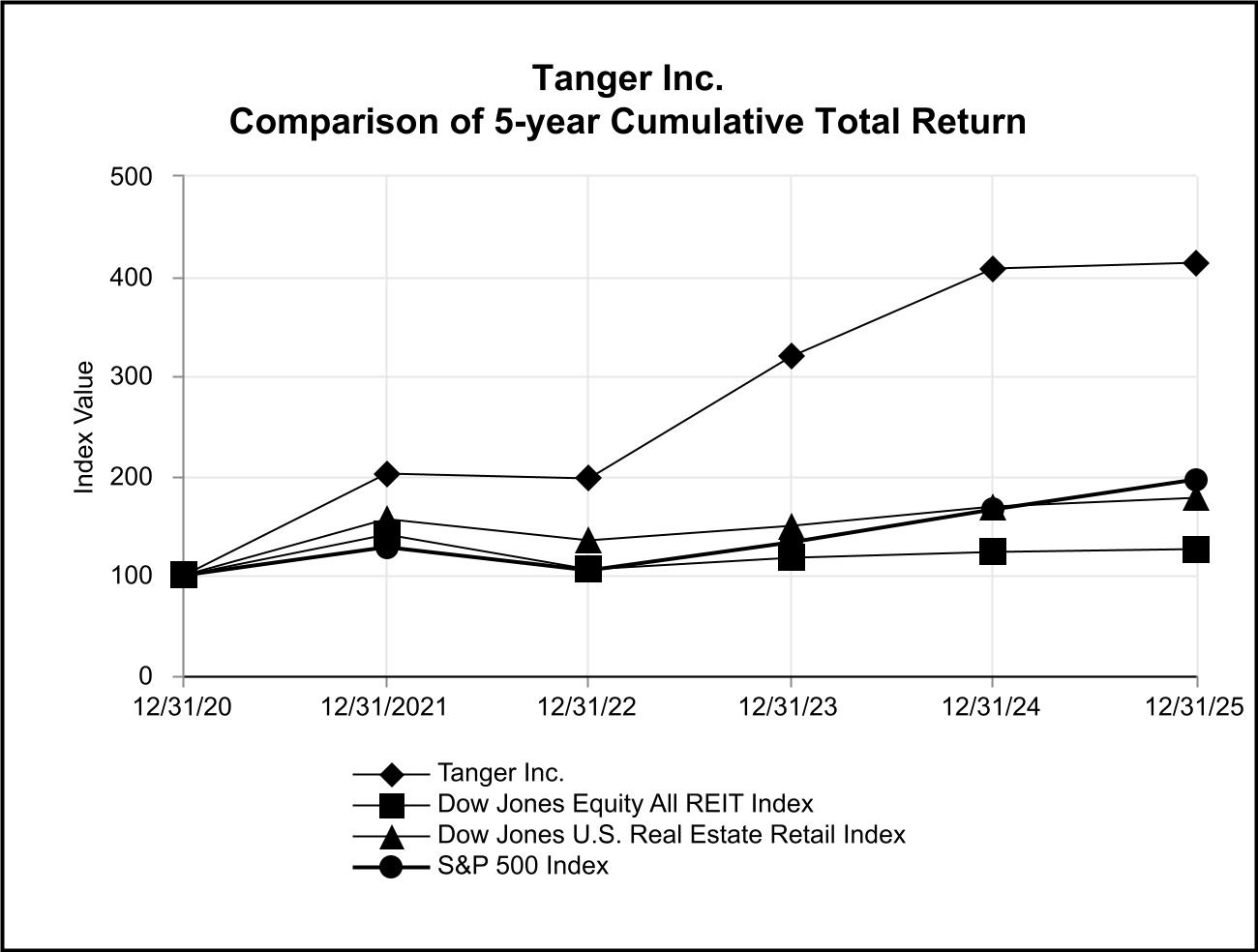
| Period Ended | |||||||||||||||||||||||||||||||||||
| Index | 12/31/2020 | 12/31/2021 | 12/31/2022 | 12/31/2023 | 12/31/2024 | 12/31/2025 | |||||||||||||||||||||||||||||
| Tanger Inc. | 100.00 | 201.59 | 196.94 | 319.16 | 407.58 | 413.25 | |||||||||||||||||||||||||||||
| Dow Jones Equity All REIT Index | 100.00 | 141.20 | 105.89 | 117.86 | 123.58 | 126.55 | |||||||||||||||||||||||||||||
Dow Jones U.S. Real Estate Retail Index | 100.00 | 156.73 | 135.11 | 149.27 | 168.71 | 178.04 | |||||||||||||||||||||||||||||
| S&P 500 Index | 100.00 | 128.71 | 105.40 | 133.10 | 166.40 | 196.16 | |||||||||||||||||||||||||||||
50
Tanger Properties Limited Partnership Market Information
There is no established public trading market for the Operating Partnership's common units. As of December 31, 2025, the Company and its wholly-owned subsidiary, Tanger LP Trust, owned 115,097,359 units of the Operating Partnership and the Non-Company LPs owned 4,662,904 Class A limited partnership units of the Operating Partnership. We made distributions per common unit during the year ended 2025 as follows:
| 2025 | ||||||||
| First Quarter | $ | 0.2750 | ||||||
| Second Quarter | 0.2925 | |||||||
| Third Quarter | 0.2925 | |||||||
| Fourth Quarter | 0.2925 | |||||||
| Distributions per unit | $ | 1.1525 | ||||||
ITEM 6.[RESERVED]
51
ITEM 7.MANAGEMENT'S DISCUSSION AND ANALYSIS OF FINANCIAL CONDITION AND RESULTS OF OPERATIONS
The following discussion should be read in conjunction with the consolidated financial statements appearing elsewhere in this report. Historical results and percentage relationships set forth in the consolidated statements of operations, including trends which might appear, are not necessarily indicative of future operations.
This Management's Discussion and Analysis of Financial Condition and Results of Operations ("MD&A") is intended to provide a reader of our financial statements with a narrative from the perspective of our management regarding our financial condition and results of operations, liquidity and certain other factors that may affect our future results. Our MD&A is presented in the following sections:
•General Overview
•Leasing Activity
•Results of Operations
•Liquidity and Capital Resources of the Company
•Liquidity and Capital Resources of the Operating Partnership
•Critical Accounting Estimates
•Recent Accounting Pronouncements
•Non-GAAP Supplemental Measures
•Economic Conditions and Outlook
52
General Overview
As of December 31, 2025, we had 31 consolidated centers and 3 open-air lifestyle centers in 21 states totaling 14.0 million square feet. We also had 6 unconsolidated centers totaling 2.1 million square feet, including 2 outlet centers located in Canada. Our portfolio also includes one managed center totaling approximately 457,000 square feet. The table below details our acquisitions, new developments, expansions and dispositions of consolidated and unconsolidated centers that impacted our results of operations and liquidity from December 31, 2022 to December 31, 2025:
Consolidated Centers | Unconsolidated Joint Venture Centers | Managed Centers | ||||||||||||||||||||||||||||||||||||||||||
Center | Quarter Acquired/Developed/Disposed | Square Feet (in thousands) | Number of Centers | Square Feet (in thousands) | Number of Centers | Square Feet (in thousands) | Number of Centers | |||||||||||||||||||||||||||||||||||||
| As of December 31, 2022 | 11,353 | 29 | 2,113 | 6 | 457 | 1 | ||||||||||||||||||||||||||||||||||||||
| Additions: | ||||||||||||||||||||||||||||||||||||||||||||
Marketplace Palm Beach, FL | Third Quarter | — | — | — | — | 301 | 1 | |||||||||||||||||||||||||||||||||||||
| Nashville, Tennessee | Fourth Quarter | 291 | 1 | — | — | — | — | |||||||||||||||||||||||||||||||||||||
| Asheville, North Carolina | Fourth Quarter | 382 | 1 | — | — | — | — | |||||||||||||||||||||||||||||||||||||
| Huntsville, Alabama | Fourth Quarter | 651 | 1 | — | — | — | — | |||||||||||||||||||||||||||||||||||||
| Other | 13 | — | — | — | — | — | ||||||||||||||||||||||||||||||||||||||
| As of December 31, 2023 | 12,690 | 32 | 2,113 | 6 | 758 | 2 | ||||||||||||||||||||||||||||||||||||||
| Additions: | ||||||||||||||||||||||||||||||||||||||||||||
| Little Rock, Arkansas | Fourth Quarter | 270 | 1 | — | — | — | — | |||||||||||||||||||||||||||||||||||||
| Other | — | — | — | — | — | — | ||||||||||||||||||||||||||||||||||||||
| As of December 31, 2024 | 12,960 | 33 | 2,113 | 6 | 758 | 2 | ||||||||||||||||||||||||||||||||||||||
| Dispositions: | ||||||||||||||||||||||||||||||||||||||||||||
| Howell, Michigan | Second Quarter | (314) | (1) | — | — | — | — | |||||||||||||||||||||||||||||||||||||
| Marketplace Palm Beach, FL | Second Quarter | — | — | — | — | (301) | (1) | |||||||||||||||||||||||||||||||||||||
| Additions: | ||||||||||||||||||||||||||||||||||||||||||||
Cleveland, Ohio | First Quarter | 639 | 1 | — | — | — | — | |||||||||||||||||||||||||||||||||||||
Kansas City, Kansas | Third Quarter | 690 | 1 | — | — | — | — | |||||||||||||||||||||||||||||||||||||
| Other | 34 | — | — | — | — | — | ||||||||||||||||||||||||||||||||||||||
| As of December 31, 2025 | 14,009 | 34 | 2,113 | 6 | 457 | 1 | ||||||||||||||||||||||||||||||||||||||
53
Leasing Activity
The following table provides information for our consolidated centers related to leases for new stores that opened or renewals that were executed during the years ended December 31, 2025 and 2024, respectively:
Comparable Space for Executed Leases (1) (2) | ||||||||||||||||||||
| Leasing Transactions | Square Feet (in 000s) | New Initial Rent (psf) (3) | Rent Spread % (4) | Tenant Allowance (psf) (5) | Average Initial Term (in years) | |||||||||||||||
| Total space | ||||||||||||||||||||
| 2025 | 495 | 2,599 | $ | 39.07 | 9.3 | % | $ | 6.73 | 4.06 | |||||||||||
| 2024 | 402 | 1,976 | $ | 36.19 | 15.2 | % | $ | 3.79 | 3.19 | |||||||||||
Comparable and Non-Comparable Space for Executed Leases (1) (2) | ||||||||||||||||||||
| Leasing Transactions | Square Feet (in 000s) | New Initial Rent (psf) (3) | Tenant Allowance (psf) (5) | Average Initial Term (in years) | ||||||||||||||||
| Total space | ||||||||||||||||||||
| 2025 | 555 | 2,887 | $ | 39.53 | $ | 11.33 | 4.43 | |||||||||||||
| 2024 | 454 | 2,250 | $ | 36.64 | $ | 10.16 | 3.81 | |||||||||||||
(1)For consolidated properties owned as of the period-end date. Represents leases for new stores or renewals that were executed during the respective calendar years and excludes license agreements, seasonal tenants and month-to-month leases.
(2)Comparable space excludes leases for space that was vacant for more than 12 months (non-comparable space).
(3)Represents average initial cash rent (base rent and common area maintenance (“CAM”)).
(4)Represents change in average initial and expiring cash rent (base rent and CAM).
(5)Includes other landlord costs.
Results of Operations
2025 Compared to 2024
Net income
Net income increased $16.7 million in 2025 to a net income of $119.5 million compared to net income of $102.8 million for 2024. The change in net income was primarily due to the following:
•higher rental revenues from a strengthened tenant mix and higher new and renewal rental rates related to the same center portfolio;
•higher rental revenues, operating expenses, depreciation and amortization from the acquisition of our center in Little Rock, AR during the fourth quarter of 2024, the Cleveland, OH center during the first quarter of 2025 and the Kansas City, KS center during the third quarter of 2025;
•decrease in net income from the sale of the Howell, MI center during the second quarter of 2025;
•higher interest expense due to the increased balance on our unsecured lines of credit that were used to partially fund our acquisitions; and
•an impairment charge of $4.2 million recorded in the first quarter of 2025 related to our Howell, MI center.
In the tables below, information set forth for acquired properties includes our centers in Little Rock, AR, Cleveland, OH and Kansas City, KS that were acquired in December 2024, February 2025 and September 2025, respectively. Properties disposed includes the center in Howell, MI that sold in April 2025.
54
Rental Revenues
Rental revenues increased $53.4 million in 2025 compared to 2024. The following table sets forth the changes in various components of rental revenues (in thousands):
| 2025 | 2024 | Increase/(Decrease) | ||||||||||||||||||
| Rental revenues from existing properties | $ | 505,578 | $ | 489,235 | $ | 16,343 | ||||||||||||||
| Rental revenues from acquired properties and property disposed | 40,095 | 6,935 | 33,160 | |||||||||||||||||
| Straight-line rent adjustments | 3,410 | 607 | 2,803 | |||||||||||||||||
| Lease termination fees | 1,103 | 896 | 207 | |||||||||||||||||
| Amortization of above and below market rent adjustments, net | 710 | (157) | 867 | |||||||||||||||||
| $ | 550,896 | $ | 497,516 | $ | 53,380 | |||||||||||||||
Rental revenues at existing properties were positively impacted by obtaining higher rents from new and existing tenants during the last twelve months and strengthening our tenant mix. Straight-line rent adjustment income has increased in conjunction with the additional properties added to the portfolio and stronger lease execution results.
Management, Leasing and Other Service Revenues
Management, leasing and other service revenues increased $127,000 in 2025 compared to 2024. The following table sets forth the changes in various components of management, leasing and other services (in thousands):
| 2025 | 2024 | Increase/(Decrease) | ||||||||||||||||||
| Management and marketing | $ | 3,493 | $ | 3,552 | $ | (59) | ||||||||||||||
| Leasing and other fees | 872 | 1,033 | (161) | |||||||||||||||||
| Expense reimbursements from unconsolidated joint ventures and managed properties | 5,407 | 5,060 | 347 | |||||||||||||||||
| $ | 9,772 | $ | 9,645 | $ | 127 | |||||||||||||||
Other Revenues
Other revenues increased $2.0 million in 2025 as compared to 2024. The following table sets forth the changes in other revenues (in thousands):
| 2025 | 2024 | Increase/(Decrease) | ||||||||||||||||||
| Other revenues from existing properties | $ | 20,147 | $ | 18,580 | $ | 1,567 | ||||||||||||||
| Other revenues from acquired properties and property disposed | 747 | 322 | 425 | |||||||||||||||||
| $ | 20,894 | $ | 18,902 | $ | 1,992 | |||||||||||||||
Other revenues from existing properties increased in 2025 due to an increase in other revenue streams, such as paid media sponsorships and onsite signage, on a local and national level.
55
Property Operating Expenses
Property operating expenses increased $17.8 million in 2025 compared to 2024. The following table sets forth the changes in various components of property operating expenses (in thousands):
| 2025 | 2024 | Increase/(Decrease) | ||||||||||||||||||
| Property operating expenses from existing properties | $ | 150,857 | $ | 148,671 | $ | 2,186 | ||||||||||||||
| Property operating expenses from acquired properties and property disposed | 18,234 | 2,977 | 15,257 | |||||||||||||||||
| Expenses related to unconsolidated joint ventures and managed properties | 5,407 | 5,060 | 347 | |||||||||||||||||
| Other property operating expense | 2,004 | 2,021 | (17) | |||||||||||||||||
| $ | 176,502 | $ | 158,729 | $ | 17,773 | |||||||||||||||
Property operating expenses from existing properties increased in the 2025 period primarily from higher snow removal costs, property taxes and property payroll related expenses, partially offset by decreases in advertising expenses and property insurance costs.
General and Administrative Expenses
General and administrative expenses increased $702,000 in 2025 compared to 2024. We recorded executive separation amounts totaling $1.6 million in the 2024 period. We had no executive separation costs in 2025. Exclusive of the 2024 amounts, general and administrative expenses increased approximately $2.3 million primarily due to higher compensation expenses, healthcare costs and technology related licensing costs, partially offset by lower third-party professional fees.
Depreciation and Amortization
Depreciation and amortization expense increased $12.3 million in 2025 compared to 2024. The following table sets forth the changes in various components of depreciation and amortization costs from the 2024 period to the 2025 period (in thousands):
| 2025 | 2024 | Increase/(Decrease) | ||||||||||||||||||
| Depreciation and amortization expenses from existing properties | $ | 133,656 | $ | 136,889 | $ | (3,233) | ||||||||||||||
| Depreciation and amortization from acquired properties and property disposed | 17,320 | 1,801 | 15,519 | |||||||||||||||||
| $ | 150,976 | $ | 138,690 | $ | 12,286 | |||||||||||||||
The decrease in depreciation and amortization from existing properties was primarily due to acquisition intangible lease related costs that became fully depreciated from prior acquisitions between the comparative periods.
Interest Expense
Interest expense increased $5.2 million in 2025 compared to 2024. We had outstanding balances averaging approximately $76.5 million on our unsecured lines of credit during 2025 compared to an average of $21.7 million in 2024. In addition, we assumed a $115.0 million interest only mortgage with the acquisition of the Kansas City, KS center in September 2025.
Other Income (Expense)
Other income (expense) decreased approximately $816,000 in 2025 compared to 2024 driven by higher interest income earned during the 2024 period from higher average cash balances. During the second half of 2024, we raised $115.9 million of proceeds through our ATM Program which were invested to interest bearing accounts until ultimately deployed into the February 2025 Pinecrest, OH acquisition, contributing to the reduction in other income.
Equity in Earnings of Unconsolidated Joint Ventures
Equity in earnings of unconsolidated joint ventures increased approximately $2.3 million in the 2025 period compared to the 2024 period. The Galveston joint venture refinanced its mortgage during the second quarter of 2025 that resulted in a lower interest rate and the Charlotte joint venture produced stronger comparative results between the periods.
56
2024 Compared to 2023
For a discussion of our results of operations for the year ended December 31, 2024, including a year-to-year comparison between 2024 and 2023, refer to Part II, Item 7, "Management's Discussion and Analysis of Financial Condition and Results of Operations" in our Annual Report on Form 10-K for the year ended December 31, 2024.
Liquidity and Capital Resources of the Company
In this “Liquidity and Capital Resources of the Company” section, the term, the "Company", refers only to Tanger Inc. on an unconsolidated basis, excluding the Operating Partnership.
The Company's business is operated primarily through the Operating Partnership. The Company issues public equity from time to time, but does not otherwise generate any capital itself or conduct any business itself, other than incurring certain expenses in operating as a public company, which are fully reimbursed by the Operating Partnership. The Company does not hold any indebtedness, and its only material asset is its ownership of partnership interests of the Operating Partnership. The Company's principal funding requirement is the payment of dividends on its common shares. The Company's principal source of funding for its dividend payments is distributions it receives from the Operating Partnership.
Through its status as the sole general partner of the Operating Partnership, the Company has the full, exclusive and complete responsibility for the Operating Partnership's day-to-day management and control. The Company causes the Operating Partnership to distribute all, or such portion as the Company may in its discretion determine, of its available cash in the manner provided in the Operating Partnership's partnership agreement. The Company receives proceeds from equity issuances from time to time, but is required by the Operating Partnership's partnership agreement to contribute the proceeds from its equity issuances to the Operating Partnership in exchange for partnership units of the Operating Partnership.
We are a well-known seasoned issuer with a shelf registration that expires in December 2026, which allows us to register various unspecified classes of equity securities and the Operating Partnership to register various unspecified classes of debt securities. As circumstances warrant, we may issue equity from time to time on an opportunistic basis, dependent upon market conditions and available pricing. The Operating Partnership may use the proceeds to repay debt, including borrowings under its lines of credit, develop new or existing properties, make acquisitions of properties or portfolios of properties, invest in existing or newly created joint ventures, or for general corporate purposes.
Our liquidity is dependent on the Operating Partnership's ability to make sufficient distributions to us. The Operating Partnership is a party to loan agreements with various bank lenders that require the Operating Partnership to comply with various financial and other covenants before it may make distributions to us. We also guarantee some of the Operating Partnership's debt. If the Operating Partnership fails to fulfill its debt requirements, which would trigger our guarantee obligations, then we may be required to fulfill our cash payment commitments under such guarantees. However, our only material asset is our investment in the Operating Partnership.
We believe the Operating Partnership's sources of working capital, specifically its cash flow from operations, and borrowings available under its unsecured credit facilities, are adequate for it to make its distribution payments to us and, in turn, for us to make dividend payments to our shareholders and to finance our continued operations, investment and growth strategy and additional expenses we expect to incur. However, there can be no assurance that the Operating Partnership's sources of capital will continue to be available at all or in amounts sufficient to meet its needs, including its ability to make distribution payments to us. The unavailability of capital could adversely affect the Operating Partnership's ability to pay its distributions to us, which will in turn, adversely affect our ability to pay cash dividends to our shareholders.
We operate in a manner intended to enable us to qualify as a REIT under the Internal Revenue Code. In order for us to maintain our qualification as a REIT, we must pay dividends to our shareholders aggregating annually at least 90% of our taxable income. While historically we have satisfied this distribution requirement by making cash distributions to our shareholders, it may choose to satisfy this requirement by making distributions of cash or other property, including, in limited circumstances, our own shares.
57
For tax reporting purposes, we distributed approximately $130.2 million during 2025. If in any taxable year, we were to fail to qualify as a REIT and certain statutory relief provisions were not applicable, we would not be allowed a deduction for distributions to shareholders in computing taxable income and would be subject to U.S. federal income tax (including any applicable alternative minimum tax for tax years prior to 2019) on our taxable income at the regular corporate rate.
As a result of this distribution requirement, the Operating Partnership cannot rely on retained earnings to fund its on-going operations to the same extent that other companies whose parent companies are not REITs can. We may need to continue to raise capital in the equity markets to fund the Operating Partnership's working capital needs, as well as potential developments of new or existing properties, acquisitions or investments in existing or newly created joint ventures.
We currently consolidate the Operating Partnership because we have (1) the power to direct the activities of the Operating Partnership that most significantly impact the Operating Partnership’s economic performance and (2) the obligation to absorb losses and the right to receive the residual returns of the Operating Partnership that could be potentially significant. We do not have significant assets other than our investment in the Operating Partnership. Therefore, the assets and liabilities and the revenues and expenses of the Company and the Operating Partnership are the same on their respective financial statements, except for immaterial differences related to cash, other assets and accrued liabilities that arise from public company expenses paid by the Company. However, all debt is held directly or indirectly at the Operating Partnership level, and we have guaranteed some of the Operating Partnership's unsecured debt as discussed below. Because we consolidate the Operating Partnership, the section entitled "Liquidity and Capital Resources of the Operating Partnership" should be read in conjunction with this section to understand the liquidity and capital resources of the Company on a consolidated basis and how the Company is operated as a whole.
Dividend Declarations
In January 2025, the Board declared a $0.275 cash dividend per common share payable on February 14, 2025 to each shareholder of record on January 31, 2025, and in its capacity as General Partner of the Operating Partnership, authorized a $0.275 cash distribution per Operating Partnership unit to the Operating Partnership's unitholders.
In April 2025, the Board declared a $0.2925 cash dividend per common share payable on May 15, 2025 to each shareholder of record on April 30, 2025, and in its capacity as General Partner of the Operating Partnership, authorized a $0.2925 cash distribution per Operating Partnership unit to the Operating Partnership's unitholders.
In July 2025, the Board declared a $0.2925 quarterly cash dividend per common share payable on August 15, 2025 to each shareholder of record on July 31, 2025, and, in its capacity as General Partner of the Operating Partnership, authorized a $0.2925 cash distribution per Operating Partnership unit to the Operating Partnership's unitholders.
In October 2025, the Board declared a $0.2925 quarterly cash dividend per common share payable on November 14, 2025 to each shareholder of record on October 31, 2025, and, in its capacity as General Partner of the Operating Partnership, authorized a $0.2925 cash distribution per Operating Partnership unit to the Operating Partnership's unitholders.
In January 2026, the Board declared a $0.2925 cash dividend per common share payable on February 13, 2026 to each shareholder of record on January 30, 2026, and a $0.2925 cash distribution per general and limited partnership unit to the Operating Partnership's unitholders.
58
ATM Program
Under our at-the-market share offering program (“ATM Program”), we may offer and sell our common shares, $0.01 par value per share, having an aggregate gross sales price of up to $400 million. The ATM Program includes forward sales capability detailed in the “Forward Sale Agreements” section below. We may sell the common shares in amounts and at times to be determined by us but we have no obligation to sell any of the common shares. Actual sales, if any, will depend on a variety of factors to be determined by us from time to time, including, among other things, market conditions, the trading price of the common shares, capital needs and determinations by us of the appropriate sources of its funding. We currently intend to use the net proceeds from the sale of common shares pursuant to the ATM Program for external growth, working capital and general corporate expenses. As of December 31, 2025, we had approximately $400.0 million remaining available for sales of shares under the ATM Program.
The following table sets forth information regarding settlements under our ATM Offering program:
| 2025 | 2024 | 2023 | ||||||||||||||||||
| Number of common shares settled during the period | 1,915,762 | 3,374,184 | 3,494,919 | |||||||||||||||||
| Average price per share | $ | 36.40 | $ | 34.34 | $ | 25.75 | ||||||||||||||
| Aggregate gross proceeds (in thousands) | $ | 69,731 | $ | 115,878 | $ | 89,986 | ||||||||||||||
| Aggregate net proceeds after commissions and fees (in thousands) | $ | 69,314 | $ | 114,541 | $ | 88,861 | ||||||||||||||
There were no sales of our common shares during 2025. However, during the third quarter of 2025, we settled all of the forward shares that were outstanding under the ATM Program, as discussed in the “Forward Sale Agreements” section below.
Forward Sale Agreements
During the fourth quarter of 2024, we sold an aggregate of 1.9 million shares under the ATM Program, which were subject to forward sale agreements, for an estimated aggregate gross value of $69.7 million based on the initial forward sale price of $36.40 with respect to each forward sale agreement. In September 2025, we settled all of the outstanding forward shares that were issued under the ATM Program for total gross proceeds of $69.7 million. A portion of the proceeds were used to fund the acquisition of the Legends Outlets in Kansas City, Kansas.
Share Repurchase Program
In May 2025, the Board authorized the repurchase of up to $200.0 million of the Company’s outstanding shares, replacing the previously authorized plan to repurchase up to $100.0 million of the Company's outstanding shares that expired May 31, 2025. Repurchases may be made from time to time through open market, privately-negotiated, structured or derivative transactions (including accelerated share repurchase transactions), or other methods of acquiring shares. The Company intends to structure open market purchases to occur within the pricing and volume requirements of Rule 10b-18 under the Exchange Act. The Company may, from time to time, enter into Rule 10b5-1 plans to facilitate the repurchase of its shares under this authorization. The Company did not repurchase any shares in 2025 subsequent to the authorization of the repurchase plan in May 2025. The remaining amount authorized to be repurchased under the program as of December 31, 2025 was $200.0 million.
In January 2026, we used approximately $20 million of the net proceeds from the Exchangeable Notes Offering to repurchase 589,622 of the Company’s common shares concurrently with the pricing of the Exchangeable Notes in privately negotiated transactions for $33.92 per common share.
Liquidity and Capital Resources of the Operating Partnership
In this “Liquidity and Capital Resources of the Operating Partnership” section, the terms “we”, “our” and “us” refer to the Operating Partnership or the Operating Partnership and the Company together, as the context requires.
59
Summary of Our Major Sources and Uses of Cash and Cash Equivalents
General Overview
Property rental income represents our primary source to pay property operating expenses, debt service, capital expenditures and distributions, excluding non-recurring capital expenditures and acquisitions. To the extent that our cash flow from operating activities is insufficient to cover such non-recurring capital expenditures and acquisitions, we finance such activities from borrowings under our unsecured lines of credit or from the proceeds from the Operating Partnership’s debt offerings and the Company’s equity offerings.
We believe we achieve a strong and flexible financial position by attempting to: (1) maintain a conservative leverage position relative to our portfolio when pursuing new development, expansion and acquisition opportunities, (2) extend and sequence debt maturities, (3) manage our interest rate risk through an appropriate mix of fixed and variable rate debt and interest rate hedging strategies, (4) maintain access to liquidity by using our lines of credit in a conservative manner and (5) preserve internally generated sources of capital by maintaining a conservative distribution payout ratio. We manage our capital structure to reflect a long-term investment approach and utilize multiple sources of capital to meet our requirements, including without limitation, cash on hand, retained free cash flow and debt and equity issuances.
Capital Expenditures
The following table details our capital expenditures for consolidated centers for the years ended December 31, 2025 and 2024, respectively (in thousands):
| 2025 | 2024 | Change | ||||||||||||||||||
| Capital expenditures analysis: | ||||||||||||||||||||
New center developments, redevelopments, first generation tenant allowances and expansions (1) | $ | 32,474 | $ | 27,008 | $ | 5,466 | ||||||||||||||
| Renovations | 7,497 | 6,243 | 1,254 | |||||||||||||||||
Second generation tenant allowances (2) | 20,540 | 24,437 | (3,897) | |||||||||||||||||
Other capital expenditures (3) | 37,824 | 27,152 | 10,672 | |||||||||||||||||
| 98,335 | 84,840 | 13,495 | ||||||||||||||||||
| Conversion from accrual to cash basis | (8,157) | 15,597 | (23,754) | |||||||||||||||||
| Additions to rental property-cash basis | $ | 90,178 | $ | 100,437 | $ | (10,259) | ||||||||||||||
(1)The increase in new center developments, redevelopments, first generation tenant allowances and expansions was primarily due to outparcel investments and center enhancements.
(2)In the 2025 and 2024 periods, second generation tenant allowances are presented net of $646,000 and $206,000 tenant allowance reversals respectively, which were the result of a lease modifications.
(3)The increase in other capital expenditures in 2025 was primarily related to recent acquisitions and larger scale projects.
We expect total capital expenditures for 2026 to be approximately $120.0 million as compared to capital expenditures of $90.2 million in 2025. The higher 2026 amount as compared to 2025 is driven primarily by renovations and redevelopments at certain centers and continuing operational capital expenditures. We expect to maintain sufficient liquidity to fund these capital expenditures.
60
Acquisitions, Development and Disposition
Our transaction summary for 2025, 2024 and 2023 is shown in the following table:
| Center | Location | Type | Date | Square Feet | Investment or Sale Amount (in millions) | |||||||||||||||||||||||||||
| 2025 | ||||||||||||||||||||||||||||||||
Tanger Outlets Howell | Howell, MI | Disposition | April 2025 | 314,000 | $ | 17.0 | ||||||||||||||||||||||||||
Pinecrest | Cleveland, OH | Acquisition | February 2025 | 640,000 | 167.0 | |||||||||||||||||||||||||||
Tanger Outlets Kansas City at Legends | Kansas City, KS | Acquisition | September 2025 | 690,000 | 130.0 | |||||||||||||||||||||||||||
| Total | 1,330,000 | $ | 297.0 | |||||||||||||||||||||||||||||
| 2024 | ||||||||||||||||||||||||||||||||
The Promenade at Chenal | Little Rock, AR | Acquisition | December 2024 | 270,000 | $ | 73.1 | ||||||||||||||||||||||||||
| Total | 270,000 | $ | 73.1 | |||||||||||||||||||||||||||||
2023 | ||||||||||||||||||||||||||||||||
Tanger Outlets Asheville | Asheville, NC | Acquisition | November 2023 | 382,000 | $ | 70.0 | ||||||||||||||||||||||||||
Bridge Street Town Centre | Huntsville, AL | Acquisition | November 2023 | 825,000 | 193.5 | |||||||||||||||||||||||||||
Tanger Outlets Nashville | Nashville, TN | Development | October 2023 | 291,000 | 145.0 | |||||||||||||||||||||||||||
| Total | 1,498,000 | $ | 408.5 | |||||||||||||||||||||||||||||
Potential Future Developments, Acquisitions and Dispositions
As of the date of the filing of this Annual Report, we are not in the pre-development period for any potential new developments. We may use joint venture arrangements to develop potential sites. We expect to maintain sufficient liquidity to fund existing capital expenditures.
In the case of projects to be wholly-owned by us, we expect to fund these projects with cash on hand, borrowings under our unsecured lines of credit and cash flows from operations, but may also fund them with capital from additional public debt and equity offerings. For projects to be developed through joint venture arrangements, we may use collateralized construction loans to fund a portion of the project, with our share of the equity requirements funded from sources described above.
We intend to continue to grow our portfolio by developing, expanding or acquiring additional retail real estate assets. Future retail real estate assets may be wholly-owned by us, owned through joint ventures or partnership arrangements, or through management agreements. However, you should note that any developments or expansions that we, or a joint venture that we have an ownership interest in, have planned or anticipated may not be started or completed as scheduled, or may not result in accretive net income or FFO. See the section "Non-GAAP Supplemental Earnings Measures" - "Funds From Operations" below for further discussion of FFO. In addition, we regularly evaluate acquisition or disposition proposals and engage from time to time in negotiations for acquisitions or dispositions of properties. We may also enter into letters of intent for the purchase or sale of properties. Any prospective acquisition or disposition that is being evaluated or that is subject to a letter of intent may not be consummated, or if consummated, may not result in an increase in earnings or liquidity.
Unconsolidated Real Estate Joint Ventures
From time to time, we form joint venture arrangements to develop or acquire centers. As of December 31, 2025, we have partial ownership interests in six unconsolidated centers totaling approximately 2.1 million square feet, including two centers located in Canada. See Note 5 to the consolidated financial statements for details of our individual joint ventures, including, but not limited to, the carrying values of our investments, fees we receive for services provided to the joint ventures, recent development and financing transactions and condensed combined summary financial information.
61
We may elect to fund cash needs of a joint venture through equity contributions (generally on a basis proportionate to our ownership interests in the joint venture), advances or partner loans, although such funding is not typically required contractually or otherwise. We separately report investments in joint ventures for which accumulated distributions have exceeded investments in, and our share of net income or loss of, the joint ventures within other liabilities in the consolidated balance sheets because we are committed and intend to provide further financial support to these joint ventures. We believe our joint ventures will be able to fund their operating and capital needs during the year ended 2026 based on their sources of working capital, specifically cash flow from operations, access to contributions from partners, and ability to refinance all or portion of their debt obligations, including the ability to exercise upcoming extensions of near-term maturities.
Our joint ventures are typically encumbered by a mortgage on the joint venture property. We provide guarantees to lenders for our joint ventures which include standard non-recourse carve out indemnifications for losses arising from items such as but not limited to fraud, physical waste, payment of taxes, environmental indemnities, misapplication of insurance proceeds or security deposits and failure to maintain required insurance. A default by a joint venture under its debt obligations may expose us to liability under the guaranty. For construction and mortgage loans, we may include a guaranty of completion as well as a principal guaranty. The principal guarantees include terms for release based upon satisfactory completion of construction and performance targets including occupancy thresholds and minimum debt service coverage tests. Our joint ventures may contain make whole provisions in the event that demands are made on any existing guarantees.
Our joint ventures are generally subject to buy-sell provisions, which are customary for joint venture agreements in the real estate industry. Either partner may initiate these provisions (subject to any applicable lock up period), which could result in either the sale of our interest or the use of available cash or additional borrowings to acquire the other party's interest. Under these provisions, one partner sets a price for the property, then the other partner has the option to either (1) purchase their partner's interest based on that price or (2) sell its interest to the other partner based on that price. Since the partner other than the partner who triggers the provision has the option to be the buyer or seller, we do not consider this arrangement to be a mandatory redeemable obligation.
Future Debt Obligations
As described further in Note 8 to the consolidated financial statements, as of December 31, 2025, scheduled maturities and principal amortization of our existing debt for 2026, 2027, and 2028 are $355.7 million, $740.0 million and $44.0 million, respectively. There are no scheduled maturities in 2029. As of December 31, 2025, scheduled maturities after 2029 aggregate to $461.7 million. In anticipation of our upcoming maturities, we have raised $225 million of incremental term loans, extended the maturity to 2030, and $250 million of proceeds from our Exchangeable Notes.
Future Interest Payments
We are obligated to make periodic interest payments at fixed and variable rates, depending on the terms of the applicable debt agreements. Based on applicable interest rates and scheduled debt maturities as of December 31, 2025 and the debt transactions discussed in our subsequent events footnote, these interest obligations total approximately $306.2 million and range from approximately $52.0 million to $79.1 million on an annual basis over the next five years. Our variable rate debt agreements are based on Daily SOFR so the Daily SOFR rate at December 31, 2025, combined with interest rate swaps entered into, was used to calculate future interest expense.
Operating Lease Obligations
As described further in Note 20 to the consolidated financial statements, as of December 31, 2025, we had a total of $249.6 million of minimum operating lease obligations. These minimum lease payments range from approximately $5.1 million to $6.4 million on an annual basis over the next five years.
Other Contractual Obligations
Other contractual obligations totaled $4.7 million as of December 31, 2025. These obligations range from approximately $338,000 to $2.1 million on an annual basis over the next five years.
62
Cash Flows
The following table sets forth our changes in cash flows from 2025 and 2024 (in thousands):
| 2025 | 2024 | Change | ||||||||||||||||||
| Net cash provided by operating activities | $ | 295,421 | $ | 260,592 | $ | 34,829 | ||||||||||||||
| Net cash used in investing activities | (263,537) | (178,007) | (85,530) | |||||||||||||||||
| Net cash used in financing activities | (25,622) | (48,335) | 22,713 | |||||||||||||||||
| Effect of foreign currency rate changes on cash and equivalents | 326 | (122) | 448 | |||||||||||||||||
Net increase/(decrease) in cash and cash equivalents | $ | 6,588 | $ | 34,128 | $ | (27,540) | ||||||||||||||
Operating Activities
The increase in net cash provided by operating activities was primarily due to the addition of two centers during 2025, changes in working capital and an increase in rental revenues at existing centers primarily driven by an increase in occupancy rates and increase in rental rates.
Investing Activities
The increase in net cash used in investing activities was primarily driven by the acquisition of our Cleveland, OH and Kansas City, KS centers during 2025, partially offset by proceeds from the sale of our center in Howell, MI.
Financing Activities
The primary cause for the decrease in net cash used in financing activities was higher draws on our unsecured lines of credit to fund acquisitions and development and proceeds from the amendment of our mortgage at our Southaven, MS center, offset by higher dividend payments and lower proceeds from share issuances.
Financing Arrangements
See Notes 7 and 8 to the consolidated financial statements, for details of our current outstanding debt, financing transactions that have occurred over the past three years and debt maturities. As of December 31, 2025, unsecured borrowings represented 89% of our outstanding debt and 93% of the gross book value of our real estate portfolio was unencumbered. As of December 31, 2025, 3% of our outstanding debt, excluding variable rate debt with interest rate protection agreements in place, had variable interest rates and therefore was subject to market fluctuations.
We intend to retain the ability to raise additional capital, including public debt or equity, to pursue attractive investment opportunities that may arise and to otherwise act in a manner that we believe to be in the best interests of our shareholders and unitholders. The Company and Operating Partnership are well-known seasoned issuers with a joint shelf registration statement on Form S-3, expiring in December 2026, that allows us to register unspecified amounts of different classes of securities. To generate capital to reinvest into other attractive investment opportunities, we may also consider the use of additional operational and developmental joint ventures, property management opportunities, the sale or lease of outparcels on our existing properties and the sale of certain properties that do not meet our long-term investment criteria. Based on cash provided by operations, existing lines of credit, ongoing relationships with certain financial institutions and our ability to sell debt or issue equity subject to market conditions, we believe that we have access to the necessary financing to fund the planned capital expenditures for at least the next twelve months.
We anticipate that adequate cash will be available to fund our operating and administrative expenses, regular debt service obligations, and the payment of dividends in accordance with REIT requirements in both the short and long-term. Although we receive most of our rental payments on a monthly basis, dividends and distributions to shareholders and unitholders, respectively, are typically made quarterly and interest payments on the senior, unsecured notes are made semi-annually. Amounts accumulated for such payments will be used in the interim to reduce the outstanding borrowings under our existing unsecured lines of credit or invested in short-term money market or other suitable instruments.
63
We believe our current balance sheet position is financially sound, particularly given our recent extension and expansion of our term loans and issuance of our exchangeable notes in January 2026 along with capacity under our existing line of credit; however, due to the uncertainty and unpredictability of the capital and credit markets, we can give no assurance that affordable access to capital will exist between now and our next significant debt maturity, which is our $350.0 million unsecured senior notes due September 2026.
Equity Offerings under the ATM Program
During 2025, we did not sell any shares under our at-the-market share offering program (“ATM Program”). As of December 31, 2025, we have a remaining authorization of $400.0 million under the ATM Program.
Our ATM Program also provides that we may sell common shares through forward sale contracts. Actual sales under the ATM Program will depend on a variety of factors including market conditions, the trading price of our common shares, our capital needs, and our determination of the appropriate sources of funding to meet such needs.
During the fourth quarter of 2024, we sold an aggregate of 1.9 million shares under the ATM Program which were subject to forward sale agreements for an estimated aggregate gross value of $69.7 million based on the initial forward sale price of $36.40 with respect to each forward sale agreement. In September 2025, we settled all of the outstanding forward shares under the ATM Program for total gross proceeds of $69.7 million. A portion of the proceeds were used to fund the acquisition of the Legends Outlets in Kansas City, Kansas.
Unsecured Term Loans
In January 2026, we closed on $550.0 million of unsecured term loans, comprised of (i) an amendment of our existing $325.0 million term loan increasing the capacity to $350.0 million and extending the maturity to December 2030 (the "2030 Term Loan") and (ii) a new $200.0 million term loan due January 2033 (the "2033 Term Loan"). We drew an incremental $75.0 million at closing, for a total outstanding amount of $400.0 million and has a combined $150.0 million available under a delayed draw feature, allowing us to draw the proceeds over a six to nine month period. The applicable pricing margin is SOFR plus 95 basis points for the 2030 Term Loan and SOFR plus 125 basis points for the 2033 Term Loan based on our current credit rating.
Derivatives
Throughout 2025 and into January 2026, we entered into several interest rate swap agreements on our unsecured debt totaling $275.0 million with effective dates throughout 2026 with a weighted average interest rate of 3.3%. These agreements have expiration dates ranging from October 1, 2027 to September 1, 2030.
Unsecured Lines of Credit Amendments
In January 2026, the Operating Partnership also entered into amendments to each of (i) the Revolving Credit Agreement with, Bank of America, N.A., as administrative agent, and the lenders party thereto, and (ii) the Liquidity Credit Agreement with Bank of America, N.A.,referred to herein as the Operating Partnership’s unsecured lines of credit, such amendments in each case removing the 10 basis point SOFR credit adjustment spread and making certain conforming changes from the 2030 Term Loan and the 2033 Term Loan.
Exchangeable Notes
In January 2026, the Operating Partnership issued $250.0 million aggregate principal amount of 2.375% Exchangeable Senior Notes due 2031 (the “Exchangeable Notes”), which are guaranteed, on a senior unsecured basis, by the Company. The Exchangeable Notes bear interest at a rate of 2.375% per year, payable semi-annually in arrears on January 15 and July 15 of each year, beginning on July 15, 2026. The Exchangeable Notes mature on January 15, 2031, unless earlier exchanged, redeemed or repurchased. The Exchangeable Notes will be exchangeable at an initial exchange rate of 24.0662 common shares per $1,000 principal amount of the Exchangeable Notes (equivalent to an exchange price of approximately $41.55 per common share). The Exchangeable Notes will be exchangeable for cash up to the aggregate principal amount of the Exchangeable Notes to be exchanged and, in respect of the remainder of the exchange obligation, if any, in excess thereof, cash, common shares or a combination thereof, at the election of the Operating Partnership. Net proceeds after the initial purchaser’s discount and estimated offering costs were approximately $243 million.
64
In connection with the Exchangeable Notes, we entered into privately negotiated capped call transactions with certain of the initial purchasers of the Exchangeable Notes or their affiliates or other financial institutions. The capped call transactions cover, subject to customary adjustments, the number of Company common shares that underlie the Exchangeable Notes. The cap price of the capped call transaction initially is approximately $47.49 per share, which represents a premium of approximately 40% over the last reported sale price of the Company's common shares of $33.92 per share on the New York Stock Exchange on January 7, 2026, and is subject to certain adjustments under the terms of the capped call transactions. A portion of the proceeds from the Exchangeable Notes were used to pay the capped call premium of approximately $9 million, which will be recorded in shareholders' equity for the Company and partners' equity for the Operating Partnership.
Finally, concurrent with the pricing of the Exchangeable Notes, we repurchased approximately 590,000 Company common shares for approximately $20 million in privately negotiated transactions effected with or through one of the initial purchasers or its affiliate, at a price per share equal to the last reported sale price of the Common Shares on the New York Stock Exchange on January 7, 2026.
Other Financing Activity
In April 2025, the Southaven, Mississippi consolidated joint venture amended its mortgage increasing the outstanding borrowings from $51.7 million to $61.7 million and extending the maturity date from October 2026 to April 2030 with no extension options. The stated interest rate remained unchanged at the Adjusted Secured Overnight Financing Rate (“Adjusted SOFR”) + 2.0%. In December 2025, the mortgage was amended to remove the SOFR spread, making the interest rate Daily SOFR + 2.0%. In May 2025, we entered into an interest rate swap transaction to fix the interest rate at 3.5% through April 2029.
In September 2025, we assumed a $115.0 million 7.57% interest only mortgage that matures in November 2027 in conjunction with the acquisition of the Legends Outlets in Kansas City, Kansas. The effective interest rate calculated as part of the purchase price allocation was 6.0%.
The Operating Partnership’s debt agreements require the maintenance of certain ratios, including debt service coverage and leverage, and limit the payment of dividends such that dividends and distributions will not exceed FFO, as defined in the debt agreements, for the prior fiscal year on an annual basis or 95% on a cumulative basis.
Debt Covenants
We have historically been, and, at December 31, 2025 are, in compliance with all of our debt covenants. Our continued compliance with these covenants depends on many factors and could be impacted by current or future economic conditions. Failure to comply with these covenants would result in a default which, if we were unable to cure or obtain a waiver from the lenders, could accelerate the repayment obligations. Further, in the event of default, we may be restricted from paying dividends to our shareholders in excess of dividends required to maintain our REIT qualification. Accordingly, an event of default could have a material and adverse impact on us. As a result, we have considered our short-term (one year or less from the date of filing these financial statements) liquidity needs and the adequacy of our estimated cash flows from operating activities and other financing sources to meet these needs. These other sources include but are not limited to: existing cash, ongoing relationships with certain financial institutions, our ability to sell debt or issue equity subject to market conditions and proceeds from the potential sale of non-core assets. We believe that we have access to the necessary financing to fund our short-term liquidity needs.
As of December 31, 2025, we were in compliance with all financial and non-financial covenants related to our debt obligations, as detailed below:
| Senior unsecured notes financial covenants | Required | Actual | ||||||
| Total Consolidated Debt to Adjusted Total Assets | < 60% | 37 | % | |||||
| Total Secured Debt to Adjusted Total Assets | < 40% | 4 | % | |||||
| Total Unencumbered Assets to Unsecured Debt | > 150% | 277 | % | |||||
| Consolidated Income Available for Debt Service to Annual Debt Service Charge | > 1.5 x | 5.6 | x | |||||
65
| Lines of credit and term loan | Required | Actual | ||||||
| Total Liabilities to Total Adjusted Asset Value | < 60% | 35 | % | |||||
| Secured Indebtedness to Total Adjusted Asset Value | < 35% | 6 | % | |||||
| EBITDA to Fixed Charges | > 1.5 x | 4.7 | x | |||||
| Total Unsecured Indebtedness to Adjusted Unencumbered Asset Value | < 60% | 29 | % | |||||
| Unencumbered Interest Coverage Ratio | > 1.5 x | 5.8 | x | |||||
Debt of unconsolidated joint ventures
The following table details information regarding the outstanding debt of the unconsolidated joint ventures and guarantees of such debt provided by us as of December 31, 2025 (dollars in millions):
| Joint Venture | Ownership % | Total Joint Venture Debt | Maturity Date | Interest Rate | Effective Interest Rate | Percent Guaranteed by the Operating Partnership | ||||||||||||||||||||||||||||||||
Charlotte, NC | 50% | $ | 96.0 | July 2028 | 4.27% | 4.3 | % | — | % | |||||||||||||||||||||||||||||
Columbus, OH | 50% | 71.0 | October 2032 | 6.25% | 6.3 | % | — | % | ||||||||||||||||||||||||||||||
Houston, TX | 50% | 60.0 | June 2030 | Daily SOFR + 1.65% | 5.1 | % | — | % | ||||||||||||||||||||||||||||||
National Harbor, MD | 50% | 90.4 | January 2030 | 4.63% | 4.6 | % | — | % | ||||||||||||||||||||||||||||||
| Debt origination costs | 50% | (1.7) | ||||||||||||||||||||||||||||||||||||
| $ | 315.7 | 5.0 | % | |||||||||||||||||||||||||||||||||||
Houston/Galveston, Texas
In June 2025, the Galveston/Houston joint venture refinanced its mortgage loan to extend the maturity from June 2026 to June 2030, which included an increase in principal balance from $58.0 million to $60.0 million, and reduced the interest rate from the Daily Secured Overnight Financing Rate (“Daily SOFR”) + 3.0% to Daily SOFR + 1.65%. In conjunction with this refinancing, the joint venture entered into a $60.0 million interest rate swap that fixes Daily SOFR at 3.4% until June 2029. The refinancing provided for the removal of the Operating Partnership's principal guarantee.
Critical Accounting Estimates
The preparation of financial statements and related disclosures in conformity with GAAP and the Company’s discussion and analysis of its financial condition and operating results require the Company’s management to make judgments, assumptions and estimates that affect the amounts reported. Management bases its estimates on historical experience and on various other assumptions it believes to be reasonable under the circumstances, the results of which form the basis for making judgments about the carrying values of assets and liabilities. Actual results may differ from these estimates, and such differences may be material. Management believes the Company’s critical accounting estimates are those related to impairment of long-lived assets, impairment of investments, revenue recognition and collectability of operating lease receivables. Management considers these estimates critical because they are both important to the portrayal of the Company’s financial condition and operating results, and they require management to make judgments and estimates about inherently uncertain matters. The Company’s senior management has reviewed these critical accounting estimates and related disclosures with the Audit Committee of the Board.
66
Evaluation of Impairment of long-lived assets
Rental property held and used by us is reviewed for impairment in the event that facts and circumstances indicate the carrying amount of an asset may not be recoverable. In such an event, we compare the estimated future undiscounted cash flows associated with the asset to the asset's carrying amount, and if less than such carrying amount, recognize an impairment loss in an amount by which the carrying amount exceeds its fair value. The cash flow estimates used both for determining recoverability and estimating fair value are inherently judgmental and reflect current and projected trends in rental, occupancy, capitalization and discount rates, and estimated holding periods for the applicable assets. Impairment analyses are based on our current plans, intended holding periods and available market information at the time the analyses are prepared. If our estimates of the projected future cash flows change based on uncertain market conditions or holding periods, our evaluation of impairment losses may be different and such differences could be material to our consolidated financial statements.
Due to the financial impacts from the COVID-19 pandemic, we began performing the above described procedures on our Atlantic City, New Jersey center in 2020. While the center’s performance has improved since that time, we have continued to perform those procedures and concluded each quarter that the carrying amount of the asset was recoverable. We evaluate different holding period scenarios and apply probabilities to those scenarios to determine an average holding period of 9 years. Management has the intent, and we have the ability, to hold the property for at least this period, and we believe this period is reasonable based on the center’s performance and our history of being a long-term owner and operator of our centers. We believe the carrying value is recoverable because in our models the sum of the estimated future undiscounted cash flows, $51.1 million, and the estimated potential disposition proceeds of the sale of the center, $65.5 million (in aggregate totaling $116.6 million) exceeds the carrying value of $102.1 million by $14.6 million. The recorded carrying amount includes intangible lease costs from our 2011 acquisition of the center. Accordingly, we will continue to monitor circumstances and events in future periods that could affect inputs such as the expected holding period, operating cash flow forecasts and capitalization rates, utilized to determine whether an impairment charge is necessary. As these inputs are difficult to predict and are subject to future events that may alter our assumptions, the future cash flows estimated by management in its impairment analysis may not be achieved, and actual losses or impairment may be realized in the future.
In April 2025, we sold the center in Howell, Michigan for $17.0 million. As part of our quarterly impairment evaluation procedures, we recorded a $4.2 million impairment charge in the first quarter of 2025 to lower the property’s carrying value to the estimated fair value based on the purchase agreement.
Evaluation of Impairment of investments
Our estimates of value for each joint venture investment are based on a number of assumptions that are subject to economic and market uncertainties including, among others, estimated hold period, terminal capitalization rates, demand for space, competition for tenants, changes in market rental rates and operating costs of the property. These above factors are considered in the estimation process and are subject to significant management judgment, difficult to predict and contingent on future events that may alter our assumptions and the values estimated by us in our impairment analysis may not be realized.
Acquisitions of Real Estate
In accordance with the guidance for business combinations, we determine whether the acquisition of a property qualifies as a business combination, which requires that the assets acquired and liabilities assumed constitute a business. If the property acquired is not a business, we account for the transaction as an asset acquisition and therefore capitalize transaction costs. We evaluate each real estate acquisition to determine whether the integrated set of acquired assets and activities meets the definition of a business.
67
We allocate the purchase price of asset acquisitions based on the fair value of land, building, tenant improvements, debt and deferred lease costs and other intangibles, such as the value of leases with above or below market rents, origination costs associated with the in-place leases, the value of in-place leases and tenant relationships, if any. We depreciate the amount allocated to building, deferred lease costs and other intangible assets over their estimated useful lives, which range up to 36 years. The values of the above and below market leases are amortized and recorded as either an increase (in the case of below market leases) or a decrease (in the case of above market leases) to rental income over the remaining term of the associated lease. The values of below market leases that are considered to have renewal periods with below market rents are amortized over the remaining term of the associated lease plus the renewal periods when the renewal is deemed probable to occur. The value associated with in-place leases is amortized over the remaining lease term and tenant relationships are amortized over the expected term, which includes an estimated probability of the lease renewal. If a tenant terminates its lease prior to the contractual termination of the lease and no rental payments are being made on the lease, any unamortized balance of the related intangibles is written off. The tenant improvements and origination costs are amortized as an expense over the remaining life of the lease (or charged against earnings if the lease is terminated prior to its contractual expiration date). In instances where an acquisition includes the assumption of a mortgage or other debt, we amortize the related discount or premium over the life of the debt instrument. We assess fair value based on estimated cash flow projections that utilize appropriate discount and capitalization rates and available market information. These cash flow projections may be derived from various observable and unobservable inputs and assumptions. Also, we may utilize third-party valuation specialists.
The table below summarizes our asset acquisitions from 2023 - 2025. Purchase price includes capitalized transaction costs.
Date | Purchase Price | Debt Assumed | Intangible Assets | |||||||||||||||||
| 2025 | Kansas City, KS center was acquired for a total purchase price of $130.0 million. | $115.0 million, 7.57% interest-only mortgage, with an effective rate of 6.0% (see Note 8), that matures in November 2027. | Approximately $0.9 million and $11.3 million, respectively, were allocated to the value of leases with above and below market rents. | |||||||||||||||||
| 2025 | Cleveland, OH center was acquired for a total purchase price of $167.0 million. | Approximately $6.9 million and $7.5 million, respectively, were allocated to the value of leases with above and below market rents. | ||||||||||||||||||
| 2024 | Little Rock, AR center was acquired for a total purchase price of $73.1 million. | Approximately $4.7 million and $4.0 million, respectively, were allocated to the value of leases with above and below market rents. | ||||||||||||||||||
| 2023 | Huntsville, AL center was acquired for a total purchase price of $193.5 million. | Approximately $4.9 million and $3.5 million, respectively, were allocated to the value of leases with above and below market rents. | ||||||||||||||||||
| 2023 | Asheville, NC center was acquired for a total purchase price of $70.0 million. | Approximately $2.1 million and $2.9 million, respectively, were allocated to the value of leases with above and below market rents. | ||||||||||||||||||
68
Revenue recognition and collectability of operating lease receivables
We, as a lessor, retain substantially all of the risks and benefits of ownership of our centers and account for our leases as operating leases. We accrue fixed lease income on a straight-line basis over the terms of the leases, when we believe substantially all lease income, including the related straight-line rent receivable, is probable of collection. Our assessment of collectability requires the exercise of considerable judgment and incorporates available operational performance measures such as sales and the aging of billed amounts as well as other publicly available information with respect to our tenant’s financial condition, liquidity and capital resources. When a tenant seeks to reorganize its operations through bankruptcy proceedings, we assess the collectability of receivable balances including, among other things, the timing of a tenant’s bankruptcy filing and our expectations of the assumption by the tenant in bankruptcy proceeding of leases at our properties on substantially similar terms. In the event that we determine accrued receivables are not probable of collection, lease income will be recorded on a cash basis, with the corresponding tenant receivable and straight-line rent receivable charged as a direct write-off against lease income in the period of the change in our collectability determination.
Recent Accounting Pronouncements
See Note 2 to the consolidated financial statements for information on recently adopted accounting standards and new accounting pronouncements issued.
69
Non-GAAP Supplemental Measures
Funds From Operations
FFO is a widely used measure of the operating performance for real estate companies that supplements net income (loss) determined in accordance with GAAP. We determine FFO based on the definition set forth by the National Association of Real Estate Investment Trusts (“Nareit”), of which we are a member. In December 2018, Nareit issued “Nareit Funds From Operations White Paper - 2018 Restatement” which clarifies, where necessary, existing guidance and consolidates alerts and policy bulletins into a single document for ease of use. Nareit defines FFO as net income (loss) available to the Company’s common shareholders computed in accordance with GAAP, excluding (i) depreciation and amortization related to real estate, (ii) gains or losses from sales of certain real estate assets, (iii) gains and losses from change in control, (iv) impairment write-downs of certain real estate assets and investments in entities when the impairment is directly attributable to decreases in the value of depreciable real estate held by the entity and (v) after adjustments for unconsolidated partnerships and joint ventures calculated to reflect FFO on the same basis.
FFO is intended to exclude historical cost depreciation of real estate as required by GAAP, which assumes that the value of real estate assets diminishes ratably over time. Historically, however, real estate values have risen or fallen with market conditions. Because FFO excludes depreciation and amortization of real estate assets, gains and losses from property dispositions and extraordinary items, it provides a performance measure that, when compared year over year, reflects the impact to operations from trends in occupancy rates, rental rates, operating costs, development activities and interest costs, providing perspective not immediately apparent from net income (loss).
We present FFO because we consider it an important supplemental measure of our operating performance. In addition, a portion of cash bonus compensation to certain members of management is based on our FFO or Core FFO, which is described in the section below. We believe it is useful for investors to have enhanced transparency into how we evaluate our performance and that of our management. In addition, FFO is frequently used by securities analysts, investors and other interested parties in the evaluation of REITs, many of which present FFO when reporting their results. FFO is also widely used by us and others in our industry to evaluate and price potential acquisition candidates. We believe that FFO payout ratio, which represents regular distributions to common shareholders and unitholders of the Operating Partnership expressed as a percentage of FFO, is useful to investors because it facilitates the comparison of dividend coverage between REITs. Nareit has encouraged its member companies to report their FFO as a supplemental, industry-wide standard measure of REIT operating performance.
FFO has significant limitations as an analytical tool, and you should not consider it in isolation, or as a substitute for analysis of our results as reported under GAAP. Some of these limitations are:
•FFO does not reflect our cash expenditures, or future requirements, for capital expenditures or contractual commitments;
•FFO does not reflect changes in, or cash requirements for, our working capital needs;
•Although depreciation and amortization are non-cash charges, the assets being depreciated and amortized will often have to be replaced in the future, and FFO does not reflect any cash requirements for such replacements; and
•Other companies in our industry may calculate FFO differently than we do, limiting its usefulness as a comparative measure.
Because of these limitations, FFO should not be considered as a measure of discretionary cash available to us to invest in the growth of our business or our dividend paying capacity. We compensate for these limitations by relying primarily on our GAAP results and using FFO only as a supplemental measure.
70
Core Funds From Operations
We present Core FFO as a supplemental measure of our performance. We define Core FFO as FFO further adjusted to eliminate the impact of certain items that we do not consider indicative of our ongoing operating performance. These further adjustments are itemized in the table below, if applicable. You are encouraged to evaluate these adjustments and the reasons we consider them appropriate for supplemental analysis. In evaluating Core FFO you should be aware that in the future we may incur expenses that are the same as or similar to some of the adjustments in this presentation. Our presentation of Core FFO should not be construed as an inference that our future results will be unaffected by unusual or non-recurring items.
We present Core FFO because we believe it assists investors and analysts in comparing our performance across reporting periods on a consistent basis by excluding items that we do not believe are indicative of our core operating performance. In addition, we believe it is useful for investors to have enhanced transparency into how we evaluate management’s performance and the effectiveness of our business strategies. We use Core FFO when certain material, unplanned transactions occur as a factor in evaluating management’s performance and to evaluate the effectiveness of our business strategies, and may use Core FFO when determining incentive compensation.
Core FFO has limitations as an analytical tool. Some of these limitations are:
•Core FFO does not reflect our cash expenditures, or future requirements, for capital expenditures or contractual commitments;
•Core FFO does not reflect changes in, or cash requirements for, our working capital needs;
•Although depreciation and amortization are non-cash charges, the assets being depreciated and amortized will often have to be replaced in the future, and Core FFO does not reflect any cash requirements for such replacements;
•Core FFO does not reflect the impact of certain cash charges resulting from matters we consider not to be indicative of our ongoing operations; and
•Other companies in our industry may calculate Core FFO differently than we do, limiting its usefulness as a comparative measure.
Because of these limitations, Core FFO should not be considered in isolation or as a substitute for performance measures calculated in accordance with GAAP. We compensate for these limitations by relying primarily on our GAAP results and using Core FFO only as a supplemental measure.
71
Below is a reconciliation of net income to FFO and Core FFO available to common shareholders (in thousands, except per share amounts):
| 2025 | 2024 | 2023 | ||||||||||||||||||
| Net income | $ | 119,501 | $ | 102,760 | $ | 103,882 | ||||||||||||||
| Adjusted for: | ||||||||||||||||||||
| Depreciation and amortization of real estate assets - consolidated | 146,060 | 134,927 | 106,450 | |||||||||||||||||
| Depreciation and amortization of real estate assets - unconsolidated joint ventures | 9,790 | 9,334 | 10,514 | |||||||||||||||||
Impairment charge - consolidated | 4,249 | — | — | |||||||||||||||||
| FFO | 279,600 | 247,021 | 220,846 | |||||||||||||||||
| FFO attributable to noncontrolling interests in other consolidated partnerships | — | 80 | (248) | |||||||||||||||||
| Allocation of earnings to participating securities | (1,614) | (1,652) | (2,151) | |||||||||||||||||
FFO available to common shareholders (1) | $ | 277,986 | $ | 245,449 | $ | 218,447 | ||||||||||||||
| As further adjusted for: | ||||||||||||||||||||
Compensation-related adjustments (2) | — | 1,554 | (806) | |||||||||||||||||
| Impact of above adjustments to the allocation of earnings to participating securities | — | (10) | 6 | |||||||||||||||||
Core FFO available to common shareholders (1) | $ | 277,986 | $ | 246,993 | $ | 217,647 | ||||||||||||||
FFO available to common shareholders per share - diluted (1) | $ | 2.33 | $ | 2.12 | $ | 1.96 | ||||||||||||||
Core FFO available to common shareholders per share - diluted (1) | $ | 2.33 | $ | 2.13 | $ | 1.96 | ||||||||||||||
| Weighted Average Shares: | ||||||||||||||||||||
Basic weighted average common shares | 113,172 | 109,263 | 104,682 | |||||||||||||||||
Effect of dilutive securities: | ||||||||||||||||||||
Equity awards | 1,555 | 1,816 | 1,850 | |||||||||||||||||
| Diluted weighted average common shares (for earnings per share computations) | 114,727 | 111,079 | 106,532 | |||||||||||||||||
| Exchangeable operating partnership units | 4,666 | 4,708 | 4,734 | |||||||||||||||||
Diluted weighted average common shares (for FFO and Core FFO per share computations) (1) | 119,393 | 115,787 | 111,266 | |||||||||||||||||
(1)Assumes the Class A common limited partnership units of the Operating Partnership held by the noncontrolling interests are exchanged for Common Shares. Each Class A common limited partnership unit is exchangeable for one Common Share, subject to certain limitations to preserve the Company's REIT status.
(2)For the 2024 period, represents executive severance costs.
72
Portfolio Net Operating Income and Same Center NOI
We present portfolio net operating income (“Portfolio NOI”) and same center net operating income (“Same Center NOI”) as supplemental measures of our operating performance. Portfolio NOI represents our property level net operating income, which is defined as total operating revenues less property operating expenses and excludes termination fees and non-cash adjustments including straight-line rent, net above and below market rent amortization, impairment charges, loss on early extinguishment of debt, and gains or losses on the sale of assets recognized during the periods presented. We define Same Center NOI as Portfolio NOI for the properties that were operational for the entire portion of both comparable reporting periods, and which were not acquired, or subject to a material expansion or non-recurring event, such as a natural disaster, during the comparable reporting periods.
We believe Portfolio NOI and Same Center NOI are non-GAAP metrics used by industry analysts, investors and management to measure the operating performance of our properties because they provide performance measures directly related to the revenues and expenses involved in owning and operating real estate assets and provide a perspective not immediately apparent from net income (loss), FFO or Core FFO. Because Same Center NOI excludes properties developed, redeveloped, acquired and sold; as well as non-cash adjustments, gains or losses on the sale of outparcels and termination rents; it highlights operating trends such as occupancy levels, rental rates and operating costs on properties that were operational for both comparable periods. Portfolio NOI and Same Center NOI should not be considered alternatives to net income (loss) as an indication of our performance or to cash flows as a measure of our liquidity or ability to make distributions. Other REITs may use different methodologies for calculating Portfolio NOI and Same Center NOI, and accordingly, our Portfolio NOI and Same Center NOI may not be comparable to other REITs.
Portfolio NOI and Same Center NOI should not be considered alternatives to net income (loss) or as an indicator of our financial performance since they do not reflect the entire operations of our portfolio, nor do they reflect the impact of general and administrative expenses, acquisition-related expenses, interest expense, depreciation and amortization costs, other non-property income and losses, the level of capital expenditures and leasing costs necessary to maintain the operating performance of our properties, or trends in development and construction activities which are significant economic costs and activities that could materially impact our results from operations. Because of these limitations, Portfolio NOI and Same Center NOI should not be viewed in isolation or as a substitute for performance measures calculated in accordance with GAAP. We compensate for these limitations by relying primarily on our GAAP results and using Portfolio NOI and Same Center NOI only as supplemental measures.
73
Below is a reconciliation of net income to Portfolio NOI and Same Center NOI for the consolidated portfolio (in thousands):
| 2025 | 2024 | |||||||||||||
| Net income | $ | 119,501 | $ | 102,760 | ||||||||||
| Adjusted to exclude: | ||||||||||||||
| Equity in earnings of unconsolidated joint ventures | (13,580) | (11,289) | ||||||||||||
| Interest expense | 65,860 | 60,637 | ||||||||||||
| Other (income) expense | (668) | (1,484) | ||||||||||||
Impairment charge | 4,249 | — | ||||||||||||
| Depreciation and amortization | 150,976 | 138,690 | ||||||||||||
| Other non-property expenses | (1,648) | (1,174) | ||||||||||||
| Corporate general and administrative expenses | 78,923 | 78,341 | ||||||||||||
Non-cash adjustments (1) | (3,776) | (91) | ||||||||||||
| Lease termination fees | (1,103) | (896) | ||||||||||||
| Portfolio NOI - Consolidated | 398,734 | 365,494 | ||||||||||||
| Non-same center NOI - Consolidated | (22,587) | (4,278) | ||||||||||||
Same Center NOI - Consolidated (2) | $ | 376,147 | $ | 361,216 | ||||||||||
(1)Non-cash items include straight-line rent, above and below market rent amortization, straight-line rent expense on land leases and gains or losses on outparcel sales, as applicable.
(2)Centers excluded from Same Center NOI Basis:
| Center | Date | Event | ||||||
| Kansas City, KS | September 2025 | Acquired | ||||||
| Howell, MI | April 2025 | Sold | ||||||
| Cleveland, OH | February 2025 | Acquired | ||||||
| Little Rock, AR | December 2024 | Acquired | ||||||
Adjusted EBITDA, EBITDAre and Adjusted EBITDAre
We present Earnings Before Interest, Taxes, Depreciation and Amortization (“EBITDA”) as adjusted for items described below (“Adjusted EBITDA”), EBITDA for Real Estate (“EBITDAre”) and Adjusted EBITDAre, all non-GAAP measures, as supplemental measures of our operating performance. Each of these measures is defined as follows:
We define Adjusted EBITDA as net income (loss) available to the Company's common shareholders computed in accordance with GAAP before net interest expense, income taxes (if applicable), depreciation and amortization, gains and losses on sale of operating properties, joint venture properties, outparcels and other assets, impairment write-downs of depreciated property and of investment in unconsolidated joint ventures caused by a decrease in value of depreciated property in the affiliate, compensation related to voluntary retirement plan and other executive officer severance, certain executive departure related adjustments, gain on sale of non-real estate asset adjustments, casualty gains and losses, gains and losses on early extinguishment of debt, net and other items that we do not consider indicative of the Company's ongoing operating performance.
We determine EBITDAre based on the definition set forth by Nareit, which is defined as net income (loss) available to the Company's common shareholders computed in accordance with GAAP before net interest expense, income taxes (if applicable), depreciation and amortization, gains and losses on sale of operating properties, gains and losses on change of control and impairment write-downs of depreciated property and of investment in unconsolidated joint ventures caused by a decrease in value of depreciated property in the affiliate and after adjustments to reflect our share of the EBITDAre of unconsolidated joint ventures.
Adjusted EBITDAre is defined as EBITDAre excluding gains and losses on early extinguishment of debt, net, casualty gains and losses, compensation related to voluntary retirement plan and other executive officer severance, certain executive departure related adjustments, gain on sale of non-real estate asset adjustments, gains and losses on sale of outparcels, and other items that that we do not consider indicative of the Company's ongoing operating performance.
74
We present Adjusted EBITDA, EBITDAre and Adjusted EBITDAre as we believe they are useful for investors, creditors and rating agencies as they provide additional performance measures that are independent of a Company’s existing capital structure to facilitate the evaluation and comparison of the Company’s operating performance to other REITs and provide a more consistent metric for comparing the operating performance of the Company’s real estate between periods.
Adjusted EBITDA, EBITDAre and Adjusted EBITDAre have significant limitations as analytical tools, including:
•They do not reflect our net interest expense;
•They do not reflect gains or losses on sales of operating properties or impairment write-downs of depreciated property and of investment in unconsolidated joint ventures caused by a decrease in value of depreciated property in the affiliate;
•Adjusted EBITDA and Adjusted EBITDAre do not reflect gains and losses on extinguishment of debt and other items that may affect operations; and
•Other companies in our industry may calculate these measures differently than we do, limiting its usefulness as a comparative measure.
Because of these limitations, Adjusted EBITDA, EBITDAre and Adjusted EBITDAre should not be considered in isolation or as a substitute for performance measures calculated in accordance with GAAP. We compensate for these limitations by relying primarily on our GAAP results and using Adjusted EBITDA, EBITDAre and Adjusted EBITDAre only as supplemental measures.
Below is a reconciliation of Net Income to Adjusted EBITDA (in thousands):
| 2025 | 2024 | 2023 | ||||||||||||||||||
| Net income | $ | 119,501 | $ | 102,760 | $ | 103,882 | ||||||||||||||
| Adjusted to exclude: | ||||||||||||||||||||
| Interest expense, net | 65,060 | 59,414 | 38,149 | |||||||||||||||||
Income tax expense (benefit) | 567 | 45 | (408) | |||||||||||||||||
| Depreciation and amortization | 150,976 | 138,690 | 108,889 | |||||||||||||||||
Impairment charge - consolidated | 4,249 | — | ||||||||||||||||||
Compensation-related adjustments (1) | — | 1,554 | (806) | |||||||||||||||||
| Adjusted EBITDA | $ | 340,353 | $ | 302,463 | $ | 249,706 | ||||||||||||||
Below is a reconciliation of Net Income to EBITDAre and Adjusted EBITDAre (in thousands):
| 2025 | 2024 | 2023 | ||||||||||||||||||
| Net income | $ | 119,501 | $ | 102,760 | $ | 103,882 | ||||||||||||||
| Adjusted to exclude: | ||||||||||||||||||||
| Interest expense, net | 65,060 | 59,414 | 38,149 | |||||||||||||||||
Income tax expense (benefit) | 567 | 45 | (408) | |||||||||||||||||
| Depreciation and amortization | 150,976 | 138,690 | 108,889 | |||||||||||||||||
Impairment charge - consolidated | 4,249 | — | ||||||||||||||||||
Pro-rata share of interest expense, net - unconsolidated joint ventures | 8,477 | 8,725 | 8,779 | |||||||||||||||||
| Pro-rata share of depreciation and amortization - unconsolidated joint ventures | 9,790 | 9,334 | 10,514 | |||||||||||||||||
| EBITDAre | $ | 358,620 | $ | 318,968 | $ | 269,805 | ||||||||||||||
Compensation-related adjustments (1) | — | 1,554 | (806) | |||||||||||||||||
| Adjusted EBITDAre | $ | 358,620 | $ | 320,522 | $ | 268,999 | ||||||||||||||
(1)For the 2024 period, represents executive severance costs and for the 2023 period, represents the reversal of previously expensed compensation related to a voluntary executive departure.
75
Economic Conditions and Outlook
We are closely monitoring the impact of supply chain and labor issues, inflationary and deflationary pressures, changes in interest rates and the overall macroeconomic environment on all aspects of our business and geographies, including how it will impact our tenants and business partners.
The majority of our leases contain provisions designed to mitigate the impact of inflation. Such provisions include clauses for the escalation of base rent and clauses enabling us to receive percentage rentals based on tenants’ gross sales (above predetermined levels), which generally increase as prices rise. A component of most leases includes a pro-rata share or escalating fixed contributions by the tenant for property operating expenses, including common area maintenance, real estate taxes, insurance and advertising and promotion, thereby reducing exposure to increases in costs and operating expenses resulting from inflation.
A portion of our rental revenues are derived from rents that directly depend on the sales volume of certain tenants. Accordingly, declines in these tenants’ sales would reduce the income produced by our properties. If the sales or profitability of our retail tenants decline sufficiently, whether due to a change in consumer preferences, health concerns, legislative changes that increase the cost of their operations or otherwise, such tenants may be unable to pay their existing rents as such rents would represent a higher percentage of their sales.
In addition, certain of our lease agreements include co-tenancy and/or sales-based provisions that may allow a tenant to pay reduced rent and/or terminate a lease prior to its natural expiration if we fail to maintain certain occupancy levels or retain specified named tenants, or if the tenant does not achieve certain specified sales targets. If our occupancy declines, certain centers may fall below the minimum co-tenancy thresholds and could trigger many tenants' contractual ability to pay reduced rents, which in turn may negatively impact our results of operations. Our occupancy at our consolidated centers was 98% at the end of the years ended December 31, 2025 and 2024.
Our centers typically include well-known, national, branded companies. By maintaining a broad base of well-known tenants, increased diversity of uses, strong population growth in our markets and a geographically diverse portfolio of properties located across the United States, we believe we reduce our operating and leasing risks. During the year ended December 31, 2025, no one tenant (including affiliates) accounted for more than 7% of our square feet or 6% of our rental revenues.
Due to the relatively short-term nature of our tenants’ leases, a significant portion of the leases in our portfolio come up for renewal each year. During 2026, approximately 2.7 million square feet, or 18% of the total portfolio including our share of unconsolidated joint ventures, will come up for renewal. For the total portfolio, including the Company’s pro rata share of unconsolidated joint ventures, as of January 31, 2026, we had lease renewals executed or in process for 46.0% of the space scheduled to expire during 2026 compared to 34.9% of the space scheduled to expire during 2025 that was executed or in process as of January 31, 2025. As of January 31, 2026, we had lease renewals executed or in process for 75.6% of the space that came up for renewal in 2025.
We believe retail real estate will continue to be a profitable and fundamental distribution channel for many brands and retailers. While we continue to attract and retain additional tenants, if we were unable to successfully renew or re-lease a significant amount of this space on favorable economic terms or in a timely manner, the loss in rent and our Same Center NOI could be negatively impacted in future periods.
ITEM 7A. QUANTITATIVE AND QUALITATIVE DISCLOSURES ABOUT MARKET RISK
Market Risk
We are exposed to various market risks, including changes in interest rates. Market risk is the potential loss arising from adverse changes in market rates and prices, such as interest rates.
76
Interest Rate Risk
We may periodically enter into certain interest rate protection and interest rate swap agreements to effectively convert existing floating rate debt to a fixed rate basis. We do not enter into derivatives or other financial instruments for trading or speculative purposes. As of December 31, 2025, we had interest rate swap agreements to fix the interest rates on outstanding debt with notional amounts totaling $386.7 million. Throughout 2025 and into January 2026, we entered into several forward starting interest rate swap agreements on our unsecured debt totaling $275.0 million with effective dates throughout 2026 with a weighted average interest rate of 3.3%. These agreements have expiration dates ranging from October 1, 2027 to September 1, 2030. See Note 9 to the consolidated financial statements for additional details related to our outstanding derivatives.
As of December 31, 2025, 3% of our outstanding consolidated debt, excluding the amount of variable rate debt with interest rate protection agreements in place, had variable interest rates and therefore was subject to market fluctuations. A change in the SOFR index of 100 basis points would result in an increase or decrease of approximately $440,000 in interest expense on an annual basis.
As of December 31, 2025, the interest rate spreads associated with our unsecured lines of credit and our unsecured term loan are based on the higher of our three investment grade credit ratings. As of December 31, 2025, we had a $44.0 million balance on our unsecured line of credit. An upgrade or downgrade to our credit rating could decrease or increase, respectively, our interest expense depending on the level of change.
The information presented herein is merely an estimate and has limited predictive value. As a result, the ultimate effect upon our operating results of interest rate fluctuations will depend on the interest rate exposures that arise during the period, our hedging strategies at that time and future changes in the level of interest rates.
The estimated fair value and recorded value of our debt consisting of senior unsecured notes, unsecured term loans, secured mortgages and unsecured lines of credit was as follows (in thousands):
| December 31, 2025 | December 31, 2024 | |||||||||||||
| Fair value of debt | $ | 1,557,810 | $ | 1,348,831 | ||||||||||
| Recorded value of debt | $ | 1,596,821 | $ | 1,423,759 | ||||||||||
A 100 basis point increase from prevailing interest rates at December 31, 2025 and December 31, 2024 would result in a decrease in fair value of total consolidated debt of approximately $30.2 million and $34.5 million, respectively. Refer to Note 10 to the consolidated financial statements for a description of our methodology in calculating the estimated fair value of debt. Considerable judgment is necessary to develop estimated fair values of financial instruments. Accordingly, the estimates presented herein are not necessarily indicative of the amounts we could realize on the disposition of the financial instruments.
Foreign Currency Risk
We are also exposed to foreign currency risk on investments in centers that are located in Canada. Our currency exposure is concentrated in the Canadian Dollar. To mitigate some of the risk related to changes in foreign currency, cash flows received from our Canadian joint ventures are either reinvested to fund ongoing Canadian development activities, if applicable, or converted to U.S. dollars and utilized to repay amounts outstanding under our unsecured lines of credit, if any. Accordingly, cash held in Canadian Dollars at any point in time is insignificant. We generally do not hedge currency translation exposures.
ITEM 8.FINANCIAL STATEMENTS AND SUPPLEMENTARY DATA
The information required by this Item is set forth on the pages indicated in Item 15(a) below.
ITEM 9.CHANGES IN AND DISAGREEMENTS WITH ACCOUNTANTS ON ACCOUNTING AND FINANCIAL DISCLOSURE
Not applicable.
77
ITEM 9A. CONTROLS AND PROCEDURES
Tanger Inc.
(a)Evaluation of disclosure control procedures.
The President and Chief Executive Officer, Stephen J. Yalof (Principal Executive Officer), and Executive Vice President, Chief Financial Officer and Chief Investment Officer, Michael J. Bilerman (Principal Financial Officer), evaluated the effectiveness of the Company's disclosure controls and procedures and concluded that, as of December 31, 2025, the Company's disclosure controls and procedures were effective to ensure that the information the Company is required to disclose in its filings with the SEC under the Exchange Act is recorded, processed, summarized and reported, within the time periods specified in the SEC's rules and forms, and to ensure that information required to be disclosed by the Company in the reports that it files or submits under the Exchange Act is accumulated and communicated to the Company's management, including the Principal Executive Officer and Principal Financial Officer, as appropriate to allow timely decisions regarding required disclosure.
(b)Management's report on internal control over financial reporting.
Internal control over financial reporting, as such term is defined in Rules 13a-15(f) and 15d-15(f) under the Exchange Act, is a process designed by, or under the supervision of, the Company's Principal Executive Officer and Principal Financial Officer, or persons performing similar functions, and effected by the Board, management and other personnel, to provide reasonable assurance regarding the reliability of financial reporting and the preparation of financial statements for external purposes in accordance with generally accepted accounting principles. The Company's management, with the participation of the Company's Principal Executive Officer and Principal Financial Officer, is responsible for establishing and maintaining policies and procedures designed to maintain the adequacy of the Company's internal control over financial reporting, including those policies and procedures that:
(1)Pertain to the maintenance of records that in reasonable detail accurately and fairly reflect the transactions and dispositions of the assets of the Company;
(2)Provide reasonable assurance that transactions are recorded as necessary to permit preparation of financial statements in accordance with generally accepted accounting principles, and that receipts and expenditures of the Company are being made only in accordance with authorizations of management and directors of the Company; and
(3)Provide reasonable assurance regarding prevention or timely detection of unauthorized acquisition, use or disposition of the Company's assets that could have a material effect on the financial statements.
The Company's management has evaluated the effectiveness of the Company's internal control over financial reporting as of December 31, 2025 based on the criteria established in a report entitled Internal Control-Integrated Framework (2013), issued by the Committee of Sponsoring Organizations of the Treadway Commission. Based on our assessment and those criteria, the Company's management has concluded that the Company's internal control over financial reporting was effective at the reasonable assurance level as of December 31, 2025.
Because of its inherent limitations, internal control over financial reporting may not prevent or detect misstatements. Also, projections of any evaluation of effectiveness to future periods are subject to the risk that controls may become inadequate because of changes in conditions, or that the degree of compliance with the policies or procedures may deteriorate.
The effectiveness of the Company's internal control over financial reporting as of December 31, 2025 has been audited by Deloitte & Touche LLP, an independent registered public accounting firm, as stated in their report which appears herein.
78
(c)There were no changes in the Company's internal control over financial reporting identified in connection with the evaluation required by paragraph (d) of Exchange Act Rules 13a-15 or 15d-15 that occurred during our last fiscal quarter ended December 31, 2025 that have materially affected, or are reasonably likely to materially affect, our internal control over financial reporting.
Tanger Properties Limited Partnership
(a)Evaluation of disclosure control procedures.
The President and Chief Executive Officer, Stephen J. Yalof (Principal Executive Officer), and Executive Vice President, Chief Financial Officer and Chief Investment Officer, Michael J. Bilerman (Principal Financial Officer) of Tanger Inc., the sole general partner of the Operating Partnership, evaluated the effectiveness of the Operating Partnership's disclosure controls and procedures as defined in Rule 13a-15(c) and 15d-15(e) and concluded that, as of December 31, 2025, the Operating Partnership's disclosure controls and procedures were effective.
(b)Management's report on internal control over financial reporting.
Internal control over financial reporting, as such term is defined in Rules 13a-15(f) and 15d-15(f) under the Exchange Act, is a process designed by, or under the supervision of, the Principal Executive Officer and Principal Financial Officer of the Operating Partnership's general partner, or persons performing similar functions, and effected by the general partner's board of directors, management and other personnel, to provide reasonable assurance regarding the reliability of financial reporting and the preparation of financial statements for external purposes in accordance with generally accepted accounting principles. Management, with the participation of the Principal Executive Officer and Principal Financial Officer of the general partner, is responsible for establishing and maintaining policies and procedures designed to maintain the adequacy of the Operating Partnership's internal control over financial reporting, including those policies and procedures that:
(1)Pertain to the maintenance of records that in reasonable detail accurately and fairly reflect the transactions and dispositions of the assets of the Operating Partnership;
(2)Provide reasonable assurance that transactions are recorded as necessary to permit preparation of financial statements in accordance with generally accepted accounting principles, and that receipts and expenditures of the Operating Partnership are being made only in accordance with authorizations of management and the Board, as the Operating Partnership's sole general partner; and
(3)Provide reasonable assurance regarding prevention or timely detection of unauthorized acquisition, use or disposition of the Operating Partnership's assets that could have a material effect on the financial statements.
Management has evaluated the effectiveness of the Operating Partnership's internal control over financial reporting as of December 31, 2025 based on the criteria established in a report entitled Internal Control-Integrated Framework (2013), issued by the Committee of Sponsoring Organizations of the Treadway Commission. Based on our assessment and those criteria, management has concluded that the Operating Partnership's internal control over financial reporting was effective at the reasonable assurance level as of December 31, 2025.
Because of its inherent limitations, internal control over financial reporting may not prevent or detect misstatements. Also, projections of any evaluation of effectiveness to future periods are subject to the risk that controls may become inadequate because of changes in conditions, or that the degree of compliance with the policies or procedures may deteriorate.
The effectiveness of the Operating Partnership's internal control over financial reporting as of December 31, 2025 has been audited by Deloitte & Touche LLP, an independent registered public accounting firm, as stated in their report which appears herein.
79
(c)There were no changes in the Operating Partnership's internal control over financial reporting identified in connection with the evaluation required by paragraph (d) of Exchange Act Rules 13a-15 or 15d-15 that occurred during our last fiscal quarter ended December 31, 2025 that have materially affected, or are reasonably likely to materially affect, our internal control over financial reporting.
ITEM 9B.OTHER INFORMATION
All information required to be disclosed in a current report on Form 8-K during the fourth quarter of 2025 was reported.
Disclosure of 10b5-1 plans
During the three months ended December 31, 2025, none of the Company’s directors or officers (as defined in Rule 16a-1(f) of the Securities Exchange Act of 1934) adopted terminated
ITEM 9C. DISCLOSURE REGARDING FOREIGN JURISDICTIONS THAT PREVENT INSPECTIONS
Not applicable.
PART III
Certain information required by Part III is omitted from this Report in that the Company will file a definitive proxy statement pursuant to Regulation 14A, or the Proxy Statement, not later than 120 days after the end of the fiscal year covered by this Report, and certain information included therein is incorporated herein by reference. Only those sections of the Proxy Statement which specifically address the items set forth herein are incorporated by reference.
ITEM 10.DIRECTORS, EXECUTIVE OFFICERS AND CORPORATE GOVERNANCE
The information concerning the Company's directors required by this Item is incorporated herein by reference to the Company's Proxy Statement to be filed with respect to the Company's 2026 Annual Meeting of Shareholders.
The information concerning the Company's executive officers required by this Item is incorporated herein by reference to the section at the end of Part I, entitled “Information About The Executive Officers of Tanger Inc.”
The information concerning our Company Code of Business Conduct and Ethics required by this Item, which is posted on our website at www.tanger.inc, is incorporated herein by reference to the Company's Proxy Statement to be filed with respect to the Company's 2026 Annual Meeting of Shareholders. The information found on, or otherwise accessible through, our website is not incorporated into, and does not form a part of, this Annual Report on Form 10-K or any other report or document we file with or furnish to the SEC. If, in the future, we amend, modify or waive a provision in the Code of Business Conduct and Ethics, we may, rather than filing a Current Report on Form 8-K, satisfy the disclosure requirement by posting such information on our website as necessary.
The additional information required by this Item is incorporated herein by reference to the Company's Proxy Statement to be filed with respect to the Company's 2026 Annual Meeting of Shareholders.
80
ITEM 11.EXECUTIVE COMPENSATION
The information required by this Item is incorporated herein by reference to the Company's Proxy Statement to be filed with respect to the Company's 2026 Annual Meeting of Shareholders.
ITEM 12.SECURITY OWNERSHIP OF CERTAIN BENEFICIAL OWNERS AND MANAGEMENT AND RELATED SHAREHOLDER MATTERS.
The information concerning the security ownership of certain beneficial owners and management required by this Item is incorporated by reference herein to the Company's Proxy Statement to be filed with respect to the Company's 2026 Annual Meeting of Shareholders.
Securities Authorized for Issuance Under Equity Compensation Plans
The table below provides information as of December 31, 2025 with respect to compensation plans under which our equity securities are authorized for issuance. For each common share issued by the Company, the Operating Partnership issues one corresponding unit of limited partnership interest to the Company's wholly-owned subsidiaries. Therefore, when the Company grants an equity-based award, the Operating Partnership treats each award as having been granted by the Operating Partnership. In the discussion below, the term "we" refers to the Company and the Operating Partnership together and the term "common shares" is meant to also include corresponding units of the Operating Partnership.
| Plan Category | (a) Number of Securities to be Issued Upon Exercise of Outstanding Options, Warrants and Rights | (b) Weighted Average Exercise Price of Outstanding Options, Warrants and Rights | (c) Number of Securities Remaining Available for Future Issuance Under Equity Compensation Plans (Excluding Securities Reflected in Column (a)) | ||||||||||||||||||||
| Equity compensation plans approved by security holders | 1,226,546 | (1) | $ | 16.97 | 3,417,000 | (2) | |||||||||||||||||
| Equity compensation plans not approved by security holders | 1,000,000 | (3) | 7.15 | — | |||||||||||||||||||
| Total | 2,226,546 | $ | 9.87 | 3,417,000 | |||||||||||||||||||
(1)Includes (a) 382,700 common shares issuable upon the exercise of outstanding options (282,700 of which are vested and exercisable), (b) 465,469 restricted common shares that may be issued in respect of notional units granted under the 2023 Performance Share Plan (the "2023 PSP") upon the satisfaction of certain conditions (assumes a maximum payout), (c) 285,853 restricted common shares that may be issued in respect of notional units granted under the 2024 Performance Share Plan (the "2024 PSP") upon the satisfaction of certain conditions (assumes a payout between target and maximum), (d) 77,344 common shares or restricted common shares that may be issued in respect of notional units or LTIP units granted under the 2025 Performance Share Plan (the "2025 PSP") upon the satisfaction of certain conditions (assumes a payout between minimum and target) and (e) 15,180 common shares that may be issued in respect of time-vested LTIP units. Because there is no exercise price associated with the 2023 PSP, 2024 PSP, 2025 PSP awards or time-vested LTIP units, such awards are not included in the weighted average exercise price calculation.
(2)Represents common shares available for issuance under the Amended and Restated Incentive Award Plan. Under the Amended and Restated Incentive Award Plan, the Company may award stock options, restricted common shares, restricted share units, performance awards, dividend equivalents, deferred shares, deferred share units, share payments profit interests, and share appreciation rights. Share availability under the Amended and Restated Incentive Award Plan was determined using the same assumptions with respect to outstanding performance-based awards as is stated above in footnote (1).
(3)Includes 1,000,000 common shares issuable upon the exercise of outstanding options that were issued to our Chief Executive Officer, Stephen J. Yalof, as an inducement to his entering into employment with the Company and were granted outside of the Company’s shareholder approved equity plan pursuant to New York Stock Exchange rules. The options to purchase common shares have an exercise price of $7.15. One-fourth of the options vested on each of December 31, 2020, 2021, 2022, and 2023, respectively. The vested options became exercisable once the fair market value of the Common Shares underlying the options became at least equal to 110% of the exercise price of the options.
81
ITEM 13.CERTAIN RELATIONSHIPS AND RELATED TRANSACTIONS, AND DIRECTOR INDEPENDENCE
The information required by this Item is incorporated herein by reference to the Company's Proxy Statement to be filed with respect to the Company's 2026 Annual Meeting of Shareholders.
ITEM 14.PRINCIPAL ACCOUNTING FEES AND SERVICES
The information required by this Item is incorporated herein by reference to the Company's Proxy Statement to be filed with respect to the Company's 2026 Annual Meeting of Shareholders.
PART IV
ITEM 15.EXHIBITS AND FINANCIAL STATEMENT SCHEDULES
(a) (1) Financial Statements
Reports of Independent Registered Public Accounting Firm (Tanger Inc.) (PCAOB ID No. | |||||
F-7 | |||||
F-8 | |||||
F-9 | |||||
F-10 | |||||
F-13 | |||||
F-14 | |||||
F-15 | |||||
F-16 | |||||
F-17 | |||||
F-18 | |||||
F-19 | |||||
(2) Financial Statement Schedules
All other schedules have been omitted because of the absence of conditions under which they are required or because the required information is given in the above-listed financial statements or notes thereto.
82
(3)Exhibits
The Exhibit Index attached hereto is hereby incorporated by reference to this Item.
Exhibit Index
| Exhibit No. | Description | |||||||
| 3.1 | ||||||||
| 3.1A | ||||||||
| 3.1B | ||||||||
| 3.1C | ||||||||
| 3.1D | ||||||||
| 3.1E | ||||||||
| 3.1F | ||||||||
| 3.1G | ||||||||
| 3.1H | ||||||||
3.1I | ||||||||
| 3.2 | ||||||||
| 4.1 | Senior Indenture dated as of March 1, 1996. (Incorporated by reference to the exhibits to the Company's Current Report on Form 8-K dated March 6, 1996.) | |||||||
| 4.1A | ||||||||
| 4.1D | ||||||||
| 4.1E | ||||||||
| 4.1F | ||||||||
| 4.1G | ||||||||
83
| 4.1H | ||||||||
| 4.1I | ||||||||
| 4.1J | ||||||||
| 4.1K | ||||||||
| 4.2 | ||||||||
| 10.1 * | ||||||||
| 10.1A * | ||||||||
| 10.1B* | ||||||||
| 10.2 * | ||||||||
| 10.5 | Agreement Pursuant to Item 601(b)(4)(iii)(A) of Regulation S-K. (Incorporated by reference to the exhibits to the Company's Registration Statement on Form S-11 filed May 27, 1993, as amended.) | |||||||
| 10.6 | Assignment and Assumption Agreement among Stanley K. Tanger, Stanley K. Tanger & Company, the Tanger Family Limited Partnership, the Operating Partnership and the Company. (Incorporated by reference to the exhibits to the Company's Registration Statement on Form S-11 filed May 27, 1993, as amended.) | |||||||
| 10.7 | ||||||||
| 10.8 | ||||||||
| 10.9 * | ||||||||
| 10.10* | ||||||||
| 10.11* | ||||||||
| 10.12* | ||||||||
| 10.13* | ||||||||
84
| 10.14* | ||||||||
| 10.15 | ||||||||
| 10.16 | ||||||||
| 10.17 | ||||||||
| 10.18 | ||||||||
| 10.19* | ||||||||
| 10.20* | ||||||||
| 10.21* | ||||||||
| 10.22* | ||||||||
| 10.23* | ||||||||
10.24* | ||||||||
| 10.25* | ||||||||
| 10.26* | ||||||||
| 10.27* | ||||||||
| 10.28* | ||||||||
| 10.29* | ||||||||
| 10.30* | ||||||||
| 10.31 | ||||||||
85
86
| 32.4 | ||||||||
| 97.1 | ||||||||
| 99.1 | ||||||||
| 101.INS** | Inline XBRL Instance Document - the Instance Document does not appear in the interactive data file because its XBRL tags are embedded within the Inline XBRL document. | |||||||
| 101.SCH** | Inline XBRL Taxonomy Extension Schema Document | |||||||
| 101.CAL** | Inline XBRL Taxonomy Extension Calculation Linkbase Document | |||||||
| 101.LAB** | Inline XBRL Taxonomy Extension Label Linkbase Document | |||||||
| 101.PRE** | Inline XBRL Taxonomy Extension Presentation Linkbase Document | |||||||
| 101.DEF** | Inline XBRL Taxonomy Extension Definition Linkbase Document | |||||||
| 104** | Cover Page Interactive Data File (formatted as Inline XBRL and contained in Exhibit 101) | |||||||
* Management contract or compensatory plan or arrangement.
** Submitted herewith.
Item 16. FORM 10-K SUMMARY
None.
87
SIGNATURES of Tanger Inc.
Pursuant to the requirements of Section 13 or 15(d) of the Securities Exchange Act of 1934, the registrant has duly caused this report to be signed on its behalf by the undersigned, thereunto duly authorized.
| TANGER INC. | ||||||||
| By: | /s/ Stephen J. Yalof | |||||||
| Stephen J. Yalof | ||||||||
| President and Chief Executive Officer | ||||||||
February 26, 2026
88
Pursuant to the requirements of the Securities Exchange Act of 1934, this report has been signed below by the following persons on behalf of the registrant and in the capacities and on the dates indicated:
Signature | Title | Date | ||||||||||||
| /s/ Stephen J. Yalof | February 26, 2026 | |||||||||||||
| Stephen J. Yalof | Director, President, Chief Executive Officer (Principal Executive Officer) | |||||||||||||
| /s/ Michael J. Bilerman | ||||||||||||||
| Michael J. Bilerman | Executive Vice President, Chief Financial Officer and Chief Investment Officer (Principal Financial Officer) | February 26, 2026 | ||||||||||||
| /s/ Thomas J. Guerrieri Jr. | ||||||||||||||
| Thomas J. Guerrieri Jr. | Senior Vice President, Chief Accounting Officer (Principal Accounting Officer) | February 26, 2026 | ||||||||||||
| /s/ Steven B. Tanger | ||||||||||||||
| Steven B. Tanger | Chair of the Board | February 26, 2026 | ||||||||||||
| /s/ Bridget M. Ryan-Berman | ||||||||||||||
| Bridget M. Ryan-Berman | Lead Director | February 26, 2026 | ||||||||||||
| /s/ Jeffrey B. Citrin | ||||||||||||||
| Jeffrey B. Citrin | Director | February 26, 2026 | ||||||||||||
| /s/ Sandeep L. Mathrani | ||||||||||||||
| Sandeep L. Mathrani | Director | February 26, 2026 | ||||||||||||
| /s/ Thomas J. Reddin | ||||||||||||||
| Thomas J. Reddin | Director | February 26, 2026 | ||||||||||||
| /s/ Susan E. Skerritt | ||||||||||||||
| Susan E. Skerritt | Director | February 26, 2026 | ||||||||||||
| /s/ Sonia Syngal | ||||||||||||||
| Sonia Syngal | Director | February 26, 2026 | ||||||||||||
| /s/ Luis A. Ubiñas | ||||||||||||||
| Luis A. Ubiñas | Director | February 26, 2026 | ||||||||||||
89
SIGNATURES of Tanger Properties Limited Partnership
Pursuant to the requirements of Section 13 or 15(d) of the Securities Exchange Act of 1934, the registrant has duly caused this report to be signed on its behalf by the undersigned, thereunto duly authorized.
| TANGER PROPERTIES LIMITED PARTNERSHIP | ||||||||
| By: | TANGER INC., its sole general partner | |||||||
| By: | /s/ Stephen J. Yalof | |||||||
| Stephen J. Yalof | ||||||||
| President and Chief Executive Officer | ||||||||
February 26, 2026
90
Pursuant to the requirements of the Securities Exchange Act of 1934, this report has been signed below by the following persons on behalf of Tanger Inc. in its capacity as General Partner of Tanger Properties Limited Partnership and in the capacities and on the dates indicated:
Signature | Title | Date | ||||||||||||
| /s/ Stephen J. Yalof | ||||||||||||||
| Stephen J. Yalof | Director, President, and Chief Executive Officer (Principal Executive Officer) | February 26, 2026 | ||||||||||||
| /s/ Michael J. Bilerman | ||||||||||||||
| Michael J. Bilerman | Executive Vice President, Chief Financial Officer and Chief Investment Officer (Principal Financial Officer) | February 26, 2026 | ||||||||||||
| /s/ Thomas J. Guerrieri Jr. | ||||||||||||||
| Thomas J. Guerrieri Jr. | Senior Vice President, Chief Accounting Officer (Principal Accounting Officer) | February 26, 2026 | ||||||||||||
| /s/ Steven B. Tanger | ||||||||||||||
| Steven B. Tanger | Chair of the Board | February 26, 2026 | ||||||||||||
| /s/ Bridget M. Ryan-Berman | ||||||||||||||
| Bridget M. Ryan-Berman | Lead Director | February 26, 2026 | ||||||||||||
| /s/ Jeffrey B. Citrin | ||||||||||||||
| Jeffrey B. Citrin | Director | February 26, 2026 | ||||||||||||
| /s/ Sandeep L. Mathrani | ||||||||||||||
| Sandeep L. Mathrani | Director | February 26, 2026 | ||||||||||||
| /s/ Thomas J. Reddin | ||||||||||||||
| Thomas J. Reddin | Director | February 26, 2026 | ||||||||||||
| /s/ Susan E. Skerritt | ||||||||||||||
| Susan E. Skerritt | Director | February 26, 2026 | ||||||||||||
| /s/ Sonia Syngal | ||||||||||||||
| Sonia Syngal | Director | February 26, 2026 | ||||||||||||
| /s/ Luis A. Ubiñas | ||||||||||||||
| Luis A. Ubiñas | Director | February 26, 2026 | ||||||||||||
91
REPORT OF INDEPENDENT REGISTERED PUBLIC ACCOUNTING FIRM
To the shareholders and the Board of Directors of Tanger Inc.
Opinion on the Financial Statements
We have audited the accompanying consolidated balance sheets of Tanger Inc. and subsidiaries (the "Company") as of December 31, 2025 and 2024, the related consolidated statements of operations, comprehensive income, shareholders' equity, and cash flows, for each of the three years in the period ended December 31, 2025, and the related notes and the schedule listed in the Index at Item 15(a)(2) (collectively referred to as the "financial statements"). In our opinion, the financial statements present fairly, in all material respects, the financial position of the Company as of December 31, 2025 and 2024, and the results of its operations and its cash flows for each of the three years in the period ended December 31, 2025, in conformity with accounting principles generally accepted in the United States of America.
We have also audited, in accordance with the standards of the Public Company Accounting Oversight Board (United States) (PCAOB), the Company's internal control over financial reporting as of December 31, 2025, based on criteria established in Internal Control — Integrated Framework (2013) issued by the Committee of Sponsoring Organizations of the Treadway Commission and our report dated February 26 2026, expressed an unqualified opinion on the Company's internal control over financial reporting.
Basis for Opinion
These financial statements are the responsibility of the Company's management. Our responsibility is to express an opinion on the Company's financial statements based on our audits. We are a public accounting firm registered with the PCAOB and are required to be independent with respect to the Company in accordance with the U.S. federal securities laws and the applicable rules and regulations of the Securities and Exchange Commission and the PCAOB.
We conducted our audits in accordance with the standards of the PCAOB. Those standards require that we plan and perform the audit to obtain reasonable assurance about whether the financial statements are free of material misstatement, whether due to error or fraud. Our audits included performing procedures to assess the risks of material misstatement of the financial statements, whether due to error or fraud, and performing procedures that respond to those risks. Such procedures included examining, on a test basis, evidence regarding the amounts and disclosures in the financial statements. Our audits also included evaluating the accounting principles used and significant estimates made by management, as well as evaluating the overall presentation of the financial statements. We believe that our audits provide a reasonable basis for our opinion.
Critical Audit Matter
The critical audit matter communicated below is a matter arising from the current-period audit of the financial statements that was communicated or required to be communicated to the audit committee and that (1) relates to accounts or disclosures that are material to the financial statements and (2) involved our especially challenging, subjective, or complex judgments. The communication of critical audit matters does not alter in any way our opinion on the financial statements, taken as a whole, and we are not, by communicating the critical audit matter below, providing a separate opinion on the critical audit matter or on the accounts or disclosures to which it relates.
F-1
Rental property, net - Impairment of Long-Lived Assets – Refer to Note 2 to the financial statements
Critical Audit Matter Description
Rental property held and used by the Company is reviewed for impairment in the event that facts and circumstances indicate that the carrying amount of an asset may not be recoverable. In such event, the Company compares the estimated future undiscounted cash flows associated with the asset to the asset’s carrying amount, and if less than such carrying amount, recognizes an impairment loss in an amount by which the carrying amount exceeds its fair value. The cash flow estimates used both for determining recoverability and estimating fair value are inherently judgmental and reflect current and projected trends in rental, occupancy, capitalization, and discount rates, and estimated holding periods for the applicable assets.
Given the Company’s cash flow estimates used for determining recoverability require management to make significant estimates and assumptions related to current and projected trends in rental, occupancy, and capitalization rates, and estimated holding periods, performing audit procedures to evaluate the reasonableness of management’s undiscounted future cash flows analysis required a high degree of auditor judgment and an increased extent of effort.
How the Critical Audit Matter Was Addressed in the Audit
Our audit procedures related to the undiscounted future cash flows analysis and the assessment of expected remaining holding period included the following, among others:
•We tested the effectiveness of controls over management’s evaluation of the recoverability of rental property assets, including the significant assumptions over net operating income, capitalization rates, and estimated holding periods.
•We evaluated the undiscounted future cash flows analysis, including estimates of net operating income, capitalization rates, and estimated holding periods for certain rental property assets with impairment indicators by performing the following, where applicable:
◦We evaluated management’s cash flow projections by comparing to the Company’s historical results and considered the impact of leasing activity.
◦We evaluated capitalization rates by comparing to external market sources.
◦We evaluated management’s estimated holding period by comparing to historical holding periods for assets sold in recent years, reviewing board minutes, and conducting inquiries of management, leasing personnel, and others outside of the accounting department.
◦We tested the mathematical accuracy of the undiscounted future cash flows analysis.
/s/ Deloitte & Touche LLP
February 26, 2026
We have served as the Company's auditor since 2016.
F-2
REPORT OF INDEPENDENT REGISTERED PUBLIC ACCOUNTING FIRM
To the shareholders and the Board of Directors of Tanger Inc.
Opinion on Internal Control over Financial Reporting
We have audited the internal control over financial reporting of Tanger Inc. and subsidiaries (the “Company”) as of December 31, 2025, based on criteria established in Internal Control — Integrated Framework (2013) issued by the Committee of Sponsoring Organizations of the Treadway Commission (COSO). In our opinion, the Company maintained, in all material respects, effective internal control over financial reporting as of December 31, 2025, based on criteria established in Internal Control — Integrated Framework (2013) issued by COSO.
We have also audited, in accordance with the standards of the Public Company Accounting Oversight Board (United States) (PCAOB), the consolidated financial statements as of and for the year ended December 31, 2025, of the Company and our report dated February 26 2026, expressed an unqualified opinion on those financial statements.
Basis for Opinion
The Company’s management is responsible for maintaining effective internal control over financial reporting and for its assessment of the effectiveness of internal control over financial reporting, included in the accompanying Management's Report on Internal Control over Financial Reporting. Our responsibility is to express an opinion on the Company’s internal control over financial reporting based on our audit. We are a public accounting firm registered with the PCAOB and are required to be independent with respect to the Company in accordance with the U.S. federal securities laws and the applicable rules and regulations of the Securities and Exchange Commission and the PCAOB.
We conducted our audit in accordance with the standards of the PCAOB. Those standards require that we plan and perform the audit to obtain reasonable assurance about whether effective internal control over financial reporting was maintained in all material respects. Our audit included obtaining an understanding of internal control over financial reporting, assessing the risk that a material weakness exists, testing and evaluating the design and operating effectiveness of internal control based on the assessed risk, and performing such other procedures as we considered necessary in the circumstances. We believe that our audit provides a reasonable basis for our opinion.
Definition and Limitations of Internal Control over Financial Reporting
A company’s internal control over financial reporting is a process designed to provide reasonable assurance regarding the reliability of financial reporting and the preparation of financial statements for external purposes in accordance with generally accepted accounting principles. A company’s internal control over financial reporting includes those policies and procedures that (1) pertain to the maintenance of records that, in reasonable detail, accurately and fairly reflect the transactions and dispositions of the assets of the company; (2) provide reasonable assurance that transactions are recorded as necessary to permit preparation of financial statements in accordance with generally accepted accounting principles, and that receipts and expenditures of the company are being made only in accordance with authorizations of management and directors of the company; and (3) provide reasonable assurance regarding prevention or timely detection of unauthorized acquisition, use, or disposition of the company’s assets that could have a material effect on the financial statements.
Because of its inherent limitations, internal control over financial reporting may not prevent or detect misstatements. Also, projections of any evaluation of effectiveness to future periods are subject to the risk that controls may become inadequate because of changes in conditions, or that the degree of compliance with the policies or procedures may deteriorate.
/s/ Deloitte & Touche LLP
February 26, 2026
F-3
REPORT OF INDEPENDENT REGISTERED PUBLIC ACCOUNTING FIRM
To the shareholders and the Board of Directors of Tanger Properties Limited Partnership
Opinion on the Financial Statements
We have audited the accompanying consolidated balance sheets of Tanger Properties Limited Partnership and subsidiaries (the "Operating Partnership") as of December 31, 2025 and 2024, the related consolidated statements of operations, comprehensive income, equity, and cash flows, for each of the three years in the period ended December 31, 2025, and the related notes and the schedule listed in the Index at Item 15(a)(2) (collectively referred to as the "financial statements"). In our opinion, the financial statements present fairly, in all material respects, the financial position of the Operating Partnership as of December 31, 2025 and 2024, and the results of its operations and its cash flows for each of the three years in the period ended December 31, 2025, in conformity with accounting principles generally accepted in the United States of America.
We have also audited, in accordance with the standards of the Public Company Accounting Oversight Board (United States) (PCAOB), the Operating Partnership's internal control over financial reporting as of December 31, 2025, based on criteria established in Internal Control — Integrated Framework (2013) issued by the Committee of Sponsoring Organizations of the Treadway Commission and our report dated February 26, 2026, expressed an unqualified opinion on the Operating Partnership’s internal control over financial reporting.
Basis for Opinion
These financial statements are the responsibility of the Operating Partnership’s management. Our responsibility is to express an opinion on the Operating Partnership's financial statements based on our audits. We are a public accounting firm registered with the PCAOB and are required to be independent with respect to the Operating Partnership in accordance with the U.S. federal securities laws and the applicable rules and regulations of the Securities and Exchange Commission and the PCAOB.
We conducted our audits in accordance with the standards of the PCAOB. Those standards require that we plan and perform the audit to obtain reasonable assurance about whether the financial statements are free of material misstatement, whether due to error or fraud. Our audits included performing procedures to assess the risks of material misstatement of the financial statements, whether due to error or fraud, and performing procedures that respond to those risks. Such procedures included examining, on a test basis, evidence regarding the amounts and disclosures in the financial statements. Our audits also included evaluating the accounting principles used and significant estimates made by management, as well as evaluating the overall presentation of the financial statements. We believe that our audits provide a reasonable basis for our opinion.
Critical Audit Matter
The critical audit matter communicated below is a matter arising from the current-period audit of the financial statements that was communicated or required to be communicated to the audit committee and that (1) relates to accounts or disclosures that are material to the financial statements and (2) involved our especially challenging, subjective, or complex judgments. The communication of critical audit matters does not alter in any way our opinion on the financial statements, taken as a whole, and we are not, by communicating the critical audit matter below, providing a separate opinion on the critical audit matter or on the accounts or disclosures to which it relates.
F-4
Rental property, net - Impairment of Long-Lived Assets – Refer to Note 2 to the financial statements
Critical Audit Matter Description
Rental property held and used by the Operating Partnership is reviewed for impairment in the event that facts and circumstances indicate that the carrying amount of an asset may not be recoverable. In such event, the Operating Partnership compares the estimated future undiscounted cash flows associated with the asset to the asset’s carrying amount, and if less than such carrying amount, recognizes an impairment loss in an amount by which the carrying amount exceeds its fair value. The cash flow estimates used both for determining recoverability and estimating fair value are inherently judgmental and reflect current and projected trends in rental, occupancy, capitalization, and discount rates, and estimated holding periods for the applicable assets.
Given the Operating Partnership’s cash flow estimates used for determining recoverability require management to make significant estimates and assumptions related to current and projected trends in rental, occupancy, and capitalization rates, and estimated holding periods, performing audit procedures to evaluate the reasonableness of management’s undiscounted future cash flows analysis required a high degree of auditor judgment and an increased extent of effort.
How the Critical Audit Matter Was Addressed in the Audit
Our audit procedures related to the undiscounted future cash flows analysis and the assessment of expected remaining holding period included the following, among others:
•We tested the effectiveness of controls over management’s evaluation of the recoverability of rental property assets, including the significant assumptions over net operating income, capitalization rates, and estimated holding periods.
•We evaluated the undiscounted future cash flows analysis, including estimates of net operating income, capitalization rates, and estimated holding periods for certain rental property assets with impairment indicators by performing the following, where applicable:
◦We evaluated management’s cash flow projections by comparing to the Operating Partnership’s historical results and considered the impact of leasing activity.
◦We evaluated capitalization rates by comparing to external market sources.
◦We evaluated management’s estimated holding period by comparing to historical holding periods for assets sold in recent years, reviewing board minutes, and conducting inquiries of management, leasing personnel, and others outside of the accounting department.
◦We tested the mathematical accuracy of the undiscounted future cash flows analysis.
/s/ Deloitte & Touche LLP
February 26, 2026
We have served as the Operating Partnership's auditor since 2016.
F-5
REPORT OF INDEPENDENT REGISTERED PUBLIC ACCOUNTING FIRM
To the shareholders and the Board of Directors of Tanger Properties Limited Partnership
Opinion on Internal Control over Financial Reporting
We have audited the internal control over financial reporting of Tanger Properties Limited Partnership and subsidiaries (the “Operating Partnership”) as of December 31, 2025, based on criteria established in Internal Control — Integrated Framework (2013) issued by the Committee of Sponsoring Organizations of the Treadway Commission (COSO). In our opinion, the Operating Partnership maintained, in all material respects, effective internal control over financial reporting as of December 31, 2025, based on criteria established in Internal Control — Integrated Framework (2013) issued by COSO.
We have also audited, in accordance with the standards of the Public Company Accounting Oversight Board (United States) (PCAOB), the consolidated financial statements as of and for the year ended December 31, 2025, of the Operating Partnership and our report dated February 26, 2026, expressed an unqualified opinion on those financial statements.
Basis for Opinion
The Operating Partnership’s management is responsible for maintaining effective internal control over financial reporting and for its assessment of the effectiveness of internal control over financial reporting, included in the accompanying Management's Report on Internal Control over Financial Reporting. Our responsibility is to express an opinion on the Operating Partnership’s internal control over financial reporting based on our audit. We are a public accounting firm registered with the PCAOB and are required to be independent with respect to the Operating Partnership in accordance with the U.S. federal securities laws and the applicable rules and regulations of the Securities and Exchange Commission and the PCAOB.
We conducted our audit in accordance with the standards of the PCAOB. Those standards require that we plan and perform the audit to obtain reasonable assurance about whether effective internal control over financial reporting was maintained in all material respects. Our audit included obtaining an understanding of internal control over financial reporting, assessing the risk that a material weakness exists, testing and evaluating the design and operating effectiveness of internal control based on the assessed risk, and performing such other procedures as we considered necessary in the circumstances. We believe that our audit provides a reasonable basis for our opinion.
Definition and Limitations of Internal Control over Financial Reporting
A company’s internal control over financial reporting is a process designed to provide reasonable assurance regarding the reliability of financial reporting and the preparation of financial statements for external purposes in accordance with generally accepted accounting principles. A company’s internal control over financial reporting includes those policies and procedures that (1) pertain to the maintenance of records that, in reasonable detail, accurately and fairly reflect the transactions and dispositions of the assets of the company; (2) provide reasonable assurance that transactions are recorded as necessary to permit preparation of financial statements in accordance with generally accepted accounting principles, and that receipts and expenditures of the company are being made only in accordance with authorizations of management and directors of the company; and (3) provide reasonable assurance regarding prevention or timely detection of unauthorized acquisition, use, or disposition of the company’s assets that could have a material effect on the financial statements.
Because of its inherent limitations, internal control over financial reporting may not prevent or detect misstatements. Also, projections of any evaluation of effectiveness to future periods are subject to the risk that controls may become inadequate because of changes in conditions, or that the degree of compliance with the policies or procedures may deteriorate.
/s/ Deloitte & Touche LLP
February 26, 2026
F-6
TANGER INC. AND SUBSIDIARIES
CONSOLIDATED BALANCE SHEETS
(in thousands, except share data)
| December 31, | ||||||||||||||
| 2025 | 2024 | |||||||||||||
| Assets | ||||||||||||||
| Rental property: | ||||||||||||||
| Land | $ | $ | ||||||||||||
| Buildings, improvements and fixtures | ||||||||||||||
| Construction in progress | ||||||||||||||
| Accumulated depreciation | ( | ( | ||||||||||||
| Total rental property, net | ||||||||||||||
| Cash and cash equivalents | ||||||||||||||
| Restricted cash | ||||||||||||||
| Investments in unconsolidated joint ventures | ||||||||||||||
| Deferred lease costs and other intangibles, net | ||||||||||||||
| Operating lease right-of-use assets | ||||||||||||||
| Prepaids and other assets | ||||||||||||||
| Total assets | $ | $ | ||||||||||||
| Liabilities and Equity | ||||||||||||||
| Liabilities | ||||||||||||||
| Debt: | ||||||||||||||
| Senior, unsecured notes, net | $ | $ | ||||||||||||
| Unsecured term loans, net | ||||||||||||||
| Mortgages payable, net | ||||||||||||||
Unsecured lines of credit | ||||||||||||||
| Total debt | ||||||||||||||
| Accounts payable and accrued expenses | ||||||||||||||
| Operating lease liabilities | ||||||||||||||
| Other liabilities | ||||||||||||||
| Total liabilities | ||||||||||||||
| Commitments and contingencies (Note 21) | ||||||||||||||
| Equity | ||||||||||||||
| Tanger Inc.: | ||||||||||||||
Common shares, $ | ||||||||||||||
| Paid in capital | ||||||||||||||
| Accumulated distributions in excess of net income | ( | ( | ||||||||||||
| Accumulated other comprehensive loss | ( | ( | ||||||||||||
| Equity attributable to Tanger Inc. | ||||||||||||||
| Equity attributable to noncontrolling interests: | ||||||||||||||
| Noncontrolling interests in Operating Partnership | ||||||||||||||
| Noncontrolling interests in other consolidated partnerships | ||||||||||||||
| Total equity | ||||||||||||||
| Total liabilities and equity | $ | $ | ||||||||||||
The accompanying notes are an integral part of these consolidated financial statements.
F-7
TANGER INC. AND SUBSIDIARIES
CONSOLIDATED STATEMENTS OF OPERATIONS
(in thousands, except per share data)
| For the years ended December 31, | ||||||||||||||||||||
| 2025 | 2024 | 2023 | ||||||||||||||||||
| Revenues: | ||||||||||||||||||||
| Rental revenues | $ | $ | $ | |||||||||||||||||
| Management, leasing and other services | ||||||||||||||||||||
| Other revenues | ||||||||||||||||||||
| Total revenues | ||||||||||||||||||||
| Expenses: | ||||||||||||||||||||
| Property operating | ||||||||||||||||||||
| General and administrative | ||||||||||||||||||||
Impairment charge | ||||||||||||||||||||
| Depreciation and amortization | ||||||||||||||||||||
| Total expenses | ||||||||||||||||||||
| Other income (expense): | ||||||||||||||||||||
| Interest expense | ( | ( | ( | |||||||||||||||||
| Other income (expense) | ||||||||||||||||||||
| Total other income (expense) | ( | ( | ( | |||||||||||||||||
| Income before equity in earnings of unconsolidated joint ventures | ||||||||||||||||||||
| Equity in earnings of unconsolidated joint ventures | ||||||||||||||||||||
| Net income | ||||||||||||||||||||
| Noncontrolling interests in Operating Partnership | ( | ( | ( | |||||||||||||||||
| Noncontrolling interests in other consolidated partnerships | ( | |||||||||||||||||||
| Net income attributable to Tanger Inc. | $ | $ | $ | |||||||||||||||||
| Basic earnings per common share: | ||||||||||||||||||||
| Net income | $ | $ | $ | |||||||||||||||||
| Diluted earnings per common share: | ||||||||||||||||||||
| Net income | $ | $ | $ | |||||||||||||||||
The accompanying notes are an integral part of these consolidated financial statements.
F-8
TANGER INC. AND SUBSIDIARIES
CONSOLIDATED STATEMENTS OF COMPREHENSIVE INCOME
(in thousands)
| For the years ended December 31, | ||||||||||||||||||||
| 2025 | 2024 | 2023 | ||||||||||||||||||
| Net income | $ | $ | $ | |||||||||||||||||
| Other comprehensive income (loss): | ||||||||||||||||||||
| Foreign currency translation adjustments | ( | |||||||||||||||||||
| Change in fair value of cash flow hedges | ( | ( | ||||||||||||||||||
| Other comprehensive income (loss) | ( | ( | ( | |||||||||||||||||
| Comprehensive income | ||||||||||||||||||||
| Comprehensive income attributable to noncontrolling interests | ( | ( | ( | |||||||||||||||||
| Comprehensive income attributable to Tanger Inc. | $ | $ | $ | |||||||||||||||||
The accompanying notes are an integral part of these consolidated financial statements.
F-9
TANGER INC. AND SUBSIDIARIES
CONSOLIDATED STATEMENTS OF SHAREHOLDERS' EQUITY
(in thousands, except share and per share data)
| Common shares | Paid in capital | Accumulated distributions in excess of earnings | Accumulated other comprehensive income (loss) | Total shareholders' equity | Noncontrolling interest in Operating Partnership | Noncontrolling interests in other consolidated partnerships | Total equity | ||||||||||||||||||||||
Balance, December 31, 2022 | $ | $ | ( | $ | ( | $ | $ | $ | — | $ | |||||||||||||||||||
| Net income | — | — | — | ||||||||||||||||||||||||||
| Other comprehensive income | — | — | — | ( | ( | ( | — | ( | |||||||||||||||||||||
| Compensation under Incentive Award Plan | — | — | — | — | — | ||||||||||||||||||||||||
Issuance of | — | — | — | — | |||||||||||||||||||||||||
Issuance of | — | — | — | — | |||||||||||||||||||||||||
Grant of | ( | — | — | — | — | — | |||||||||||||||||||||||
Withholding of | ( | ( | — | — | ( | — | — | ( | |||||||||||||||||||||
| Adjustment for noncontrolling interests in Operating Partnership | — | ( | — | — | ( | — | |||||||||||||||||||||||
Exchange of | — | — | — | — | — | — | — | ||||||||||||||||||||||
Common dividends ($ | — | — | ( | — | ( | — | — | ( | |||||||||||||||||||||
| Distributions to noncontrolling interests | — | — | — | — | — | ( | ( | ( | |||||||||||||||||||||
Balance, December 31, 2023 | $ | $ | ( | $ | ( | $ | $ | $ | — | $ | |||||||||||||||||||
The accompanying notes are an integral part of these consolidated financial statements.
F-10
TANGER INC. AND SUBSIDIARIES
CONSOLIDATED STATEMENTS OF SHAREHOLDERS' EQUITY
(in thousands, except share and per share data)
| Common shares | Paid in capital | Accumulated distributions in excess of earnings | Accumulated other comprehensive income (loss) | Total shareholders' equity | Noncontrolling interest in Operating Partnership | Noncontrolling interests in other consolidated partnerships | Total equity | ||||||||||||||||||||||
Balance, December 31, 2023 | $ | $ | ( | $ | ( | $ | $ | $ | $ | ||||||||||||||||||||
| Net income | — | — | — | ( | |||||||||||||||||||||||||
| Other comprehensive loss | — | — | — | ( | ( | ( | — | ( | |||||||||||||||||||||
| Compensation under Incentive Award Plan | — | — | — | — | — | ||||||||||||||||||||||||
Issuance of | — | — | — | — | |||||||||||||||||||||||||
Issuance of | — | — | — | — | |||||||||||||||||||||||||
Grant of | ( | — | — | — | — | — | |||||||||||||||||||||||
Issuance of | ( | — | — | — | — | — | — | ||||||||||||||||||||||
Withholding of | ( | ( | — | — | ( | — | — | ( | |||||||||||||||||||||
| Adjustment for noncontrolling interests in Operating Partnership | — | ( | — | — | ( | — | |||||||||||||||||||||||
Common dividends ($ | — | — | ( | — | ( | — | — | ( | |||||||||||||||||||||
| Distributions to noncontrolling interests | — | — | — | — | — | ( | ( | ||||||||||||||||||||||
Balance, December 31, 2024 | $ | $ | ( | $ | ( | $ | $ | $ | $ | ||||||||||||||||||||
The accompanying notes are an integral part of these consolidated financial statements.
F-11
TANGER INC. AND SUBSIDIARIES CONSOLIDATED STATEMENTS OF SHAREHOLDERS' EQUITY (in thousands, except share and per share data) | |||||||||||||||||||||||||||||
| Common shares | Paid in capital | Accumulated distributions in excess of earnings | Accumulated other comprehensive income (loss) | Total shareholders' equity | Noncontrolling interest in Operating Partnership | Noncontrolling interests in other consolidated partnerships | Total equity | ||||||||||||||||||||||
Balance, December 31, 2024 | $ | $ | ( | $ | ( | $ | $ | $ | $ | ||||||||||||||||||||
| Net income | — | — | — | ||||||||||||||||||||||||||
| Other comprehensive loss | — | — | — | ( | ( | ( | — | ( | |||||||||||||||||||||
| Compensation under Incentive Award Plan | — | — | — | — | — | ||||||||||||||||||||||||
Issuance of | — | — | — | — | — | ||||||||||||||||||||||||
Issuance of | — | — | — | — | |||||||||||||||||||||||||
Grant of | ( | — | — | — | — | — | |||||||||||||||||||||||
Withholding of | ( | ( | — | — | ( | — | — | ( | |||||||||||||||||||||
| Adjustment for noncontrolling interests in Operating Partnership | — | ( | — | — | ( | — | |||||||||||||||||||||||
Exchange of | 1 | (1) | — | — | — | — | — | — | |||||||||||||||||||||
Common dividends ($ | — | — | ( | — | ( | — | — | ( | |||||||||||||||||||||
| Distributions to noncontrolling interests | — | — | — | — | — | ( | — | ( | |||||||||||||||||||||
Balance, December 31, 2025 | $ | $ | ( | $ | ( | $ | $ | $ | $ | ||||||||||||||||||||
The accompanying notes are an integral part of these consolidated financial statements.
F-12
TANGER INC. AND SUBSIDIARIES
CONSOLIDATED STATEMENTS OF CASH FLOWS
(in thousands)
| For the years ended December 31, | ||||||||||||||||||||
| 2025 | 2024 | 2023 | ||||||||||||||||||
| Operating Activities | ||||||||||||||||||||
| Net income | $ | $ | $ | |||||||||||||||||
| Adjustments to reconcile net income (loss) to net cash provided by operating activities: | ||||||||||||||||||||
| Depreciation and amortization | ||||||||||||||||||||
Impairment charge | ||||||||||||||||||||
| Amortization of deferred financing costs | ||||||||||||||||||||
| Equity in earnings of unconsolidated joint ventures | ( | ( | ( | |||||||||||||||||
| Equity-based compensation expense | ||||||||||||||||||||
Amortization of debt discounts, net | ||||||||||||||||||||
Amortization of market rent rate adjustments, net | ( | |||||||||||||||||||
| Straight-line rent adjustments | ( | ( | ||||||||||||||||||
| Distributions of cumulative earnings from unconsolidated joint ventures | ||||||||||||||||||||
| Other non-cash | ||||||||||||||||||||
| Changes in other asset and liabilities: | ||||||||||||||||||||
| Other assets | ( | |||||||||||||||||||
| Accounts payable and accrued expenses | ( | |||||||||||||||||||
| Net cash provided by operating activities | ||||||||||||||||||||
| Investing Activities | ||||||||||||||||||||
| Additions to rental property | ( | ( | ( | |||||||||||||||||
| Additions to investments in unconsolidated joint ventures | ( | |||||||||||||||||||
Net proceeds from sale of real estate assets | ||||||||||||||||||||
Acquisition of real estate assets | ( | ( | ( | |||||||||||||||||
| Additions to short-term investments | ( | |||||||||||||||||||
Proceeds from short-term investments | ||||||||||||||||||||
| Distributions in excess of cumulative earnings from unconsolidated joint ventures | ||||||||||||||||||||
| Additions to non-real estate assets | ( | ( | ( | |||||||||||||||||
| Additions to deferred lease costs | ( | ( | ( | |||||||||||||||||
| Payments for other investing activities | ( | ( | ( | |||||||||||||||||
| Proceeds from other investing activities | ||||||||||||||||||||
Net cash used in investing activities | ( | ( | ( | |||||||||||||||||
| Financing Activities | ||||||||||||||||||||
| Cash dividends paid | ( | ( | ( | |||||||||||||||||
| Distributions to noncontrolling interests in Operating Partnership | ( | ( | ( | |||||||||||||||||
| Proceeds from revolving credit facility | ||||||||||||||||||||
| Repayments of revolving credit facility | ( | ( | ( | |||||||||||||||||
| Proceeds from notes, mortgages and loans | ||||||||||||||||||||
| Repayments of notes, mortgages and loans | ( | ( | ( | |||||||||||||||||
| Employee income taxes paid related to shares withheld upon vesting of equity awards | ( | ( | ( | |||||||||||||||||
| Distributions to noncontrolling interests in other consolidated partnerships | ( | |||||||||||||||||||
| Additions to deferred financing costs | ( | ( | ( | |||||||||||||||||
| Proceeds from exercise of options | ||||||||||||||||||||
Proceeds from issuance of common shares | ||||||||||||||||||||
| Payment for other financing activities | ( | ( | ( | |||||||||||||||||
| Net cash provided by (used in) financing activities | ( | ( | ( | |||||||||||||||||
| Effect of foreign currency rate changes on cash and cash equivalents | ( | ( | ||||||||||||||||||
| Net increase/(decrease) in cash, cash equivalents and restricted cash | ( | |||||||||||||||||||
| Cash, cash equivalents and restricted cash beginning of year | ||||||||||||||||||||
| Cash, cash equivalents and restricted cash end of year | $ | $ | $ | |||||||||||||||||
The accompanying notes are an integral part of these consolidated financial statements.
F-13
TANGER PROPERTIES LIMITED PARTNERSHIP AND SUBSIDIARIES
CONSOLIDATED BALANCE SHEETS
(in thousands, except for unit data)
| December 31, | ||||||||||||||
| 2025 | 2024 | |||||||||||||
| Assets | ||||||||||||||
| Rental property: | ||||||||||||||
| Land | $ | $ | ||||||||||||
| Buildings, improvements and fixtures | ||||||||||||||
| Construction in progress | ||||||||||||||
| Accumulated depreciation | ( | ( | ||||||||||||
| Total rental property, net | ||||||||||||||
| Cash and cash equivalents | ||||||||||||||
| Restricted cash | ||||||||||||||
| Investments in unconsolidated joint ventures | ||||||||||||||
| Deferred lease costs and other intangibles, net | ||||||||||||||
| Operating lease right-of-use assets | ||||||||||||||
| Prepaids and other assets | ||||||||||||||
| Total assets | $ | $ | ||||||||||||
| Liabilities and Equity | ||||||||||||||
| Liabilities | ||||||||||||||
| Debt: | ||||||||||||||
| Senior, unsecured notes, net | $ | $ | ||||||||||||
| Unsecured term loans, net | ||||||||||||||
| Mortgages payable, net | ||||||||||||||
Unsecured lines of credit | ||||||||||||||
| Total debt | ||||||||||||||
| Accounts payable and accrued expenses | ||||||||||||||
| Operating lease liabilities | ||||||||||||||
| Other liabilities | ||||||||||||||
| Total liabilities | ||||||||||||||
| Commitments and contingencies (Note 21) | ||||||||||||||
| Equity | ||||||||||||||
| Partners' Equity: | ||||||||||||||
General partner, | ||||||||||||||
Limited partners, | ||||||||||||||
| Accumulated other comprehensive loss | ( | ( | ||||||||||||
| Total partners' equity | ||||||||||||||
| Noncontrolling interests in consolidated partnerships | ||||||||||||||
| Total equity | ||||||||||||||
| Total liabilities and equity | $ | $ | ||||||||||||
The accompanying notes are an integral part of these consolidated financial statements.
F-14
TANGER PROPERTIES LIMITED PARTNERSHIP AND SUBSIDIARIES
CONSOLIDATED STATEMENTS OF OPERATIONS
(in thousands, except per unit data)
| For the years ended December 31, | ||||||||||||||||||||
| 2025 | 2024 | 2023 | ||||||||||||||||||
| Revenues: | ||||||||||||||||||||
| Rental revenues | $ | $ | $ | |||||||||||||||||
| Management, leasing and other services | ||||||||||||||||||||
| Other revenues | ||||||||||||||||||||
| Total revenues | ||||||||||||||||||||
| Expenses: | ||||||||||||||||||||
| Property operating | ||||||||||||||||||||
| General and administrative | ||||||||||||||||||||
Impairment charge | ||||||||||||||||||||
| Depreciation and amortization | ||||||||||||||||||||
| Total expenses | ||||||||||||||||||||
| Other income (expense): | ||||||||||||||||||||
| Interest expense | ( | ( | ( | |||||||||||||||||
| Other income (expense) | ||||||||||||||||||||
| Total other income (expense) | ( | ( | ( | |||||||||||||||||
| Income before equity in earnings of unconsolidated joint ventures | ||||||||||||||||||||
| Equity in earnings of unconsolidated joint ventures | ||||||||||||||||||||
| Net income | ||||||||||||||||||||
| Noncontrolling interests in consolidated partnerships | ( | |||||||||||||||||||
| Net income available to partners | ||||||||||||||||||||
| Net income available to limited partners | ||||||||||||||||||||
| Net income available to general partner | $ | $ | $ | |||||||||||||||||
| Basic earnings per common unit: | ||||||||||||||||||||
| Net income | $ | $ | $ | |||||||||||||||||
| Diluted earnings per common unit: | ||||||||||||||||||||
| Net income | $ | $ | $ | |||||||||||||||||
The accompanying notes are an integral part of these consolidated financial statements.
F-15
TANGER PROPERTIES LIMITED PARTNERSHIP AND SUBSIDIARIES
CONSOLIDATED STATEMENTS OF COMPREHENSIVE INCOME (LOSS)
(in thousands)
| For the years ended December 31, | ||||||||||||||||||||
| 2025 | 2024 | 2023 | ||||||||||||||||||
| Net income | $ | $ | $ | |||||||||||||||||
| Other comprehensive income (loss): | ||||||||||||||||||||
| Foreign currency translation adjustments | ( | |||||||||||||||||||
| Change in fair value of cash flow hedges | ( | ( | ||||||||||||||||||
| Other comprehensive income (loss) | ( | ( | ( | |||||||||||||||||
| Comprehensive income | ||||||||||||||||||||
| Comprehensive (income) attributable to noncontrolling interests in consolidated partnerships | ( | |||||||||||||||||||
| Comprehensive income attributable to the Operating Partnership | $ | $ | $ | |||||||||||||||||
The accompanying notes are an integral part of these consolidated financial statements.
F-16
TANGER PROPERTIES LIMITED PARTNERSHIP AND SUBSIDIARIES
CONSOLIDATED STATEMENTS OF EQUITY
(in thousands, except unit and per unit data)
| General partner | Limited partners | Accumulated other comprehensive income (loss) | Total partners' equity | Noncontrolling interests in consolidated partnerships | Total equity | ||||||||||||||||||
Balance, December 31, 2022 | $ | $ | $ | ( | $ | $ | — | $ | |||||||||||||||
| Net income | — | ||||||||||||||||||||||
Other comprehensive income | — | — | ( | ( | — | ( | |||||||||||||||||
| Compensation under Incentive Award Plan | — | — | — | ||||||||||||||||||||
Grant of | — | — | — | — | — | — | |||||||||||||||||
Issuance of | — | — | — | ||||||||||||||||||||
Issuance of | — | — | |||||||||||||||||||||
Withholding of | — | ( | — | ( | — | ( | |||||||||||||||||
Common distributions $ | ( | ( | — | ( | — | ( | |||||||||||||||||
| Distributions to noncontrolling interests | — | — | — | — | ( | ( | |||||||||||||||||
Balance, December 31, 2023 | $ | $ | $ | ( | $ | $ | — | $ | |||||||||||||||
| Net income | — | ( | |||||||||||||||||||||
| Other comprehensive loss | — | — | ( | ( | — | ( | |||||||||||||||||
| Compensation under Incentive Award Plan | — | — | — | ||||||||||||||||||||
Grant of | — | — | — | — | — | — | |||||||||||||||||
Issuance of | — | — | — | ||||||||||||||||||||
Issuance of | — | — | — | — | — | — | |||||||||||||||||
Issuance of | — | — | |||||||||||||||||||||
Withholding of | — | ( | — | ( | — | ( | |||||||||||||||||
| Contributions from noncontrolling interests | — | — | — | — | |||||||||||||||||||
Common distributions ($ | ( | ( | — | ( | — | ( | |||||||||||||||||
| Distributions to noncontrolling interests | — | — | — | — | |||||||||||||||||||
Balance, December 31, 2024 | $ | $ | $ | ( | $ | $ | $ | ||||||||||||||||
| Net income | — | — | |||||||||||||||||||||
| Other comprehensive loss | — | — | ( | ( | — | ( | |||||||||||||||||
| Compensation under Incentive Award Plan | — | — | — | ||||||||||||||||||||
Grant of | — | — | — | — | — | — | |||||||||||||||||
Issuance of | — | — | — | ||||||||||||||||||||
Issuance of | — | — | — | ||||||||||||||||||||
Withholding of | — | ( | — | ( | — | ( | |||||||||||||||||
| Contributions from noncontrolling interests | — | — | — | — | — | ||||||||||||||||||
| Adjustment for noncontrolling interests in other consolidated partnerships | — | — | — | — | — | — | |||||||||||||||||
| Acquisition of noncontrolling interest in other consolidated partnership | — | — | — | — | — | — | |||||||||||||||||
Common distributions ($ | ( | ( | — | ( | — | ( | |||||||||||||||||
| Distributions to noncontrolling interests | — | — | — | — | — | — | |||||||||||||||||
Balance, December 31, 2025 | $ | $ | $ | ( | $ | $ | $ | ||||||||||||||||
The accompanying notes are an integral part of these consolidated financial statements.
F-17
TANGER PROPERTIES LIMITED PARTNERSHIP AND SUBSIDIARIES
CONSOLIDATED STATEMENTS OF CASH FLOWS
(in thousands)
| For the years ended December 31, | ||||||||||||||||||||
| 2025 | 2024 | 2023 | ||||||||||||||||||
| Operating activities | ||||||||||||||||||||
| Net income | $ | $ | $ | |||||||||||||||||
| Adjustments to reconcile net income to net cash provided by operating activities: | ||||||||||||||||||||
| Depreciation and amortization | ||||||||||||||||||||
Impairment charge | ||||||||||||||||||||
| Amortization of deferred financing costs | ||||||||||||||||||||
| Equity in earnings of unconsolidated joint ventures | ( | ( | ( | |||||||||||||||||
| Equity-based compensation expense | ||||||||||||||||||||
Amortization of debt discounts, net | ||||||||||||||||||||
Amortization of market rent rate adjustments, net | ( | |||||||||||||||||||
| Straight-line rent adjustments | ( | ( | ||||||||||||||||||
| Distributions of cumulative earnings from unconsolidated joint ventures | ||||||||||||||||||||
| Other non-cash | ||||||||||||||||||||
| Changes in other assets and liabilities: | ||||||||||||||||||||
| Other assets | ( | |||||||||||||||||||
| Accounts payable and accrued expenses | ( | |||||||||||||||||||
| Net cash provided by operating activities | ||||||||||||||||||||
| Investing activities | ||||||||||||||||||||
| Additions to rental property | ( | ( | ( | |||||||||||||||||
| Additions to investments in unconsolidated joint ventures | ( | |||||||||||||||||||
| Net proceeds on sale of assets | ||||||||||||||||||||
Acquisition of real estate assets | ( | ( | ( | |||||||||||||||||
| Additions to short-term investments | ( | |||||||||||||||||||
Proceeds from short-term investments | ||||||||||||||||||||
| Distributions in excess of cumulative earnings from unconsolidated joint ventures | ||||||||||||||||||||
| Additions to non-real estate assets | ( | ( | ( | |||||||||||||||||
| Additions to deferred lease costs | ( | ( | ( | |||||||||||||||||
| Payments for other investing activities | ( | ( | ( | |||||||||||||||||
| Proceeds from other investing activities | ||||||||||||||||||||
Net cash used in investing activities | ( | ( | ( | |||||||||||||||||
| Financing activities | ||||||||||||||||||||
| Cash distributions paid | ( | ( | ( | |||||||||||||||||
| Proceeds from revolving credit facility | ||||||||||||||||||||
| Repayments of revolving credit facility | ( | ( | ( | |||||||||||||||||
| Proceeds from notes, mortgages and loans | ||||||||||||||||||||
| Repayments of notes, mortgages and loans | ( | ( | ( | |||||||||||||||||
| Employee income taxes paid related to shares withheld upon vesting of equity awards | ( | ( | ( | |||||||||||||||||
| Distributions to noncontrolling interests in other consolidated partnerships | ( | |||||||||||||||||||
| Additions to deferred financing costs | ( | ( | ( | |||||||||||||||||
| Proceeds from exercise of options | ||||||||||||||||||||
| Proceeds from the Company’s common share offering | ||||||||||||||||||||
Contributions from noncontrolling interests in other consolidated partnerships | ||||||||||||||||||||
| Payment for other financing activities | ( | ( | ( | |||||||||||||||||
| Net cash provided by (used in) financing activities | ( | ( | ( | |||||||||||||||||
| Effect of foreign currency rate changes on cash and cash equivalents | ( | ( | ||||||||||||||||||
| Net increase (decrease) in cash, cash equivalents and restricted cash | ( | |||||||||||||||||||
| Cash, cash equivalents and restricted cash beginning of year | ||||||||||||||||||||
| Cash, cash equivalents and restricted cash end of year | $ | $ | $ | |||||||||||||||||
The accompanying notes are an integral part of these consolidated financial statements.
F-18
NOTES TO CONSOLIDATED FINANCIAL STATEMENTS OF
TANGER INC. AND
TANGER PROPERTIES LIMITED PARTNERSHIP
1.Organization of the Company
Tanger Inc. and its subsidiaries, which we refer to as the Company, is one of the leading owners and operators of outlet and and other open-air retail destinations in the United States and Canada. We are a fully integrated, self-administered and self-managed real estate investment trust ("REIT") which, through our controlling interest in Tanger Properties Limited Partnership and its subsidiaries, which we refer to as the Operating Partnership, focuses on developing, acquiring, owning, operating and managing outlet and other open-air retail centers. As of December 31, 2025, we owned and operated 31 consolidated centers and 3 open-air lifestyle centers, with a total gross leasable area of approximately 14.0 million square feet. All references to gross leasable area, square feet, occupancy, stores and store brands contained in the notes to the consolidated financial statements are unaudited. These centers were 98 % occupied and contained over 2,600 stores, representing approximately 700 store brands. We also had partial ownership interests in 6 unconsolidated centers totaling approximately 2.1 million square feet, including 2 centers in Canada. The portfolio also includes one managed center. Each of our centers, except one joint venture center, features the Tanger brand name.
Our centers and other assets are held by, and all of our operations are conducted by the Operating Partnership. Accordingly, the descriptions of our business, employees and assets are also descriptions of the business, employees and assets of the Operating Partnership. Unless the context indicates otherwise, the term “Company” refers to Tanger Inc. and subsidiaries and the term “Operating Partnership” refers to Tanger Properties Limited Partnership and subsidiaries. The terms “we”, “our” and “us” refer to the Company or the Company and the Operating Partnership together, as the text requires.
In November 2021, the Company was admitted as the sole General Partner of the Operating Partnership. Prior to this administrative change, the Company owned the majority of the units of partnership interest issued by the Operating Partnership through its two wholly-owned subsidiaries, Tanger GP Trust and Tanger LP Trust. Tanger GP Trust controlled the Operating Partnership as its sole general partner and Tanger LP Trust held a limited partnership interest therein. Following the aforementioned change to the ownership structure, the Company has replaced Tanger GP Trust as the sole general partner of the Operating Partnership and Tanger LP Trust retains its limited partnership interest in the Operating Partnership.
The Company, including its wholly-owned subsidiary, Tanger LP Trust, owns the majority of the units of partnership interest issued by the Operating Partnership. As of December 31, 2025, the Company and its wholly owned subsidiaries owned 115,097,359 units of the Operating Partnership and other limited partners (the "Non-Company LPs") collectively owned 4,662,904 Class A common limited partnership units. Each Class A common limited partnership unit held by the Non-Company LPs is exchangeable for one of the Company's common shares, subject to certain limitations to preserve the Company's status as a REIT for U.S. federal income tax purposes. Class B common limited partnership units, which are held by Tanger LP Trust, are not exchangeable for common shares of the Company.
2.Summary of Significant Accounting Policies
Principles of Consolidation - The consolidated financial statements of the Company include its accounts and its consolidated subsidiaries, as well as the Operating Partnership and its consolidated subsidiaries. The consolidated financial statements of the Operating Partnership include its accounts and its consolidated subsidiaries. Intercompany balances and transactions have been eliminated in consolidation.
The Company currently consolidates the Operating Partnership because it has (1) the power to direct the activities of the Operating Partnership that most significantly impact the Operating Partnership’s economic performance and (2) the obligation to absorb losses and the right to receive the residual returns of the Operating Partnership that could be potentially significant.
F-19
We consolidate properties that are wholly-owned or properties where we own less than 100% but control such properties. Control is determined using an evaluation based on accounting standards related to the consolidation of voting interest entities and variable interest entities ("VIE"). For joint ventures that are determined to be a VIE, we consolidate the entity where we are deemed to be the primary beneficiary. Determination of the primary beneficiary is based on whether an entity has (1) the power to direct the activities of the VIE that most significantly impact the entity's economic performance, and (2) the obligation to absorb losses of the entity that could potentially be significant to the VIE or the right to receive benefits from the entity that could potentially be significant to the VIE. Our determination of the primary beneficiary considers various factors including the form of our ownership interest, our representation in an entity's governance, the size of our investment, our ability to participate in policy making decisions and the rights of the other investors to participate in the decision making process to replace us as manager and or liquidate the venture, if applicable. As of December 31, 2025, we did not have a joint venture that was a VIE.
Investments in real estate joint ventures that we do not control but may exercise significant influence on are accounted for using the equity method of accounting. These investments are recorded initially at cost and subsequently adjusted for our equity in the venture's net income or loss, cash contributions, distributions and other adjustments required under the equity method of accounting.
For certain of these investments, we record our equity in the venture's net income or loss under the hypothetical liquidation at book value (“HLBV”) method of accounting due to the structures and the preferences we receive on the distributions from our joint ventures pursuant to the respective joint venture agreements. Under this method, we recognize income and loss in each period based on the change in liquidation proceeds we would receive from a hypothetical liquidation of our investment based on depreciated book value. Therefore, income or loss may be allocated disproportionately as compared to the ownership percentages due to specified preferred return rate thresholds and may be more or less than actual cash distributions received and more or less than what we may receive in the event of an actual liquidation. In the event a basis difference is created between our underlying interest in the venture’s net assets and our initial investment, we amortize such amount over the estimated life of the venture as a component of equity in earnings of unconsolidated joint ventures.
Noncontrolling interests - In the Company's consolidated financial statements, the “Noncontrolling interests in the Operating Partnership” reflects the Non-Company LP's percentage ownership of the Operating Partnership's units. "Noncontrolling interests in other consolidated partnerships" consist of outside equity interests in partnerships or joint ventures not wholly-owned by the Company or the Operating Partnership that are consolidated with the financial results of the Company and Operating Partnership because the Operating Partnership exercises control over the entities that own the properties. Noncontrolling interests are initially recorded in the consolidated balance sheets at fair value based upon purchase price allocations. Income or losses are allocated to the noncontrolling interests based on the allocation provisions within the partnership or joint venture agreements.
Use of Estimates - The preparation of financial statements in conformity with GAAP requires management to make estimates and assumptions that affect the reported amounts of assets and liabilities, as well as disclosure of contingent assets and liabilities at the date of the financial statements, and the reported amounts of revenues and expenses during the reporting period. Estimates are used in the calculations of impairment losses, costs capitalized to originate operating leases, costs incurred for the construction and development of properties, and the values of deferred lease costs and other intangibles related to the acquisition of properties. Actual results could differ from those estimates.
F-20
Rental Properties - Rental properties are recorded at cost less accumulated depreciation. Buildings, improvements and fixtures consist primarily of permanent buildings and improvements made to land such as infrastructure and costs incurred in providing rental space to tenants.
The pre-construction stage of project development involves certain costs to secure land control and zoning and complete other initial tasks essential to the development of the project. These costs are transferred from other assets to construction in progress when the pre-construction tasks are completed. Costs of unsuccessful pre-construction efforts are expensed when the project is no longer probable and, if significant, are recorded as abandoned pre-development costs in the consolidated statement of operations.
We also capitalize other costs incurred for the construction and development of properties, including interest, real estate taxes and payroll and related costs associated with employees directly involved. Capitalization of costs commences at the time the development of the property becomes probable and ceases when the property is substantially completed and ready for its intended use. We consider a construction project as substantially completed and ready for its intended use upon the completion of tenant improvements. We cease capitalization on the portion that is substantially completed and occupied or held available for occupancy, and capitalize only those costs associated with the portion under construction. The amount of payroll and related costs capitalized for the construction and development of properties is based on our estimate of the amount of costs directly related to the construction or development of these assets.
Interest costs are capitalized during periods of active construction for qualified expenditures based upon interest rates in place during the construction period until construction is substantially complete. This includes interest incurred on funds invested in or advanced to unconsolidated joint ventures for qualifying development activities until placed in service.
Payroll and related costs and interest costs capitalized for the years ended December 31, 2025, 2024 and 2023 were as follows (in thousands):
| 2025 | 2024 | 2023 | ||||||||||||||||||
| Payroll and related costs capitalized | $ | $ | $ | |||||||||||||||||
| Interest costs capitalized | $ | $ | $ | |||||||||||||||||
Depreciation is computed on the straight-line basis over the estimated useful lives of the assets. We generally use estimated lives of 36 years for buildings and improvements, 15 years for land improvements and 7 years for equipment. Tenant finishing allowances are amortized over the life of the associated lease. Capitalized interest costs are amortized over lives which are consistent with the constructed assets. Expenditures for ordinary maintenance and repairs are charged to operations as incurred while significant renovations and improvements which improve and/or extend the useful life of the asset are capitalized and depreciated over their estimated useful life. In accordance with our policy, we review the estimated useful lives of our fixed assets on an ongoing basis.
Depreciation expense related to rental property included in net income for each of the years ended December 31, 2025, 2024 and 2023 was as follows (in thousands):
| 2025 | 2024 | 2023 | ||||||||||||||||||
| Depreciation expense related to rental property | $ | $ | $ | |||||||||||||||||
F-21
Cash and Cash Equivalents - All highly liquid investments with an original maturity of three months or less at the date of purchase are considered to be cash equivalents. Cash balances at a limited number of banks may periodically exceed insurable amounts. We believe that we mitigate our risk by investing in or through major financial institutions.
Restricted Cash - Restricted cash consists of cash required to be escrowed pursuant to loan agreements.
Short-term Investments - Investments with an original maturity of greater than three months and less than one year from the date of purchase are considered short-term investments and are stated at fair value. Interest on our short-term investments is recognized as interest income in our Consolidated Statement of Operations.
Forward Equity Sales - Our ATM program allows for the sale of common shares through forward sales contracts. These contracts meet all conditions for equity classification, and as such, common shares are recorded at the offering price specified in the contract upon settlement. We also account for the potential dilution from forward sales contracts in the earnings per share calculations, using the treasury stock method to determine any dilutive impact before settlement.
Deferred Charges - Deferred charges include deferred lease costs and other intangible assets consisting of fees and costs incurred to originate operating leases and are amortized over the expected lease term. Deferred lease costs capitalized, including amounts paid to third-party brokers and internal leasing costs for the years ended December 31, 2025, 2024 and 2023 were as follows (in thousands):
| 2025 | 2024 | 2023 | ||||||||||||||||||
| Deferred lease costs capitalized- payroll and related costs | $ | $ | $ | |||||||||||||||||
| Total deferred lease costs capitalized | $ | $ | $ | |||||||||||||||||
Deferred financing costs - Deferred financing costs include fees and costs incurred to obtain long-term financing and are amortized over the terms of the respective loans on a straight-line basis, which approximates the effective interest method. Deferred financing costs are presented in the accompanying consolidated balance sheets as a direct deduction of the carrying amount of the related debt liability, except those incurred under a revolving-debt arrangement, which are presented as a component of other assets. Upon repayment, or in conjunction with a material change in the terms of the underlying debt agreement, remaining unamortized costs are written off as a component of net interest expense. Amortization of deferred financing costs is included as a component of net interest expense. See Note 8.
F-22
Impairment of Long-Lived Assets - Rental property held and used by us is reviewed for impairment in the event that facts and circumstances indicate the carrying amount of an asset may not be recoverable. In such an event, we compare the estimated future undiscounted cash flows associated with the asset to the asset's carrying amount, and if less than such carrying amount, recognize an impairment loss in an amount by which the carrying amount exceeds its fair value. The cash flow estimates used both for determining recoverability and estimating fair value are inherently judgmental and reflect current and projected trends in rental, occupancy, capitalization, and discount rates, and estimated holding periods for the applicable assets. The estimated fair value is based primarily on the income approach. The income approach involves discounting the estimated income stream and reversion (presumed sale) value of a property over an estimated holding period to a present value at a risk-adjusted rate. Discount rates and terminal capitalization rates utilized in this approach are derived from property-specific information, market transactions and other financial and industry data.
Due to the financial impacts from the COVID-19 pandemic, we began performing the above described procedures on our Atlantic City, New Jersey center in 2020. While the center’s performance has improved since that time, we have continued to perform those procedures and concluded each quarter that the carrying amount of the asset was recoverable. We evaluate different holding period scenarios and apply probabilities to those scenarios to determine an average holding period of 9 years. Management has the intent, and we have the ability, to hold the property for at least this period, and we believe this period is reasonable based on the center’s performance and our history of being a long-term owner and operator of our centers. We believe the carrying value is recoverable because in our models the sum of the estimated future undiscounted cash flows, $51.1 million, and the estimated potential disposition proceeds of the sale of the center, $65.5 million (in aggregate totaling $116.6 million) exceeds the carrying value of $102.1 million by $14.6 million. The recorded carrying amount includes intangible lease costs from our 2011 acquisition of the center.
We continue to monitor facts and circumstances and events in future periods that could affect inputs such as the expected holding period, operating cash flow forecasts and capitalization rates, utilized to determine whether an impairment charge is necessary. We can provide no assurance that material impairment charges with respect to our properties will not occur in future periods.
Sales of Real Estate - For sales of real estate where we have consideration to which we are entitled in exchange for transferring the real estate, the related assets and liabilities are removed from the balance sheet and the resultant gain or loss is recorded in the period the transaction closes. Any post sale involvement is accounted for as separate performance obligations and when the separate performance obligations are satisfied, the sales price allocated to each is recognized.
F-23
For transactions that do not meet the criteria for a sale, we evaluate the nature of the continuing involvement, including put and call provisions, if present, and account for the transaction as a financing arrangement, profit-sharing arrangement, leasing arrangement or other alternate method of accounting, rather than as a sale, based on the nature and extent of the continuing involvement. Some transactions may have numerous forms of continuing involvement. In those cases, we determine which method is most appropriate based on the substance of the transaction.
Derivatives - We selectively enter into interest rate protection agreements to mitigate the impact of changes in interest rates on our variable rate borrowings. The notional amounts of such agreements are used to measure the interest to be paid or received and do not represent the amount of exposure to loss. None of these agreements are used for speculative or trading purposes.
Income Taxes - We operate in a manner intended to enable the Company to qualify as a REIT under the Internal Revenue Code. A REIT which distributes at least 90 % of its taxable income to its shareholders each year and which meets certain other conditions is not taxed on that portion of its taxable income which is distributed to its shareholders. We intend to continue to qualify as a REIT and to distribute substantially all of the Company's taxable income to its shareholders. Accordingly, no provision has been made in the Company's consolidated financial statements for U.S. federal income taxes. As a partnership, the allocated share of income or loss for the year with respect to the Operating Partnership is included in the income tax returns for the partners; accordingly, no provision has been made for U.S. federal income taxes in the Operating Partnership's consolidated financial statements. In addition, we continue to evaluate uncertain tax positions. The tax years 2021 through 2023 remain open to examination by the major tax jurisdictions to which we are subject.
With regard to the Company's unconsolidated Canadian joint ventures, deferred tax assets result principally from depreciation deducted under GAAP that exceed capital cost allowances claimed under Canadian tax rules. A valuation allowance is provided if we believe all or some portion of the deferred tax asset may not be realized. We have determined that a full valuation allowance is required as we believe it is not probable that the deferred tax assets will be realized.
For income tax purposes, distributions paid to the Company's common shareholders consist of ordinary income, capital gains, return of capital or a combination thereof. Dividends per share for the years ended December 31, 2025, 2024 and 2023 were taxable as follows:
| 2025 | 2024 | 2023 | ||||||||||||||||||
| Common dividends per share: | ||||||||||||||||||||
| Ordinary income | $ | $ | $ | |||||||||||||||||
| Capital gain | ||||||||||||||||||||
| $ | $ | $ | ||||||||||||||||||
F-24
The following reconciles net income available to the Company's shareholders to taxable income (loss) available to common shareholders for the years ended December 31, 2025, 2024 and 2023 (in thousands):
| 2025 | 2024 | 2023 | ||||||||||||||||||
| Net income available to the Company's shareholders | $ | $ | $ | |||||||||||||||||
| Book/tax difference on: | ||||||||||||||||||||
| Depreciation and amortization | ( | |||||||||||||||||||
| Sale of assets and interests in unconsolidated entities | ( | ( | ( | |||||||||||||||||
| Equity in earnings from unconsolidated joint ventures | ( | |||||||||||||||||||
| Share-based payment compensation | ||||||||||||||||||||
| Other differences | ( | |||||||||||||||||||
| Taxable income (loss) available to common shareholders | $ | $ | $ | |||||||||||||||||
Revenue Recognition - As a lessor, substantially all of our revenues are earned from arrangements that are within the scope of ASC 842. We utilized the practical expedient in Accounting Standards Update ("ASU") 2018-11 to account for lease and non-lease components as a single component which resulted in all of our revenues associated with leases being recorded as rental revenues in the consolidated statements of operations. Base rentals are recognized on a straight-line basis over the term of the lease. Tenant expense reimbursements are recognized in the period the applicable expenses are incurred. As a result of combining all components of a lease, all fixed contractual payments, including consideration received from certain executory costs, are now recognized on a straight-line basis. Straight-line rent adjustments are recorded as a receivable in other assets on the consolidated balance sheets. Common area maintenance expense reimbursements are based on the tenant's proportionate share of the allocable operating expenses for the property.
As a provision of a tenant lease, if we make a cash payment to the tenant for purposes other than funding the construction of landlord assets, we defer the amount of such payments as a lease incentive. We amortize lease incentives as a reduction of base rental revenue over the term of the lease. The majority of our leases contain provisions that provide additional rents based on tenants' sales volume (“percentage rentals”) and reimbursement of the tenants' share of advertising and promotion, common area maintenance, insurance and real estate tax expenses. Percentage rentals are recognized when specified targets that trigger the contingent rent are met. Payments received from the early termination of leases are recognized as revenue from the time the payment is receivable until the tenant vacates the space.
The values of the above and below market leases are amortized and recorded as either an increase (in the case of below market leases) or a decrease (in the case of above market leases) to rental income over the remaining term of the associated lease. If a tenant terminates its lease prior to the original contractual termination of the lease and no rental payments are being made on the lease, any unamortized balance of the related above or below market lease value will be written off.
We receive development, leasing, loan guarantee, management and marketing fees from third parties and unconsolidated affiliates for services provided to properties held in joint ventures and managed properties. Development and leasing fees received from unconsolidated affiliates are recognized as revenue when earned to the extent of the third party partners' ownership interest. Development and leasing fees earned to the extent of our ownership interest are recorded as a reduction to our investment in the unconsolidated affiliate. Loan guarantee fees are recognized over the term of the guarantee. Management fees and marketing fees are recognized as revenue when earned. Fees recognized from these activities are shown as management, leasing and other services in our consolidated statements of operations. Our share of fees received from consolidated joint ventures are eliminated in consolidation. Expense reimbursements from unconsolidated joint ventures are recognized in the period the applicable expenses are incurred.
Operating Lease Receivable - Our accounts receivable from tenants, which is recorded in prepaids and other assets on the consolidated balance sheets, has increased from approximately $8.5 million at December 31, 2024 to approximately $12.6 million at December 31, 2025. Straight-line rent adjustments recorded as a receivable in prepaid and other assets on the consolidated balance sheets were approximately $52.4 million and $49.4 million as of December 31, 2025 and December 31, 2024, respectively.
F-25
Individual leases are assessed for collectability and upon the determination that the collection of rents is not probable, accrued rent and accounts receivable are written off as an adjustment to rental revenue. Revenue from leases where collection is deemed to be less than probable is recorded on a cash basis until collectability is determined to be probable. Further, we assess whether operating lease receivables, at a portfolio level, are appropriately valued based upon an analysis of balances outstanding, historical bad debt levels and current economic trends including discussions with tenants for potential lease amendments. Our estimate of the collectability of accrued rents and accounts receivable is based on the best information available to us at the time of preparing the financial statements.
Concentration of Credit Risk - We perform ongoing credit evaluations of our tenants. Although the tenants operate principally in the retail industry, the properties are geographically diverse. No single tenant accounted for 10% or more of combined base and percentage rental revenues or gross leasable area during 2025, 2024 or 2023.
Supplemental Cash Flow Information - We purchase capital equipment and incur costs relating to construction of new facilities, including tenant finishing allowances. Expenditures included in accounts payable and accrued expenses were as follows for the years ended December 31, 2025, 2024 and 2023 (in thousands):
| 2025 | 2024 | 2023 | ||||||||||||||||||
| Costs relating to construction included in accounts payable and accrued expenses | $ | $ | $ | |||||||||||||||||
Interest paid, net of interest capitalized was as follows for the years ended December 31, 2025, 2024 and 2023 (in thousands):
| 2025 | 2024 | 2023 | ||||||||||||||||||
| Interest paid, net of interest capitalized | $ | $ | $ | |||||||||||||||||
Non-cash financing activities that occurred during the third quarter of 2025 include the assumption of mortgage debt in the amount of $115.0 million, including net premiums of $3.8 million, related to the acquisition of our center in Kansas City, KS.
The following table summarizes cash, cash equivalents and restricted cash (in thousands) for the Company:
| 2025 | 2024 | |||||||||||||
Beginning of period: | ||||||||||||||
Cash and cash equivalents | $ | $ | ||||||||||||
Restricted cash | ||||||||||||||
Cash, cash equivalents, and restricted cash | $ | $ | ||||||||||||
End of period: | ||||||||||||||
Cash and cash equivalents | $ | $ | ||||||||||||
Restricted cash | ||||||||||||||
Cash, cash equivalents, and restricted cash | $ | $ | ||||||||||||
Accounting for Equity-Based Compensation - We have a shareholder approved equity-based compensation plan, the Incentive Award Plan of Tanger Inc. and Tanger Properties Limited Partnership (Amended and Restated as of May 19, 2023) (the "Plan"), which covers our independent directors, officers and our employees. We may issue non-qualified options and other equity-based awards under the Plan.
In February 2025, we entered into the Third Amended and Restated Limited Partnership Agreement, providing for the creation of LTIP units, entitled to the same non-liquidating distributions and allocations of profits and losses as the Class A Units on a per unit basis.
F-26
Certain of the Company’s unvested restricted common share awards and LTIP units contain non-forfeitable rights to dividends or dividend equivalents. The impact of these unvested restricted common share awards and LTIP units on earnings per share has been calculated using the two-class method whereby earnings are allocated to the unvested restricted common share awards and LTIP units based on dividends declared and the unvested restricted common shares’ and LTIP units’ participation rights in undistributed earnings. Unvested restricted common shares and LTIP units that do not contain non-forfeitable rights to dividends or dividend equivalents are included in the diluted earnings per share computation if the effect is dilutive, using the treasury stock method.
We account for our equity-based compensation plan under the fair value provisions of the relevant accounting guidance and we estimate expected forfeitures in determining compensation cost.
F-27
Recently issued accounting standards
The following table provides a brief description of recent accounting pronouncements and the expected impact on our financial statements:
| Standard | Description | Date of Adoption | Effect on the financial statements or other significant matters | |||||||||||||||||
ASU 2023-09, Income Taxes (Topic 740): Improvements to Income Tax Disclosures | ASU 2023-09 requires disclosure of a reconciliation between the amount of reported income tax expense (or benefit) from continuing operations and the amount computed by multiplying the income (or loss) from continuing operations before income taxes. This guidance is effective for fiscal years beginning after December 15, 2024 | January 1, 2025 | Adopting this guidance did not have a material impact on our financial statement disclosures. | |||||||||||||||||
ASU 2024-03, Income Statement - Reporting Comprehensive Income - Expense Disaggregation Disclosures (Subtopic 220-40): Disaggregation of Income Statement Expenses | ASU 2024-03 requires disclosure in the notes to the financial statements of specified information about certain costs and expenses. ASU 2024-03 is effective beginning with the Form 10-K for the year ended December 31, 2027, and subsequent interim periods beginning in 2028. | January 1, 2027 | We are currently evaluating the impact adopting this guidance will have on our financial statement disclosures. | |||||||||||||||||
ASU 2025-06, Intangibles-Goodwill and Other-Internal-Use Software (Subtopic 350-40) | ASU 2025-06 requires companies capitalize internal use software costs when management has authorized and committed to funding the software project and when it has been determined that it is probable that the project will be completed and the software will be suited to perform the function intended. This guidance is effective for fiscal years beginning after December 15, 2027, and interim periods beginning in 2028. | January 1, 2028 | We are currently evaluating the impact adopting this guidance will have on our financial statement disclosures. | |||||||||||||||||
ASU 2025-11, Interim Reporting (Topic 270) - Narrow-Scope Improvements | ASU 2025-11 provides a clearer framework and more consistent application of interim disclosure requirements for public business entities. This guidance is effective for fiscal years beginning after December 15, 2027. | January 1, 2028 | We are currently evaluating the impact adopting this guidance will have on our financial statement disclosures. | |||||||||||||||||
ASU 2025-12, Codification Improvements | ASU 2025-12 refines existing guidance to further enhance the interpretation and application of the Codification. The guidance is effective for fiscal years beginning after December 15, 2026, and interim periods within those annual reporting periods. | January 1, 2027 | We are currently evaluating the impact adopting this guidance will have on our financial statement disclosures. | |||||||||||||||||
F-28
3. Rental Property Acquisitions and Developments
2025 Acquisitions
Cleveland, Ohio
In February 2025, we purchased Pinecrest in Cleveland, Ohio, a 640,000 -square-foot open-air, grocery-anchored, mixed-use center, for $167.0 million using cash on hand and available liquidity. We accounted for the transaction as an asset acquisition and additionally capitalized approximately $905,000 in transaction costs.
Kansas City, Kansas
In September 2025, we purchased the Legends Outlets in Kansas City, Kansas, a 690,000 -square-foot open-air outlet center, for $130.0 million, including the assumption of a $115.0 million, 7.57 % interest-only mortgage, with an effective rate of 6.0 % (see Note 7), that matures in November 2027. We accounted for the transaction as an asset acquisition and additionally capitalized approximately $1.5 million in transaction costs.
In conjunction with the loan assumption, at closing we placed $37.2 million into interest-bearing reserve accounts primarily to meet the loan to cost ratio as defined in the loan agreement as well as certain property tax and insurance escrows. The reserves are included within restricted cash on the consolidated balance sheets. The reserves can be accessed and used for qualifying tax, insurance and capital expenditures at the property and any remaining funds can be returned to us when the loan is repaid. The cash required for this acquisition was funded with a portion of the September 2025 settlement of previously issued forward equity from the fourth quarter of 2024 (see Note 11).
The assets acquired in the above acquisitions were recorded at relative fair value as determined by management, with the assistance of third-party valuation specialists, based on information available at the acquisition dates and on current assumptions as to future operations (See Note 2). The aggregate fair value purchase price of the properties acquired during the year ended December 31, 2025 has been allocated as follows:
| Fair value (in thousands) | Weighted-Average Amortization Period (in years) | |||||||||||||
| Land | $ | |||||||||||||
| Buildings, improvements and fixtures | ||||||||||||||
| Deferred lease costs and other intangibles: | ||||||||||||||
| Above market lease value | ||||||||||||||
| Below market lease value | ( | |||||||||||||
| Lease in place value | ||||||||||||||
| Lease and legal costs | ||||||||||||||
| Total deferred lease costs and other intangibles, net | ||||||||||||||
Debt premium | ( | |||||||||||||
| Total fair value of net assets acquired | $ | |||||||||||||
F-29
There was no
2024 Acquisition
Little Rock, Arkansas
In December 2024, we purchased The Promenade At Chenal in Little Rock, Arkansas, a 270,000 square foot open-air lifestyle center for $73.1 million using cash and proceeds from the ATM Program. We accounted for the transaction as an asset acquisition and additionally capitalized approximately $516,000 in transaction costs once the acquisition was deemed probable.
The assets acquired were recorded at relative fair value as determined by management, with the assistance of third party valuation specialists, based on information available at the acquisition dates and on current assumptions as to future operations (See Note 2). The consideration transferred to complete these rental property acquisitions and the purchase price allocation amongst the identifiable assets acquired and liabilities assumed was as follows:
Fair value (in thousands) | Weighted-Average Amortization Period (in years) | |||||||||||||
| Land | $ | |||||||||||||
| Buildings, improvements and fixtures | ||||||||||||||
| Deferred lease costs and other intangibles: | ||||||||||||||
| Above market lease value | ||||||||||||||
| Below market lease value | ( | |||||||||||||
| Lease in place value | ||||||||||||||
| Lease and legal costs | ||||||||||||||
| Total deferred lease costs and other intangibles, net | ||||||||||||||
| Total fair value of assets acquired | $ | |||||||||||||
There was no
F-30
2023 Developments
In October 2023, we opened a 291,000 square foot center in Nashville, Tennessee. As of December 31, 2025 the center was 100% occupied.
2023 Acquisitions
Asheville, North Carolina
In November 2023, we purchased Asheville Outlets in Asheville, North Carolina, a 382,000 square foot outlet center, for a purchase price of $70.0 million using cash. We accounted for the transaction as an asset acquisition and additionally capitalized approximately $295,000 in transaction costs once the acquisition was deemed probable.
Huntsville, Alabama
In November 2023, we purchased Bridge Street Town Centre in Huntsville, Alabama, an 825,000 square foot lifestyle center (including approximately 174,000 square feet ground leased to tenants), for $193.5 million using cash, proceeds from the ATM Program, and amounts available under our unsecured lines of credit. At closing, we received a $5.4 million credit for unpaid tenant allowances. We accounted for the transaction as an asset acquisition and additionally capitalized approximately $1.3 million in transaction costs once the acquisition was deemed probable.
The assets acquired were recorded at relative fair value as determined by management, with the assistance of third party valuation specialists, based on information available at the acquisition dates and on current assumptions as to future operations (See Note 2). The consideration transferred to complete these rental property acquisitions and the purchase price allocation amongst the identifiable assets acquired and liabilities assumed was as follows:
Fair value (in thousands) | Weighted-Average Amortization Period (in years) | |||||||||||||
| Land | $ | |||||||||||||
| Buildings, improvements and fixtures | ||||||||||||||
| Deferred lease costs and other intangibles: | ||||||||||||||
| Above market lease value | ||||||||||||||
| Below market lease value | ( | |||||||||||||
| Lease in place value | ||||||||||||||
| Lease and legal costs | ||||||||||||||
| Total deferred lease costs and other intangibles, net | ||||||||||||||
| Total fair value of assets acquired | $ | |||||||||||||
There was no
4. Disposition of Properties
The following table sets forth the property sold during 2025 (in thousands):
| Property | Location | Date Sold | Square Feet | Net Sales Proceeds | Gain on Sale | ||||||||||||
| Howell | Howell, MI | April 2025 | $ | ||||||||||||||
There were no sales of property during 2024 or 2023.
F-31
5. Investments in Unconsolidated Real Estate Joint Ventures
The equity method of accounting is used to account for each of the individual joint ventures. We have an ownership interest in the following unconsolidated real estate joint ventures:
| As of December 31, 2025 | ||||||||||||||||||||||||||||||||
| Joint Venture | Center Locations | Ownership % | Square Feet (in 000's) | Carrying Value of Investment (in millions) | Total Joint Venture Debt, Net (in millions) (1) | |||||||||||||||||||||||||||
| Investments included in investments in unconsolidated joint ventures: | ||||||||||||||||||||||||||||||||
| RioCan Canada | Ontario, Canada | % | $ | $ | ||||||||||||||||||||||||||||
Investments included in other liabilities: | ||||||||||||||||||||||||||||||||
Charlotte (2) | Charlotte, NC | % | $ | ( | $ | |||||||||||||||||||||||||||
National Harbor (2) | National Harbor, MD | % | ( | |||||||||||||||||||||||||||||
Galveston/Houston (2) | Texas City, TX | % | ( | |||||||||||||||||||||||||||||
| Columbus | Columbus, OH | % | ( | |||||||||||||||||||||||||||||
| $ | ( | $ | ||||||||||||||||||||||||||||||
| As of December 31, 2024 | ||||||||||||||||||||||||||||||||
| Joint Venture | Center Locations | Ownership % | Square Feet (in 000's) | Carrying Value of Investment (in millions) | Total Joint Venture Debt, Net (in millions) (1) | |||||||||||||||||||||||||||
| Investments included in investments in unconsolidated joint ventures: | ||||||||||||||||||||||||||||||||
| RioCan Canada | Ontario, Canada | % | $ | $ | ||||||||||||||||||||||||||||
| Investments included in other liabilities: | ||||||||||||||||||||||||||||||||
Charlotte (2) | Charlotte, NC | % | $ | ( | $ | |||||||||||||||||||||||||||
National Harbor (2) | National Harbor, MD | % | ( | |||||||||||||||||||||||||||||
Galveston/Houston (2) | Texas City, TX | % | ( | |||||||||||||||||||||||||||||
| Columbus | Columbus, OH | % | ( | |||||||||||||||||||||||||||||
| $ | ( | $ | ||||||||||||||||||||||||||||||
(1)Net of debt origination costs of $1.7 million and $1.6 million as of December 31, 2025 and 2024, respectively.
(2)We separately report investments in joint ventures for which accumulated distributions have exceeded investments in and our share of net income or loss of the joint ventures within other liabilities in the consolidated balance sheets because we are committed and intend to provide further financial support to these joint ventures. The negative carrying value is due to the distributions of proceeds from mortgage loans and quarterly distributions of excess cash flow exceeding the original contributions from the partners and equity in earnings of the joint ventures.
Fees we received for various services provided to our unconsolidated joint ventures were recognized in management, leasing and other services as follows (in thousands):
| Year Ended December 31, | ||||||||||||||||||||
| 2025 | 2024 | 2023 | ||||||||||||||||||
| Fees: | ||||||||||||||||||||
| Management and marketing | $ | $ | $ | |||||||||||||||||
| Leasing and other fees | ||||||||||||||||||||
| Expense reimbursements from unconsolidated joint ventures | ||||||||||||||||||||
| Total Fees | $ | $ | $ | |||||||||||||||||
F-32
Our investments in real estate joint ventures are reduced by the percentage of the profits earned for leasing and development services associated with our ownership interest in each joint venture. Our carrying value of investments in unconsolidated joint ventures differs from our share of the assets reported in the “Condensed Combined Balance Sheets - Unconsolidated Joint Ventures” shown below due to adjustments to the book basis, including intercompany profits on sales of services that are capitalized by the unconsolidated joint ventures. The differences in basis (totaling $1.4 million and $2.4 million as of December 31, 2025 and 2024, respectively) are amortized over the various useful lives of the related assets.
Charlotte
In July 2014, we opened an approximately 398,000 square foot center in Charlotte, North Carolina that was developed through, and is owned by, a joint venture formed in May 2013. In June 2018, the joint venture closed on a $100.0 million mortgage loan with a fixed interest rate of approximately 4.3 % and a maturity date of July 2028. The proceeds from the loan were used to pay off the prior $90.0 million mortgage loan with an interest rate of LIBOR + 1.45 %, which had an original maturity date of November 2018. The joint venture distributed the incremental net loan proceeds of $9.3 million equally to its partners. Our partner provides property management, marketing and leasing services to the joint venture.
Columbus
In June 2016, we opened an approximately 355,000 square foot center in Columbus, Ohio. The development was initially fully funded with equity contributed to the joint venture by the Company and its partner. In September 2022, the joint venture refinanced its mortgage. The $71.0 million non-recourse loan has a maturity date of October 2032 and a fixed interest rate of 6.25 %. We provide property management, marketing and leasing services to the joint venture.
Galveston/Houston
In October 2012, we opened an approximately 353,000 square foot center in Texas City, Texas that was developed through, and is owned by, a joint venture formed in June 2011. In February 2021, the Galveston/Houston joint venture amended its mortgage loan to extend the maturity date to June 2023, which required a reduction in principal balance from $80.0 million to $64.5 million. The amendment also changed the interest rate from LIBOR + 1.65 % to LIBOR + 1.85 %. Each partner made a capital contribution of $7.0 million to fund the reduction in principal balance.
In June 2025, the Galveston/Houston joint venture refinanced its mortgage loan to extend the maturity from June 2026 to June 2030, which included an increase in principal balance from $58.0 million to $60.0 million, and reduced the interest rate from the Daily SOFR + 3.0 % to Daily SOFR + 1.65 %. In conjunction with this refinancing, the joint venture entered into a $60.0 million interest rate swap that fixes Daily SOFR at 3.4 % until June 2029. The refinancing provided for the removal of the principal guaranty from the Operating Partnership. We provide property management, marketing and leasing services to the joint venture.
National Harbor
In November 2013, we opened an approximately 341,000 square foot center at National Harbor in the Washington, D.C. Metro area that was developed through, and is owned by, a joint venture formed in May 2011. In December 2018, the joint venture closed on a $95.0 million mortgage loan with a fixed interest rate of approximately 4.6 % and a maturity date of January 2030. The proceeds from the loan were used to pay off the $87.0 million construction loan with an interest rate of LIBOR + 1.65 %, which had an original maturity date of November 2019. The joint venture distributed the incremental net loan proceeds of $7.4 million equally to its partners. We provide property management, marketing and leasing services to the joint venture.
F-33
RioCan Canada
We have a 50 /50 co-ownership agreement with RioCan Real Estate Investment Trust to operate and manage centers in Canada. We provide leasing and marketing services for the centers and RioCan provides development and property management services.
Our RioCan joint venture consists of Tanger Outlets Ottawa, the first ground up development of a Tanger Center in Canada and Tanger Outlets Cookstown, an acquisition that we re-branded, both located in Ontario, Canada. Tanger Outlets Ottawa is approximately 357,000 square feet. Tanger Outlets Cookstown is approximately 308,000 square feet.
F-34
Condensed combined summary financial information of joint ventures accounted for using the equity method as of December 31, 2025 and 2024 and for the years ended December 31, 2025, 2024 and 2023 is as follows (in thousands):
| Condensed Combined Balance Sheets - Unconsolidated Joint Ventures | 2025 | 2024 | ||||||||||||
| Assets | ||||||||||||||
| Land | $ | $ | ||||||||||||
| Buildings, improvements and fixtures | ||||||||||||||
| Construction in progress | ||||||||||||||
| Accumulated depreciation | ( | ( | ||||||||||||
| Total rental property, net | ||||||||||||||
| Cash and cash equivalents | ||||||||||||||
| Deferred lease costs, net | ||||||||||||||
| Prepaids and other assets | ||||||||||||||
| Total assets | $ | $ | ||||||||||||
| Liabilities and Owners' Equity | ||||||||||||||
| Mortgages payable, net | $ | $ | ||||||||||||
| Accounts payable and other liabilities | ||||||||||||||
| Total liabilities | ||||||||||||||
| Owners' equity | ||||||||||||||
| Total liabilities and owners' equity | $ | $ | ||||||||||||
| Condensed Combined Statements of Operations- Unconsolidated Joint Ventures: | Year Ended December 31, | |||||||||||||||||||
| 2025 | 2024 | 2023 | ||||||||||||||||||
| Revenues | $ | $ | $ | |||||||||||||||||
| Expenses: | ||||||||||||||||||||
| Property operating | ||||||||||||||||||||
| General and administrative | ||||||||||||||||||||
| Depreciation and amortization | ||||||||||||||||||||
| Total expenses | ||||||||||||||||||||
| Other income (expense): | ||||||||||||||||||||
| Interest expense | ( | ( | ( | |||||||||||||||||
| Other non-operating income | ||||||||||||||||||||
| Total other income (expense) | $ | ( | $ | ( | $ | ( | ||||||||||||||
| Net income | $ | $ | $ | |||||||||||||||||
| The Company and Operating Partnership's share of: | ||||||||||||||||||||
| Net income | $ | $ | $ | |||||||||||||||||
| Depreciation, amortization and asset impairments (real estate related) | $ | $ | $ | |||||||||||||||||
F-35
6. Deferred Charges
Deferred lease costs and other intangibles, net as of December 31, 2025 and 2024, consist of the following (in thousands):
| 2025 | 2024 | |||||||||||||
| Deferred lease costs | $ | $ | ||||||||||||
| Intangible assets: | ||||||||||||||
| Above market leases | ||||||||||||||
| Lease in place value | ||||||||||||||
| Tenant relationships | ||||||||||||||
| Other intangibles | ||||||||||||||
| Accumulated amortization | ( | ( | ||||||||||||
| Deferred lease costs and other intangibles, net | $ | $ | ||||||||||||
Below market lease intangibles, net of accumulated amortization, included in other liabilities on the consolidated balance sheets as of December 31, 2025 and 2024 were $32.8 million and $19.1 million, respectively.
Amortization of deferred lease costs and other intangibles, excluding above and below market leases, included in depreciation and amortization for the years ended December 31, 2025, 2024 and 2023 was $19.5 million, $17.1 million and $8.8 million, respectively.
Amortization of above and below market lease intangibles recorded as an increase or (decrease) in base rentals for the years ended December 31, 2025, 2024 and 2023 was $710,000 , $(157,000 ) and $(275,000 ), respectively.
Estimated aggregate amortization of net above and below market leases and other intangibles for each of the five succeeding years is as follows (in thousands):
| Year | Above/(Below) Market Leases, Net (1) | Lease Cost Intangibles (2) | ||||||||||||
| 2026 | $ | ( | $ | |||||||||||
| 2027 | ( | |||||||||||||
| 2028 | ( | |||||||||||||
| 2029 | ( | |||||||||||||
| 2030 | ( | |||||||||||||
| Total | $ | ( | $ | |||||||||||
(1)These net amounts are recorded as a reduction (increase) of base rentals.
F-36
7. Debt of the Company
All of the Company's debt is held by the Operating Partnership and its consolidated subsidiaries.
The Company guarantees the Operating Partnership's obligations with respect to its unsecured lines of credit, which have a total borrowing capacity of $620.0 million, of which $576.0 million remains available as of December 31, 2025. The Company also guarantees the Operating Partnership's unsecured term loan.
The Operating Partnership had the following amounts outstanding on the debt guaranteed by the Company as of December 31, 2025 and 2024 (in thousands):
| 2025 | 2024 | |||||||||||||
| Unsecured lines of credit | $ | $ | ||||||||||||
| Unsecured term loan | $ | $ | ||||||||||||
8. Debt of the Operating Partnership
The debt of the Operating Partnership as of December 31, 2025 and 2024 consisted of the following (in thousands):
| 2025 | 2024 | |||||||||||||||||||||||||||||||||||||||||||||||||
| Stated Interest Rate(s) | Effective Rate (1) | Maturity Date | Maturity Date With Extension Option | Principal | Book Value(2) | Principal | Book Value(2) | |||||||||||||||||||||||||||||||||||||||||||
| Senior, unsecured notes: | ||||||||||||||||||||||||||||||||||||||||||||||||||
| Senior notes | Sept. 2026 | $ | $ | $ | $ | |||||||||||||||||||||||||||||||||||||||||||||
| Senior notes | July 2027 | |||||||||||||||||||||||||||||||||||||||||||||||||
| Senior notes | Sept. 2031 | |||||||||||||||||||||||||||||||||||||||||||||||||
| Unsecured term loan | Adj SOFR+ | Jan. 2027 | Jan. 2028 | |||||||||||||||||||||||||||||||||||||||||||||||
| Mortgages payable: | ||||||||||||||||||||||||||||||||||||||||||||||||||
Atlantic City (3) (4) | Dec. 2026 | |||||||||||||||||||||||||||||||||||||||||||||||||
Kansas City (5) | Nov. 2027 | |||||||||||||||||||||||||||||||||||||||||||||||||
Southaven (3) (6) | SOFR+ | April 2030 | ||||||||||||||||||||||||||||||||||||||||||||||||
| Unsecured lines of credit | Adj SOFR+ | April 2028 | April 2029 | |||||||||||||||||||||||||||||||||||||||||||||||
| Total | $ | $ | $ | $ | ||||||||||||||||||||||||||||||||||||||||||||||
(1)Includes the impact of discounts and premiums, mark-to-market adjustments for mortgages assumed in conjunction with property acquisitions and interest rate swap agreements, as applicable.
(2)Includes premiums, discounts and unamortized debt origination costs. These costs were $4.6 million and $10.1 million as of December 31, 2025 and 2024, respectively. As of December 31, 2025, and 2024, excludes $5.7 million and $7.4 million, respectively, of unamortized debt origination costs related to unsecured lines of credit, recorded in prepaids and other assets in the Consolidated Balance Sheet. Amortization of deferred debt origination costs included in interest expense for the years ended December 31, 2025, 2024 and 2023 was $3.7 million, $3.5 million and $3.2 million, respectively.
(3)We have entered into various interest rate swap agreements to effectively fix variable interest costs (see Note 9).
(4)Principal and interest due monthly with remaining principal due at maturity.
(5)The effective interest rate assigned during the purchase price allocation to the Atlantic City mortgages assumed during the acquisition in 2011 was 5.05 %. The effective interest rate assigned during the purchase price allocation to the Kansas City mortgage assumed as part of the acquisition in 2025 was 6 %.
Certain of our properties, which had a net book value of approximately $197.5 million at December 31, 2025, serve as collateral for mortgages payable. As of December 31, 2025, we maintained unsecured lines of credit that provided for borrowings of up to $620.0 million, which had $44.0 million borrowed. The unsecured lines of credit as of December 31, 2025 included a $20.0 million liquidity line and a $600.0 million syndicated line. As of December 31, 2025, the syndicated line may be increased up to $1.2 billion through an accordion feature in certain circumstances.
F-37
The unsecured lines of credit and senior unsecured notes include covenants that require the maintenance of certain ratios, including debt service coverage and leverage, and limit the payment of dividends such that dividends and distributions will not exceed FFO, as defined in the agreements, for the prior fiscal year on an annual basis or 95 % of FFO on a cumulative basis. As of December 31, 2025, we believe we were in compliance with all of our debt covenants.
2025 Transactions
Memphis Consolidated Joint Venture
In April 2025, the Southaven, Mississippi consolidated joint venture amended its mortgage increasing the outstanding borrowings from $51.7 million to $61.7 million and extending the maturity date from October 2026 to April 2030 with no extension options. The stated interest rate remained unchanged at the Adjusted Secured Overnight Financing Rate (“Adjusted SOFR”) + 2.0 %. In December 2025, the mortgage was amended to remove the SOFR spread, making the interest rate Daily SOFR + 2.0 %. In May 2025, we entered into an interest rate swap transaction to fix the interest rate at 3.5 % through April 2029.
Kansas City, Kansas Mortgage Assumption
In September 2025, we assumed a $115.0 million 7.57 % interest only mortgage that matures in November 2027 in conjunction with the acquisition of the Legends Outlets in Kansas City, Kansas. The effective interest rate calculated as part of the purchase price allocation was 6 %.
2024 Transactions
Unsecured Lines of Credit Amendments and Extension
In April 2024, we entered into amendments to our unsecured line of credit, which, among other things, increased the borrowing capacity from $520.0 million to $620.0 million, with an accordion feature to increase total borrowing capacity to $1.2 billion, extended the maturity date from July 14, 2025 to April 12, 2028 (which may be extended by one additional year by exercising extension options), and reduced the applicable pricing margin from Adjusted SOFR plus 100 basis points to Adjusted SOFR plus 85 basis points based on the Company's current credit rating.
Debt Maturities
Maturities and principal amortization of our consolidated existing debt as of December 31, 2025 for the next five years and thereafter are as follows (in thousands):
| Calendar Year | Amount | |||||||
| 2026 | $ | |||||||
| 2027 | ||||||||
| 2028 | ||||||||
| 2029 | ||||||||
| 2030 | ||||||||
| Thereafter | ||||||||
| Subtotal | ||||||||
| Net discount and debt origination costs | ( | |||||||
| Total | $ | |||||||
We have considered our short-term (one year or less from the date of filing these financial statements) liquidity needs and the adequacy of our estimated cash flows from operating activities and other financing sources to meet these needs. These other sources include but are not limited to: existing cash, ongoing relationships with certain financial institutions, our ability to sell debt or issue equity subject to market conditions and proceeds from the potential sale of non-core assets. We believe that we have access to the necessary financing to fund our short-term liquidity needs.
F-38
9. Derivative Financial Instruments
The following table summarizes the terms and fair values of our derivative financial instruments, as well as their classifications within the consolidated balance sheets as of December 31, 2025 and 2024 (notional amounts and fair values in thousands):
| Fair Value | ||||||||||||||||||||||||||||||||||||||
| Effective Date | Maturity Date | Notional Amount | Bank Pay Rate | Company Average Fixed Pay Rate | 2025 | 2024 | ||||||||||||||||||||||||||||||||
Assets (Liabilities) (1): | ||||||||||||||||||||||||||||||||||||||
| Current Derivatives | ||||||||||||||||||||||||||||||||||||||
| February 1, 2024 | February 1, 2026 | $ | Daily SOFR | % | $ | $ | ||||||||||||||||||||||||||||||||
| February 1, 2024 | August 1, 2026 | Daily SOFR | % | ( | ||||||||||||||||||||||||||||||||||
| February 1, 2024 | January 1, 2027 | Daily SOFR | % | ( | ( | |||||||||||||||||||||||||||||||||
| May 1, 2025 | April 24, 2029 | Daily SOFR | % | ( | ||||||||||||||||||||||||||||||||||
| Total | $ | % | $ | ( | $ | |||||||||||||||||||||||||||||||||
| Forward Starting Derivatives | ||||||||||||||||||||||||||||||||||||||
| February 1, 2026 | April 1, 2028 | $ | Daily SOFR | % | $ | ( | $ | |||||||||||||||||||||||||||||||
| August 1, 2026 | October 1, 2027 | Daily SOFR | % | |||||||||||||||||||||||||||||||||||
| August 1, 2026 | April 1 2028 | Daily SOFR | % | |||||||||||||||||||||||||||||||||||
| January 6, 2026 | October 1, 2029 | $ | Daily SOFR | % | ( | |||||||||||||||||||||||||||||||||
| Total | $ | % | $ | ( | $ | |||||||||||||||||||||||||||||||||
(1)Asset balances are recorded in prepaids and other assets on the consolidated balance sheets and liabilities are recorded in other liabilities on the consolidated balance sheets.
The derivative financial instruments are comprised of interest rate swaps, which are designated and qualify as cash flow hedges, with various counterparties. We do not use derivatives for trading or speculative purposes and currently do not have any derivatives that are not designated as hedges.
Changes in the fair value of derivatives designated and qualifying as cash flow hedges is recorded in accumulated other comprehensive loss and subsequently reclassified into earnings in the period that the hedged forecasted transaction affects earnings.
The following table represents the effect of the derivative financial instruments on the accompanying consolidated financial statements for the years ended December 31, 2025, 2024 and 2023, respectively (in thousands):
| 2025 | 2024 | 2023 | ||||||||||||||||||
| Interest Rate Swaps (Effective Portion): | ||||||||||||||||||||
| Amount of gain (loss) recognized in other comprehensive income (loss) | $ | ( | $ | $ | ( | |||||||||||||||
F-39
10. Fair Value Measurements
Fair value guidance establishes a three-tier fair value hierarchy, which prioritizes the inputs used in measuring fair value. These tiers are defined as follows:
| Tier | Description | |||||||
| Level 1 | Observable inputs such as quoted prices in active markets | |||||||
| Level 2 | Inputs other than quoted prices in active markets that are either directly or indirectly observable | |||||||
| Level 3 | Unobservable inputs in which little or no market data exists, therefore requiring an entity to develop its own assumptions | |||||||
Fair Value Measurements on a Recurring Basis
The following table sets forth our assets and liabilities that are measured at fair value within the fair value hierarchy (in thousands):
| Level 1 | Level 2 | Level 3 | ||||||||||||||||||||||||
| Quoted Prices in Active Markets for Identical Assets or Liabilities | Significant Observable Inputs | Significant Unobservable Inputs | ||||||||||||||||||||||||
| Total | ||||||||||||||||||||||||||
Fair value as of December 31, 2025: | ||||||||||||||||||||||||||
| Asset: | ||||||||||||||||||||||||||
| Interest rate swaps (prepaids and other assets) | $ | $ | $ | $ | ||||||||||||||||||||||
| Total assets | $ | $ | $ | $ | ||||||||||||||||||||||
| Liabilities: | ||||||||||||||||||||||||||
| Interest rate swaps (other liabilities) | $ | ( | $ | $ | ( | $ | ||||||||||||||||||||
| Total liabilities | $ | ( | $ | $ | ( | $ | ||||||||||||||||||||
| Level 1 | Level 2 | Level 3 | ||||||||||||||||||||||||
| Quoted Prices in Active Markets for Identical Assets or Liabilities | Significant Observable Inputs | Significant Unobservable Inputs | ||||||||||||||||||||||||
| Total | ||||||||||||||||||||||||||
Fair value as of December 31, 2024: | ||||||||||||||||||||||||||
| Assets: | ||||||||||||||||||||||||||
| Interest rate swaps (prepaids and other assets) | $ | $ | $ | $ | ||||||||||||||||||||||
| Total assets | $ | $ | $ | $ | ||||||||||||||||||||||
| Liabilities: | ||||||||||||||||||||||||||
| Interest rate swaps (other liabilities) | $ | ( | $ | $ | ( | $ | ||||||||||||||||||||
| Total liabilities | $ | ( | $ | $ | ( | $ | ||||||||||||||||||||
Fair values of interest rate swaps are approximated using Level 2 inputs based on current market data received from financial sources that trade such instruments and are based on prevailing market data and derived from third party proprietary models based on well recognized financial principles including counterparty risks, credit spreads and interest rate projections, as well as reasonable estimates about relevant future market conditions.
F-40
Fair Value Measurements on a Nonrecurring Basis
The following table sets forth our assets that are measured at fair value on a nonrecurring basis within the fair value hierarchy (in thousands):
| Level 1 | Level 2 | Level 3 | ||||||||||||||||||||||||
| Total | Quoted Prices in Active Markets for Identical Assets or Liabilities | Significant Observable Inputs | Significant Unobservable Inputs | |||||||||||||||||||||||
Fair value for the year ended December 31, 2025: | ||||||||||||||||||||||||||
| Asset: | ||||||||||||||||||||||||||
| Long-lived assets | $ | $ | $ | $ | ||||||||||||||||||||||
During the first quarter of 2025, we entered into an agreement to sell the Howell, Michigan outlet center for $17.0 million. We subsequently recorded a $4.2 million impairment charge in our consolidated statement of operations to lower the value to the estimated fair value based on this agreement.
Other Fair Value Disclosures
The estimated fair value and recorded value of our debt as of December 31, 2025 and 2024 were as follows (in thousands):
| 2025 | 2024 | |||||||||||||
| Level 1 Quoted Prices in Active Markets for Identical Assets or Liabilities | $ | $ | ||||||||||||
| Level 2 Significant Observable Inputs | ||||||||||||||
| Level 3 Significant Unobservable Inputs | ||||||||||||||
| Total fair value of debt | $ | $ | ||||||||||||
| Recorded value of debt | $ | $ | ||||||||||||
Our senior unsecured notes are publicly-traded, which provides quoted market rates. However, due to the limited trading volume of these notes, we have classified these instruments as Level 2 in the hierarchy. Our other debt is classified as Level 3 given the unobservable inputs utilized in the valuation. Our unsecured term loan, unsecured lines of credit and variable interest rate mortgages are all SOFR based instruments. When selecting the discount rates for purposes of estimating the fair value of these instruments, we evaluated the original credit spreads and do not believe that the use of them differs materially from current credit spreads for similar instruments and therefore the recorded values of these debt instruments is considered their fair value.
The carrying values of cash and cash equivalents, short-term investments, receivables, accounts payable, accrued expenses and other assets and liabilities are reasonable estimates of their fair values because of the short maturities of these instruments. Short-term government securities and our certificates of deposit included in short-term investments are highly liquid investments, which are classified as Level 1 in the fair value hierarchy because they are valued using quoted market prices in an active market.
11. Shareholders' Equity of the Company
As discussed in Note 12, each Class A common limited partnership unit is exchangeable for one common share of the Company. The following table sets forth the number of Class A common limited partnership units exchanged for an equal number of common shares for the years ended December 31, 2025, 2024 and 2023:
| 2025 | 2024 | 2023 | ||||||||||||||||||
| Exchange of Class A limited partnership units | ||||||||||||||||||||
F-41
At-the-Market Offering
Under our at-the-market share offering program ("ATM Program"), we may offer and sell our common shares, $0.01 par value per share, having an aggregate gross sales price of up to $400 million. The ATM Program includes forward sales capability detailed in the “Forward Sale Agreements” section below. We may sell the common shares in amounts and at times to be determined by us but we have no obligation to sell any of the common shares. Actual sales, if any, will depend on a variety of factors to be determined by us from time to time, including, among other things, market conditions, the trading price of the common shares, capital needs and determinations by us of the appropriate sources of its funding. As of December 31, 2025, we had approximately $400.0 million remaining available for sales of shares under the ATM Program.
The following table sets forth information regarding settlements under our ATM Program:
| 2025 | 2024 | 2023 | ||||||||||||||||||
Number of Common Shares settled during the period | ||||||||||||||||||||
Average price per Common Share | $ | $ | $ | |||||||||||||||||
| Aggregate gross proceeds (in thousands) | $ | $ | $ | |||||||||||||||||
| Aggregate net proceeds after commissions and fees (in thousands) | $ | $ | $ | |||||||||||||||||
Forward Sale Agreements
During 2024, we sold an aggregate of 1.9 million shares under the ATM Program which were subject to forward sale agreements, for an estimated aggregate gross value of $69.7 million based on the initial forward sale price of $36.40 with respect to each forward sale agreement. In September 2025, we settled all of the outstanding forward shares that were issued under the ATM Program for total gross proceeds of $69.7 million. A portion of the proceeds were used to fund the acquisition of the Legends Outlets in Kansas City, Kansas.
Share Repurchase Program
F-42
12. Partners' Equity of the Operating Partnership
All units of partnership interest issued by the Operating Partnership have equal rights with respect to earnings, dividends and net assets. When the Company issues common shares upon the exercise of options, the issuance of restricted share awards or the exchange of Class A common limited partnership units, the Operating Partnership issues a corresponding Class B common limited partnership unit to Tanger LP Trust, a wholly-owned subsidiary of the Company. Likewise, when the Company repurchases its outstanding common shares, the Operating Partnership repurchases corresponding Class B common limited partnership units held by Tanger LP Trust.
The following table sets forth the changes in outstanding partnership units for the years ended December 31, 2025, 2024 and 2023:
| Limited Partnership Units | ||||||||||||||||||||||||||
| General partnership units | Class A | Class B | Total | |||||||||||||||||||||||
Balance December 31, 2022 | ||||||||||||||||||||||||||
| Units withheld for employee income taxes | ( | ( | ||||||||||||||||||||||||
| Exchange of Class A limited partnership units | ( | |||||||||||||||||||||||||
| Grant of restricted common share awards by the Company, net of forfeitures | ||||||||||||||||||||||||||
| Issuance of units | ||||||||||||||||||||||||||
| Options exercised | ||||||||||||||||||||||||||
Balance December 31, 2023 | ||||||||||||||||||||||||||
| Units withheld for employee income taxes | ( | ( | ||||||||||||||||||||||||
| Grant of restricted common share awards by the Company, net of forfeitures | ||||||||||||||||||||||||||
| Issuance of units | ||||||||||||||||||||||||||
| Deferred shares issued | ||||||||||||||||||||||||||
| Options exercised | ||||||||||||||||||||||||||
Balance December 31, 2024 | ||||||||||||||||||||||||||
| Units withheld for employee income taxes | ( | ( | ||||||||||||||||||||||||
| Exchange of Class A limited partnership units | ( | |||||||||||||||||||||||||
| Grant of restricted common share awards by the Company, net of forfeitures | ||||||||||||||||||||||||||
| Issuance of units | ||||||||||||||||||||||||||
| Options exercised | ||||||||||||||||||||||||||
Balance December 31, 2025 | ||||||||||||||||||||||||||
F-43
13. Noncontrolling Interests
Noncontrolling interests in the Operating Partnership relate to the interests in the Operating Partnership owned by Non-Company LPs as discussed in Note 2. The noncontrolling interests in other consolidated partnerships consist of outside equity interests in partnerships not wholly-owned by the Company or the Operating Partnership that are consolidated with the financial results of the Company and Operating Partnership because the Operating Partnership exercises control over the entities that own the properties.
The changes in the Company's ownership interests in the subsidiaries impacted consolidated equity during the periods shown as follows (in thousands):
| 2025 | 2024 | |||||||||||||
Net income attributable to Tanger Inc. | $ | $ | ||||||||||||
| Decrease in Tanger Inc. paid-in-capital adjustments to noncontrolling interests | ( | ( | ||||||||||||
| Changes from net income attributable to Tanger Inc. and transfers from noncontrolling interest | $ | $ | ||||||||||||
14. Earnings Per Share of the Company
The following table sets forth a reconciliation of the numerators and denominators in computing earnings per share for the years ended December 31, 2025, 2024 and 2023 (in thousands, except per share amounts):
| 2025 | 2024 | 2023 | ||||||||||||||||||
| Numerator | ||||||||||||||||||||
| Net income attributable to Tanger Inc. | $ | $ | $ | |||||||||||||||||
| Less allocation of earnings to participating securities | ( | ( | ( | |||||||||||||||||
| Net income available to common shareholders of Tanger Inc. | $ | $ | $ | |||||||||||||||||
| Denominator | ||||||||||||||||||||
| Basic weighted average common shares | ||||||||||||||||||||
| Effect of dilutive securities: | ||||||||||||||||||||
| Equity awards | ||||||||||||||||||||
| Diluted weighted average common shares | ||||||||||||||||||||
| Basic earnings per common share: | ||||||||||||||||||||
| Net income | $ | $ | $ | |||||||||||||||||
| Diluted earnings per common share: | ||||||||||||||||||||
| Net income | $ | $ | $ | |||||||||||||||||
We determine diluted earnings per share based on the weighted average number of common shares outstanding combined with the incremental weighted average shares that would have been outstanding assuming all potentially dilutive securities were converted into common shares at the earliest date possible.
F-44
Notional units granted under our equity compensation plan are considered contingently issuable common shares and are included in earnings per share if the effect is dilutive using the treasury stock method and the common shares would be issuable if the end of the reporting period were the end of the contingency period. For the year ended December 31, 2025, approximately 97,000 notional units were excluded from the computation because these notional units either would not have been issuable if the end of the reporting period were the end of the contingency period or because they were anti-dilutive. There were no units excluded from the computation for the years ended December 2024 and 2023, respectively.
With respect to outstanding options, the effect of dilutive common shares is determined using the treasury stock method whereby outstanding options are assumed exercised at the beginning of the reporting period and the exercise proceeds from such options and the average measured but unrecognized compensation cost during the period are assumed to be used to repurchase our common shares at the average market price during the period. For the years ended December 31, 2025 and December 31, 2024, no options were excluded from the computation, and for the year ended December 31, 2023, approximately 451,000 options were excluded from the computation, respectively, as they were anti-dilutive. The assumed exchange of the partnership units held by the Non-Company LPs as of the beginning of the year, which would result in the elimination of earnings allocated to the noncontrolling interest in the Operating Partnership, would have no impact on earnings per share since the allocation of earnings to a common limited partnership unit, as if exchanged, is equivalent to earnings allocated to a common share.
The shares issuable upon settlement of any outstanding forward sale agreements, as described in Note 11 - Shareholders' Equity, are reflected in the diluted earnings per share calculations using the treasury stock method for the period outstanding prior to settlement. Under this method, the number of common shares used in calculating diluted earnings per share is deemed to be increased by the excess, if any, of the number of our common shares that would be issued upon full physical settlement of the shares under any outstanding forward sale agreements for the period prior to settlement over the number of our common shares that could be purchased by us in the market (based on the average market price during the period prior to settlement) using the proceeds receivable upon full physical settlement (based on the adjusted forward sales price immediately prior to
settlement).
Certain of the Company's unvested restricted common share awards contain non-forfeitable rights to dividends or dividend equivalents. The impact of these unvested restricted common share awards on earnings per share has been calculated using the two-class method whereby earnings are allocated to the unvested restricted common share awards based on dividends declared and the unvested restricted common shares' participation rights in undistributed earnings. Unvested restricted common shares that do not contain non-forfeitable rights to dividends or dividend equivalents are included in the diluted earnings per share computation if the effect is dilutive, using the treasury stock method.
F-45
15. Earnings Per Unit of the Operating Partnership
The following table sets forth a reconciliation of the numerators and denominators in computing earnings per unit for the years ended December 31, 2025, 2024 and 2023 (in thousands, except per unit amounts):
| 2025 | 2024 | 2023 | ||||||||||||||||||
| Numerator | ||||||||||||||||||||
| Net income attributable to partners of the Operating Partnership | $ | $ | $ | |||||||||||||||||
| Allocation of earnings to participating securities | ( | ( | ( | |||||||||||||||||
| Net income available to common unitholders of the Operating Partnership | $ | $ | $ | |||||||||||||||||
| Denominator | ||||||||||||||||||||
| Basic weighted average common units | ||||||||||||||||||||
| Effect of dilutive securities: | ||||||||||||||||||||
| Equity awards | ||||||||||||||||||||
| Diluted weighted average common units | ||||||||||||||||||||
| Basic earnings per common unit: | ||||||||||||||||||||
| Net income | $ | $ | $ | |||||||||||||||||
| Diluted earnings per common unit: | ||||||||||||||||||||
| Net income | $ | $ | $ | |||||||||||||||||
We determine diluted earnings per unit based on the weighted average number of common units outstanding combined with the incremental weighted average units that would have been outstanding assuming all potentially dilutive securities were converted into common units at the earliest date possible.
Notional units granted under our equity compensation plan are considered contingently issuable common units and are included in earnings per unit if the effect is dilutive using the treasury stock method and the common units would be issuable if the end of the reporting period were the end of the contingency period. For the year ended December 31, 2025, approximately 97,000 notional units were excluded from the computation because these notional units either would not have been issuable if the end of the reporting period were the end of the contingency period or because they were anti-dilutive. There were no units excluded from the computation for the years ended December 31, 2024 and 2023, respectively.
With respect to outstanding options, the effect of dilutive common units is determined using the treasury stock method, whereby outstanding options are assumed exercised at the beginning of the reporting period and the exercise proceeds from such options and the average measured but unrecognized compensation cost during the period are assumed to be used to repurchase our common units at the average market price during the period. The market price of a common unit is considered to be equivalent to the market price of a Company common share. For the years ended December 31, 2025 and December 31, 2024, no options were excluded from the computation, and for the year ended December 31, 2023, approximately 451,000 options were excluded from the computation, respectively.
The shares issuable upon settlement of any outstanding forward sale agreements, as described in Note 11 - Shareholders' Equity, are reflected in the diluted earnings per share calculations using the treasury stock method for the period outstanding prior to settlement. Under this method, the number of our common shares used in calculating diluted earnings per share is deemed to be increased by the excess, if any, of the number of our common shares that would be issued upon full physical settlement of the shares under any outstanding forward sale agreements for the period prior to settlement over the number of our common shares that could be purchased by us in the market (based on the average market price during the period prior to settlement) using the proceeds receivable upon full physical settlement (based on the adjusted forward sales price immediately prior to
settlement).
F-46
Certain of the Company's unvested restricted common share awards contain non-forfeitable rights to distributions or distribution equivalents. The impact of the corresponding unvested restricted unit awards on earnings per unit has been calculated using the two-class method whereby earnings are allocated to the unvested restricted unit awards based on distributions declared and the unvested restricted units' participation rights in undistributed earnings. Unvested restricted common units that do not contain non-forfeitable rights to dividends or dividend equivalents are included in the diluted earnings per unit computation if the effect is dilutive, using the treasury stock method.
16. Equity-Based Compensation
When a common share is issued by the Company, the Operating Partnership issues one corresponding unit of partnership interest to the Company's wholly-owned subsidiary, the Tanger LP Trust. Therefore, when the Company grants an equity-based award, the Operating Partnership treats each award as having been granted by the Operating Partnership. In the discussion below, the term "we" refers to the Company and the Operating Partnership together and the term "shares" is meant to also include corresponding units of the Operating Partnership.
We have a shareholder approved equity-based compensation plan, the Incentive Award Plan of Tanger Inc. and Tanger Properties Limited Partnership, as amended (the “Plan”), which covers our non-employee directors, officers, employees and consultants. Under the Plan, we may grant equity and equity-based awards in the form of (among other things) options with respect to common shares of the Company, restricted common shares of the Company, restricted share units with respect to common shares of the Company (which we sometimes refer to as “notional units”) and LTIP units of the Operating Partnership.
Each LTIP unit, if and upon vesting, is convertible, upon the satisfaction of minimum allocations to the capital account of the LTIP unit for federal income tax purposes, into a non-voting Class C common unit of the Operating Partnership. Each such Class C common unit may be exchanged by the holder for one common share of the Company. LTIP units are intended to qualify as profits interests for U.S. federal income tax purposes.
Effective May 19, 2023, the Plan was amended and restated to, among other things, increase the number of shares authorized for issuance under the plan to 21.3 million shares and extend the term of the plan by an additional ten years . As of December 31, 2025, common shares remaining available for future issuance totaled approximately 3.4 million common shares. The amount and terms of the awards granted under the Plan are determined by the Board (or the Compensation Committee of the Board).
We recorded equity-based compensation expense in general and administrative expenses in the consolidated statements of operations for the years ended December 31, 2025, 2024 and 2023, respectively, as follows (in thousands):
| 2025 | 2024 | 2023 | ||||||||||||||||||
| Restricted common shares and time-based LTIP awards | $ | $ | $ | |||||||||||||||||
| Performance-based notional unit awards and performance-based LTIP awards | ||||||||||||||||||||
| Options | ||||||||||||||||||||
| Total equity-based compensation | $ | $ | $ | |||||||||||||||||
Equity-based compensation expense capitalized as a part of rental property and deferred lease costs were as follows (in thousands):
| 2025 | 2024 | 2023 | ||||||||||||||||||
| Equity-based compensation expense capitalized | $ | $ | $ | |||||||||||||||||
As of December 31, 2025, there was $16.2 million of total unrecognized compensation cost related to unvested common equity-based compensation arrangements granted under the Plan. That cost is expected to be recognized over a weighted-average period of 2.3 years.
F-47
Restricted Common Share and Restricted Share Unit Awards
During the years ended 2025, 2024 and 2023, the Company granted approximately 199,000 , 254,000 and 345,000 restricted common shares and restricted share units, respectively, to the Company's non-employee directors and the Company's senior executive officers. The non-employee directors' restricted common shares generally vest over one year and the senior executive officers' restricted common shares generally vest over three years . Compensation expense related to the amortization of the deferred compensation is being recognized in accordance with the vesting schedule of the restricted common shares and restricted share units. For all of the restricted common share and restricted share unit awards described above, the grant date fair value of the awards were determined based upon the closing market price of the Company's common shares on the day prior to the grant date.
The following table summarizes information related to unvested restricted common shares and restricted share units outstanding for the years ended December 31, 2025, 2024 and 2023:
| Unvested Restricted Common Shares and Restricted Share Units | Number of shares and units | Weighted average grant date fair value | ||||||||||||
Outstanding at December 31, 2022 | $ | |||||||||||||
Granted (1) | ||||||||||||||
| Vested | ( | |||||||||||||
| Forfeited | ( | |||||||||||||
Outstanding at December 31, 2023 | $ | |||||||||||||
| Granted | ||||||||||||||
| Vested | ( | |||||||||||||
| Forfeited | ( | |||||||||||||
Outstanding at December 31, 2024 | $ | |||||||||||||
| Granted | ||||||||||||||
| Vested | ( | |||||||||||||
| Forfeited | ( | |||||||||||||
Outstanding at December 31, 2025 | $ | |||||||||||||
(1)Includes 22,819 restricted share units.
The table above excludes restricted common shares earned under the 2020, 2021 and 2022 Performance Share Plans. In connection with the 2020 Performance Share Plan, we issued approximately 759,000 restricted common shares in February 2023 with approximately 444,000 vesting during 2023 and the remaining 315,000 vesting in February 2024. In connection with the 2021 Performance Share Plan, we issued approximately 479,000 restricted common shares in February 2024 with approximately 344,000 vesting during 2024 and the remaining 135,000 vesting in February 2025. In connection with the 2022 Performance Share Plan, we issued approximately 402,000 restricted common shares in February 2025, with approximately 259,000 vesting during 2025 and the remaining 143,000 scheduled to vest in February 2026. All performance share plan vesting is contingent upon continued employment with the Company through the vesting date (unless terminated prior thereto (a) by the Company without cause, (b) by participant for good reason, (c) due to death or disability or (d) in certain cases, due to retirement).
The total value of restricted common shares vested during the years ended 2025, 2024 and 2023 was $24.0 million, $32.0 million and $18.2 million, respectively. During the years ended 2025, 2024 and 2023, we withheld shares with value equivalent to the employees' obligation for the applicable income and other employment taxes, and remitted the cash to the appropriate taxing authorities. The total number of shares withheld were approximately 236,000 , 420,000 and 380,000 for the years ended 2025, 2024 and 2023, respectively, and were based on the value of the restricted common shares on the vesting date as determined by our closing share price on the day prior to the vesting date. Total amounts paid for the employees' tax obligation to taxing authorities were $8.1 million, $12.0 million and $7.3 million for the years ended 2025, 2024 and 2023, respectively, which are reflected as a financing activity within the consolidated statements of cash flows.
F-48
Basic Long Term Incentive Plan Units
During 2025, the Company granted to certain non-employee directors 15,180 LTIP units with time-based vesting requirements and a grant date fair value of $34.59 per unit that vest over one year subject to continued service (and subject to accelerated vesting in certain cases, such as termination of the director's service due to his or her death or disability). Compensation expense for these units is being recognized over a one-year period.
Notional Unit Performance Awards and Performance LTIP Unit Awards
Performance Share Plan
Each year, the Compensation Committee of the Company approves the terms and the number of awards to be granted under the Tanger Inc. Performance Share Plan (the “PSP"), formerly titled the "Outperformance Plan". The PSP is a long-term incentive compensation plan. Recipients may earn units that may convert, subject to the achievement of the goals described below, into restricted common shares or LTIP units of the Company based on the Company’s absolute share price appreciation (or absolute total shareholder return) and its share price appreciation relative to its peer group (or relative total shareholder return) over a three-year measurement period. For all recipients, any shares or LTIP units earned at the end of the three-year measurement period are subject to a time-based vesting schedule, with 50 % of the shares or LTIP units vesting immediately following the measurement period, and the remaining 50 % vesting one year thereafter, contingent upon continued employment with the Company through the vesting date (unless terminated prior thereto (a) by the Company without cause, (b) by participant for good reason, (c) due to death or disability or (d) in certain cases, due to retirement).
The following table sets forth PSP performance targets and other relevant information about each plan:
2025 PSP (1) | 2024 PSP(1) | 2023 PSP(1) | 2022 PSP(1) | |||||||||||||||||||||||||||||||||||||||||||||||
| Performance targets | ||||||||||||||||||||||||||||||||||||||||||||||||||
| Absolute portion of award: | ||||||||||||||||||||||||||||||||||||||||||||||||||
| Percent of total award | ||||||||||||||||||||||||||||||||||||||||||||||||||
| Absolute total shareholder return range | % | - | % | - | % | - | % | - | ||||||||||||||||||||||||||||||||||||||||||
| Percentage of units to be earned | % | - | % | - | % | - | % | - | ||||||||||||||||||||||||||||||||||||||||||
| Relative portion of award: | ||||||||||||||||||||||||||||||||||||||||||||||||||
| Percent of total award | ||||||||||||||||||||||||||||||||||||||||||||||||||
| Percentile rank of peer group range | - | th | - | th | - | th | - | |||||||||||||||||||||||||||||||||||||||||||
| Percentage of units to be earned | - | - | - | - | ||||||||||||||||||||||||||||||||||||||||||||||
Maximum number of restricted common shares and LTIP units that may be earned | ||||||||||||||||||||||||||||||||||||||||||||||||||
Grant date fair value per LTIP unit | $ | N/A | N/A | N/A | ||||||||||||||||||||||||||||||||||||||||||||||
| Grant date fair value per share | $ | $ | $ | $ | ||||||||||||||||||||||||||||||||||||||||||||||
(1)The number of restricted common shares received under the 2025, 2024, 2023, and 2022 PSP will be determined on a pro-rata basis by linear interpolation between total shareholder return thresholds, both for absolute total shareholder return and for relative total shareholder return amongst the Company's peer group. The peer group is based on companies included in the FTSE Nareit Equity Retail Index.
F-49
The fair values of the PSP awards granted during the years ended December 31, 2025, 2024 and 2023 were determined at the grant dates using a Monte Carlo simulation pricing model and the following assumptions:
| PSP | PSP | PSP | ||||||||||||||||||
| 2025 | 2024 | 2023 | ||||||||||||||||||
Risk free interest rate (1) | % | % | % | |||||||||||||||||
Expected dividend yield (2) | % | % | % | |||||||||||||||||
Expected volatility (3) | % | % | % | |||||||||||||||||
(1)Represents the interest rate as of the grant date on U.S. treasury bonds having the same life as the estimated life of the notional performance unit grants.
(2)The dividend yield is calculated utilizing the dividends paid for the previous five-year period.
The following table sets forth PSP activity for the years ended December 31, 2025, 2024 and 2023:
Unvested PSP Awards | Number of units | Weighted average grant date fair value | ||||||||||||
Outstanding as of December 31, 2022 | $ | |||||||||||||
| Awarded | ||||||||||||||
Earned (1) | ( | |||||||||||||
| Forfeited | ( | |||||||||||||
Outstanding as of December 31, 2023 | $ | |||||||||||||
| Awarded | ||||||||||||||
Earned (1) | ( | |||||||||||||
| Forfeited | ( | |||||||||||||
Outstanding as of December 31, 2024 | $ | |||||||||||||
| Awarded | ||||||||||||||
Earned (1) | ( | |||||||||||||
| Forfeited | ( | |||||||||||||
Outstanding as of December 31, 2025 | $ | |||||||||||||
F-50
Option Awards
Options outstanding at December 31, 2025 had the following weighted average exercise prices and weighted average remaining contractual lives:
| Options Outstanding | Options Exercisable | |||||||||||||||||||||||||||||||
| Exercise prices | Options | Weighted average exercise price | Weighted remaining contractual life in years | Options | Weighted average exercise price | |||||||||||||||||||||||||||
| $ | $ | $ | ||||||||||||||||||||||||||||||
| $ | $ | $ | ||||||||||||||||||||||||||||||
| $ | $ | $ | ||||||||||||||||||||||||||||||
| $ | $ | $ | ||||||||||||||||||||||||||||||
| $ | $ | |||||||||||||||||||||||||||||||
A summary of option activity under the Plan for the years ended December 31, 2025, 2024 and 2023 (aggregate intrinsic value amount in thousands):
| Options | Shares | Weighted-average exercise price | Weighted-average remaining contractual life in years | Aggregate intrinsic value | ||||||||||||||||||||||
Outstanding as of December 31, 2022 | $ | $ | ||||||||||||||||||||||||
| Granted | ||||||||||||||||||||||||||
| Exercised | ( | |||||||||||||||||||||||||
| Forfeited | ( | |||||||||||||||||||||||||
Outstanding as of December 31, 2023 | $ | $ | ||||||||||||||||||||||||
| Granted | ||||||||||||||||||||||||||
| Exercised | ( | |||||||||||||||||||||||||
| Forfeited | ( | |||||||||||||||||||||||||
Outstanding as of December 31, 2024 | $ | $ | ||||||||||||||||||||||||
| Granted | ||||||||||||||||||||||||||
| Exercised | ( | |||||||||||||||||||||||||
| Forfeited | ( | |||||||||||||||||||||||||
Outstanding as of December 31, 2025 | $ | $ | ||||||||||||||||||||||||
| Vested and Expected to Vest as of | ||||||||||||||||||||||||||
December 31, 2025 | $ | $ | ||||||||||||||||||||||||
Exercisable as of December 31, 2025 | $ | $ | ||||||||||||||||||||||||
401(k) Retirement Savings Plan
F-51
17. Accumulated Other Comprehensive Loss of the Company
The following table presents changes in the balances of each component of accumulated comprehensive income (loss) for the years ended December 31, 2025, 2024 and 2023 (in thousands):
| Tanger Inc. Accumulated Other Comprehensive Income (Loss) | Noncontrolling Interest in Operating Partnership Accumulated Other Comprehensive (Income) Loss | |||||||||||||||||||||||||||||||||||||
| Foreign currency | Cash flow hedges | Total | Foreign currency | Cash flow hedges | Total | |||||||||||||||||||||||||||||||||
Balance December 31, 2022 | $ | ( | $ | $ | ( | $ | ( | $ | $ | ( | ||||||||||||||||||||||||||||
| Other comprehensive income (loss) before reclassifications | ||||||||||||||||||||||||||||||||||||||
| Reclassification out of accumulated other comprehensive income (loss) into other income (expense) for foreign currency and interest expense for cash flow hedges | ( | ( | ( | ( | ||||||||||||||||||||||||||||||||||
Balance December 31, 2023 | ( | ( | ( | ( | ( | |||||||||||||||||||||||||||||||||
| Other comprehensive income (loss) before reclassifications | ( | ( | ( | ( | ||||||||||||||||||||||||||||||||||
| Reclassification out of accumulated other comprehensive income (loss) into other income (expense) for foreign currency and interest expense for cash flow hedges | ( | ( | ||||||||||||||||||||||||||||||||||||
Balance December 31, 2024 | ( | ( | ( | ( | ||||||||||||||||||||||||||||||||||
| Other comprehensive income (loss) before reclassifications | ||||||||||||||||||||||||||||||||||||||
| Reclassification out of accumulated other comprehensive income (loss) into other income (expense) for foreign currency and interest expense for cash flow hedges | ( | ( | ( | ( | ||||||||||||||||||||||||||||||||||
Balance December 31, 2025 | $ | ( | $ | ( | $ | ( | $ | ( | $ | ( | $ | ( | ||||||||||||||||||||||||||
We expect within the next twelve months to reclassify into earnings as a decrease to interest expense approximately $1.2 million of the amounts recorded within accumulated other comprehensive income (loss) related to the interest rate swap agreements in effect and as of December 31, 2025.
F-52
18. Accumulated Other Comprehensive Loss of the Operating Partnership
The following table presents changes in the balances of each component of accumulated comprehensive income (loss) for the years ended December 31, 2025, 2024 and 2023 (in thousands):
| Foreign currency | Cash flow hedges | Accumulated other comprehensive income (loss) | ||||||||||||||||||
Balance December 31, 2022 | $ | ( | $ | $ | ( | |||||||||||||||
| Other comprehensive income (loss) before reclassifications | ||||||||||||||||||||
| Reclassification out of accumulated other comprehensive income (loss) into other income (expense) for foreign currency and interest expense for cash flow hedges | — | ( | ( | |||||||||||||||||
Balance December 31, 2023 | ( | ( | ( | |||||||||||||||||
| Other comprehensive income (loss) before reclassifications | ( | ( | ||||||||||||||||||
| Reclassification out of accumulated other comprehensive income (loss) into interest expense | — | |||||||||||||||||||
Balance December 31, 2024 | ( | ( | ||||||||||||||||||
| Other comprehensive income (loss) before reclassifications | ||||||||||||||||||||
Reclassification out of accumulated other comprehensive income (loss) into interest expense | — | ( | ( | |||||||||||||||||
Balance December 31, 2025 | $ | ( | $ | ( | $ | ( | ||||||||||||||
We expect within the next twelve months to reclassify into earnings as a decrease to interest expense approximately $1.2 million of the amounts recorded within accumulated other comprehensive income (loss) related to the interest rate swap agreements in effect and as of December 31, 2025.
F-53
19. Segment Reporting
We focus on developing, acquiring, owning, operating, and managing shopping centers. We consider each shopping center an operating segment. We aggregate the financial information of all centers into one reportable segment because the centers all have similar economic characteristics and provide similar products and services to similar types and classes of customers and tenants.
Our Chief Operating Decision Maker (“CODM”), the President and Chief Executive Officer, reviews operating and financial information using Net Operating Income ("NOI") as the key measure to assess performance and allocate resources. The CODM also uses NOI and its components to monitor budget versus actual results. Our resources are allocated by evaluating the operating results of the business as well as considering capital needs and future projections, and deploying them across the various business functions as deemed necessary while ensuring the uses align with our overall business strategy.
The following table provides the components of Portfolio Net Operating Income, a non-GAAP metric, related to our business for the years ended December 31, 2025, 2024 and 2023:
| 2025 | 2024 | 2023 | ||||||||||||||||||
| Property Revenues: | ||||||||||||||||||||
| Rental revenue | $ | $ | $ | |||||||||||||||||
| Other revenues | ||||||||||||||||||||
| Total Revenues | $ | $ | $ | |||||||||||||||||
| Property Operating Expenses: | ||||||||||||||||||||
| Advertising and promotion | $ | $ | $ | |||||||||||||||||
| Common area maintenance | ||||||||||||||||||||
| Real estate taxes | ||||||||||||||||||||
| Other operating expense | ||||||||||||||||||||
| Total Operating Expenses | $ | $ | $ | |||||||||||||||||
| Portfolio Net Operating Income - Consolidated | $ | $ | $ | |||||||||||||||||
| Equity in earnings of unconsolidated joint ventures | $ | $ | $ | |||||||||||||||||
| Interest expense | ( | ( | ( | |||||||||||||||||
Impairment charge | ( | |||||||||||||||||||
| Other income | ||||||||||||||||||||
| Depreciation and amortization | ( | ( | ( | |||||||||||||||||
| Other non-property (income) expenses | ||||||||||||||||||||
| Corporate general and administrative expenses | ( | ( | ( | |||||||||||||||||
| Non-cash adjustments | ( | |||||||||||||||||||
| Lease termination fees | ||||||||||||||||||||
| Net Income | $ | $ | $ | |||||||||||||||||
F-54
20. Lease Agreements
Lessor
As a lessor, substantially all of our revenues are earned from arrangements that are within the scope of ASC 842. We account for lease and non-lease components as a single component, which resulted in all of our revenues associated with leases being recorded as rental revenues in the consolidated statements of operations. For the years ended December 31, 2025, 2024 and 2023 we recorded a straight-line rent adjustment of $3.4 million, $607,000 and $2.2 million, respectively, as an increase to rental revenues in our consolidated statements of operations to record revenues from executory costs on a straight-line basis. In addition, direct internal leasing costs are capitalized; however, indirect internal leasing costs are expensed. We only capitalize the portion of these types of costs incurred that are a direct result of an executed lease.
As of December 31, 2025, we were the lessor to over 2,600 stores in our 34 consolidated centers, under operating leases with initial terms that expire from 2026 to 2039, with certain agreements containing extension options. We also have certain agreements which require tenants to pay their portion of reimbursable expenses such as common area expenses, utilities, insurance and real estate taxes.
For the years ended December 31, 2025, 2024 and 2023, the components of rental revenues are as follows (in thousands):
| 2025 | 2024 | 2023 | ||||||||||||||||||
| Rental revenues - fixed | $ | $ | $ | |||||||||||||||||
Rental revenues - variable (1) | ||||||||||||||||||||
| Rental revenues | $ | $ | $ | |||||||||||||||||
(1)Primarily includes rents based on a percentage of tenant sales volume and reimbursable expenses such as common area expenses, utilities, insurance and real estate taxes.
Future minimum lease receipts under non-cancelable operating leases as of December 31, 2025, excluding the effect of straight-line rent and variable rentals, are as follows (in thousands):
| 2026 | $ | |||||||
| 2027 | ||||||||
| 2028 | ||||||||
| 2029 | ||||||||
| 2029 | ||||||||
| Thereafter | ||||||||
| $ | ||||||||
Lessee
As of December 31, 2025 and 2024 we have operating lease right-of-use assets $83.5 million and $76.1 million, respectively, and operating lease liabilities of $91.6 million, and $84.5 million, respectively.
Our non-cancelable operating leases, with terms in excess of one year, have terms, including certain extension options, that expire from 2026 to 2101. Certain extension options, which are reasonably certain at inception, are used in the calculation of our operating lease right-of-use assets based on the economic life of the asset. Leases with an initial term of 12 months or less (short-term leases) are not recorded on the balance sheet; we recognize lease expense for these leases on a straight-line basis over the lease term. The majority of our operating lease expense is related to ground leases at the following centers: Myrtle Beach Hwy 17, Atlantic City, Sevierville, Riverhead, Foxwoods and Rehoboth Beach and the lease of our corporate office in Greensboro, North Carolina.
F-55
For the years ended December 31, 2025, 2024 and 2023, the components of lease costs are as follows (in thousands):
| 2025 | 2024 | 2023 | ||||||||||||||||||
| Operating lease costs | $ | $ | $ | |||||||||||||||||
| Short-term lease costs | ||||||||||||||||||||
Variable lease costs (1) | ||||||||||||||||||||
| Total lease costs | $ | $ | $ | |||||||||||||||||
The discount rate applied to measure each operating lease right-of-use asset and operating lease liability is based on our incremental borrowing rate (“IBR”). We consider the general economic environment and our credit rating and factor in various financing and asset specific adjustments to ensure the IBR is appropriate based on the intended use of the underlying lease. The lease term and discount rates are as follows:
| 2025 | ||||||||
| Weighted - average remaining lease term (years) | ||||||||
| Weighted - average discount rate | % | |||||||
Cash flow information related to leases for the years ended December 31, 2025, 2024 and 2023 was as follows (in thousands):
| 2025 | 2024 | 2023 | ||||||||||||||||||
| Operating cash outflows related to operating leases | $ | $ | $ | |||||||||||||||||
Maturities of lease liabilities as of December 31, 2025 for the next five years and thereafter are as follows (in thousands):
| 2026 | $ | |||||||
| 2027 | ||||||||
| 2028 | ||||||||
| 2029 | ||||||||
| 2030 | ||||||||
| Thereafter | ||||||||
| Total lease payments | $ | |||||||
| Less imputed interest | ||||||||
| Present value of lease liabilities | $ | |||||||
21. Commitments and Contingencies
Litigation
We are subject to legal proceedings and claims, which arise from time to time in the ordinary course of our business and have not been finally adjudicated. In our opinion, the ultimate resolution of these matters is not expected to have a material effect on our consolidated financial statements. We record a liability in our consolidated financial statements for these matters when a loss is known or considered probable and the amount can be reasonably estimated. We review these estimates each accounting period as additional information is known and adjust the loss provision when appropriate. If a matter is both probable to result in a liability and the amounts of loss can be reasonably estimated, we estimate and disclose the possible loss or range of loss to the extent necessary to make the consolidated financial statements not misleading. If the loss is not probable or cannot be reasonably estimated, a liability is not recorded in our consolidated financial statements.
F-56
Lease Agreements
In addition, certain of our lease agreements include co-tenancy and/or sales-based provisions that may allow a tenant to pay reduced rent and/or terminate a lease prior to its natural expiration if we fail to maintain certain occupancy levels or retain specified named tenants, or if the tenant does not achieve certain specified sales targets. Our occupancy at our consolidated centers was 98 98 % at December 31, 2024. If our occupancy declines, certain centers may fall below the minimum co-tenancy thresholds and could trigger many tenants ability to pay reduced rents, which in turn may negatively impact our results of operations.
Employment Agreements
We are party to employment agreements with certain executives that provide for compensation and certain other benefits. The agreements also provide for severance payments under certain circumstances. We are also party to an executive severance plan with certain other executives that provide for severance payments under certain circumstances.
Debt
We provide guarantees to lenders for our joint ventures which include standard non-recourse carve out indemnifications for losses arising from items such as but not limited to fraud, physical waste, payment of taxes, environmental indemnities, misapplication of insurance proceeds or security deposits and failure to maintain required insurance. For construction and mortgage loans, we may include a guaranty of completion as well as a principal guaranty. The principal guarantees include terms for release based upon satisfactory completion of construction and performance targets including occupancy thresholds and minimum debt service coverage tests. Our joint ventures may contain make whole provisions in the event that demands are made on any existing guarantees.
22. Subsequent Events
Dividends
In January 2026, the Board declared a $0.2925 0.2925
Unsecured Term Loans
In January 2026, we closed on $550.0 million of unsecured term loans, comprised of (i) an amendment of our existing $325.0 million term loan increasing the capacity to $350.0 million and extending the maturity to December 2030 (the "2030 Term Loan") and (ii) a new $200.0 million term loan due January 2033 (the "2033 Term Loan"). We drew an incremental $75.0 million at closing, for a total outstanding amount of $400.0 million and has a combined $150.0 million available under a delayed draw feature, allowing us to draw the proceeds over a six to nine month period. The applicable pricing margin is SOFR plus 95 basis points for the 2030 Term Loan and SOFR plus 125 basis points for the 2033 Term Loan based on our current credit rating.
Derivatives
In January 2026, we entered into $95.0 million of interest rate swap agreements on unsecured debt bringing the total amount of derivative contracts entered into during 2025 and 2026 to $275.0 million with effective dates throughout 2026 with a weighted average interest rate of 3.3 %. These agreements have expiration dates ranging from October 1, 2027, to September 1, 2030.
F-57
Exchangeable Notes
In January 2026, the Operating Partnership issued $250.0 million aggregate principal amount of 2.375 % Exchangeable Senior Notes due 2031 (the “Exchangeable Notes”), which are guaranteed, on a senior unsecured basis, by the Company. The Exchangeable Notes bear interest at a rate of 2.375 % per year, payable semi-annually in arrears on January 15 and July 15 of each year, beginning on July 15, 2026. The Exchangeable Notes mature on January 15, 2031, unless earlier exchanged, redeemed or repurchased. The Exchangeable Notes will be exchangeable at an initial exchange rate of 24.0662 common shares per $1,000 principal amount of the Exchangeable Notes (equivalent to an exchange price of approximately $41.55 per common share). The Exchangeable Notes will be exchangeable for cash up to the aggregate principal amount of the Exchangeable Notes to be exchanged and, in respect of the remainder of the exchange obligation, if any, in excess thereof, cash, common shares or a combination thereof, at the election of the Operating Partnership. Net proceeds after the initial purchaser’s discount and estimated offering costs were approximately $243 million.
In connection with the Exchangeable Notes, we entered into privately negotiated capped call transactions with certain of the initial purchasers of the Exchangeable Notes or their affiliates or other financial institutions. The capped call transactions cover, subject to customary adjustments, the number of Company common shares that underlie the Exchangeable Notes. The cap price of the capped call transaction initially is approximately $47.49 per share, which represents a premium of approximately 40 % over the last reported sale price of the Company's common shares of $33.92 per share on the New York Stock Exchange on January 7, 2026, and is subject to certain adjustments under the terms of the capped call transactions. A portion of the proceeds from the Exchangeable Notes were used to pay the capped call premium of approximately $9 million, which will be recorded in shareholders' equity for the Company and partners' equity for the Operating Partnership.
Finally, concurrent with the pricing of the Exchangeable Notes, we repurchased approximately 590,000 Company common shares for approximately $20 million in privately negotiated transactions effected with or through one of the initial purchasers or its affiliate, at a price per share equal to the last reported sale price of the Common Shares on the New York Stock Exchange on January 7, 2026.
F-58
| TANGER INC. AND SUBSIDIARIES | ||||||||||||||||||||||||||||||||||||||||||||||||||||||||
| TANGER PROPERTIES LIMITED PARTNERSHIP AND SUBSIDIARIES | ||||||||||||||||||||||||||||||||||||||||||||||||||||||||
| SCHEDULE III - REAL ESTATE AND ACCUMULATED DEPRECIATION | ||||||||||||||||||||||||||||||||||||||||||||||||||||||||
| For the Year Ended December 31, 2025 (in thousands) | ||||||||||||||||||||||||||||||||||||||||||||||||||||||||
| Description | Initial cost to Company | Costs Capitalized Subsequent to Acquisition (Improvements) (1) | Gross Amount Carried at Close of Period December 31, 2025 (2) | |||||||||||||||||||||||||||||||||||||||||||||||||||||
Center Name | Location | Encumbrances (3) | Land | Buildings, Improvements & Fixtures | Land | Buildings, Improvements & Fixtures | Land | Buildings, Improvements & Fixtures | Total | Accumulated Depreciation (1)(4) | Date of Construction or Acquisition | |||||||||||||||||||||||||||||||||||||||||||||
| Asheville | Asheville, NC | $ | $ | $ | $ | $ | $ | $ | $ | $ | 2023 (5) | |||||||||||||||||||||||||||||||||||||||||||||
| Atlantic City | Atlantic City, NJ | 2011 (5) | ||||||||||||||||||||||||||||||||||||||||||||||||||||||
| Branson | Branson, MO | 1994 | ||||||||||||||||||||||||||||||||||||||||||||||||||||||
| Charleston | Charleston, SC | 2006 | ||||||||||||||||||||||||||||||||||||||||||||||||||||||
| Commerce | Commerce, GA | 1995 | ||||||||||||||||||||||||||||||||||||||||||||||||||||||
| Daytona Beach | Daytona Beach, FL | 2016 | ||||||||||||||||||||||||||||||||||||||||||||||||||||||
| Deer Park | Deer Park, NY | 2013 (5) | ||||||||||||||||||||||||||||||||||||||||||||||||||||||
| Foley | Foley, AL | 2003 (5) | ||||||||||||||||||||||||||||||||||||||||||||||||||||||
| Fort Worth | Fort Worth, TX | 2017 | ||||||||||||||||||||||||||||||||||||||||||||||||||||||
Foxwoods (6) | Mashantucket, CT | ( | 2015 | |||||||||||||||||||||||||||||||||||||||||||||||||||||
| Gonzales | Gonzales, LA | 1992 | ||||||||||||||||||||||||||||||||||||||||||||||||||||||
| Grand Rapids | Grand Rapids, MI | 2015 | ||||||||||||||||||||||||||||||||||||||||||||||||||||||
| Hershey | Hershey, PA | 2011 (5) | ||||||||||||||||||||||||||||||||||||||||||||||||||||||
| Hilton Head I | Bluffton, SC | 2011 | ||||||||||||||||||||||||||||||||||||||||||||||||||||||
| Hilton Head II | Bluffton, SC | 2003 (5) | ||||||||||||||||||||||||||||||||||||||||||||||||||||||
| Huntsville | Huntsville, AL | 2023 (5) | ||||||||||||||||||||||||||||||||||||||||||||||||||||||
| Kansas City | Kansas City, KS | 2025 (5) | ||||||||||||||||||||||||||||||||||||||||||||||||||||||
| Lancaster | Lancaster, PA | 1994 (5) | ||||||||||||||||||||||||||||||||||||||||||||||||||||||
| Little Rock | Little Rock, AR | 2024 (5) | ||||||||||||||||||||||||||||||||||||||||||||||||||||||
| Locust Grove | Locust Grove, GA | 1994 | ||||||||||||||||||||||||||||||||||||||||||||||||||||||
| Mebane | Mebane, NC | 2010 | ||||||||||||||||||||||||||||||||||||||||||||||||||||||
| Myrtle Beach Hwy 17 | Myrtle Beach, SC | 2009 (5) | ||||||||||||||||||||||||||||||||||||||||||||||||||||||
| Myrtle Beach Hwy 501 | Myrtle Beach, SC | 2003 (5) | ||||||||||||||||||||||||||||||||||||||||||||||||||||||
| Nashville | Nashville, TN | 2023 | ||||||||||||||||||||||||||||||||||||||||||||||||||||||
| Pinecrest | Cleveland, OH | 2025 (5) | ||||||||||||||||||||||||||||||||||||||||||||||||||||||
F-59
| TANGER INC. AND SUBSIDIARIES | ||||||||||||||||||||||||||||||||||||||||||||||||||||||||
| TANGER PROPERTIES LIMITED PARTNERSHIP AND SUBSIDIARIES | ||||||||||||||||||||||||||||||||||||||||||||||||||||||||
| SCHEDULE III - REAL ESTATE AND ACCUMULATED DEPRECIATION | ||||||||||||||||||||||||||||||||||||||||||||||||||||||||
| For the Year Ended December 31, 2025 (in thousands) | ||||||||||||||||||||||||||||||||||||||||||||||||||||||||
| Description | Initial cost to Company | Costs Capitalized Subsequent to Acquisition (Improvements) (1) | Gross Amount Carried at Close of Period December 31, 2025(2) | |||||||||||||||||||||||||||||||||||||||||||||||||||||
Center Name | Location | Encumbrances (3) | Land | Buildings, Improvements & Fixtures | Land | Buildings, Improvements & Fixtures | Land | Buildings, Improvements & Fixtures | Total | Accumulated Depreciation (1)(4) | Date of Construction or Acquisition | |||||||||||||||||||||||||||||||||||||||||||||
| Pittsburgh | Pittsburgh, PA | 2008 | ||||||||||||||||||||||||||||||||||||||||||||||||||||||
| Rehoboth Beach | Rehoboth Beach, DE | 2003 (5) | ||||||||||||||||||||||||||||||||||||||||||||||||||||||
| Riverhead | Riverhead, NY | 1993 | ||||||||||||||||||||||||||||||||||||||||||||||||||||||
| San Marcos | San Marcos, TX | 1993 | ||||||||||||||||||||||||||||||||||||||||||||||||||||||
| Savannah | Pooler, GA | 2016 (5) | ||||||||||||||||||||||||||||||||||||||||||||||||||||||
| Sevierville | Sevierville, TN | 1997 (5) | ||||||||||||||||||||||||||||||||||||||||||||||||||||||
| Southaven | Southaven, MS | ( | 2015 | |||||||||||||||||||||||||||||||||||||||||||||||||||||
| Tilton | Tilton, NH | 2003 (5) | ||||||||||||||||||||||||||||||||||||||||||||||||||||||
| Westgate | Glendale, AZ | 2016 (5) | ||||||||||||||||||||||||||||||||||||||||||||||||||||||
| Other | Various | Various | ||||||||||||||||||||||||||||||||||||||||||||||||||||||
| $ | $ | $ | $ | $ | $ | $ | $ | $ | ||||||||||||||||||||||||||||||||||||||||||||||||
(1)Includes impairment charges that reduce the asset value.
(2)Aggregate cost for federal income tax purposes is approximately $3.9 billion.
(3)Including premiums and net of debt origination costs.
(4)We generally use estimated lives of 33 years for buildings and 15 years for land improvements. Tenant finishing allowances are depreciated over the initial lease term. Building, improvements & fixtures includes amounts included in construction in progress on the consolidated balance sheet.
(5)Represents year acquired.
(6)Amounts net of $6.4 million impairment charges taken during 2021 consisting of a write-off of approximately $8.6 million of building and improvement cost and $2.2 million of accumulated depreciation. Amounts net of $60.1 million impairment charges taken during 2020 consisting of a write-off of approximately $89.8 million of building and improvement cost and $29.7 million of accumulated depreciation.
F-60
TANGER INC. and SUBSIDIARIES
TANGER PROPERTIES LIMITED PARTNERSHIP and SUBSIDIARIES
SCHEDULE III - (Continued)
REAL ESTATE AND ACCUMULATED DEPRECIATION
For the Year Ended December 31, 2025
(in thousands)
The changes in total real estate for the years ended December 31, 2025, 2024 and 2023 are as follows:
| 2025 | 2024 | 2023 | ||||||||||||||||||
| Balance, beginning of year | $ | $ | $ | |||||||||||||||||
| Improvements | ||||||||||||||||||||
Impairment charge | ( | |||||||||||||||||||
| Acquisitions | ||||||||||||||||||||
| Dispositions and other | ( | ( | ( | |||||||||||||||||
| Balance, end of year | $ | $ | $ | |||||||||||||||||
The changes in accumulated depreciation for the years ended December 31, 2025, 2024 and 2023 are as follows:
| 2025 | 2024 | 2023 | ||||||||||||||||||
| Balance, beginning of year | $ | $ | $ | |||||||||||||||||
| Depreciation for the period | ||||||||||||||||||||
Impairment charge | ( | |||||||||||||||||||
| Dispositions and other | ( | ( | ( | |||||||||||||||||
| Balance, end of year | $ | $ | $ | |||||||||||||||||
F-61